


Future of Cross-Sector Patient Engagement Technology

Key Takeaways
Author


Patient engagement technology is transforming healthcare. Here's what you need to know:
- Patients are more involved than ever: Tools like AI, remote monitoring, and IoMT help patients manage their health daily, reducing hospital visits and saving billions annually.
- Collaboration is key: Healthcare providers, insurers, pharmaceutical companies, and tech firms are working together to create integrated systems that eliminate data silos.
- AI drives personalization: From symptom checkers to behavioral nudges, AI delivers tailored care, improving adherence and outcomes.
- Real-time data matters: Platforms like FHIR enable seamless data sharing, while wearables and remote monitoring improve chronic care management.
- Compliance ensures trust: HIPAA and GDPR shape how patient data is handled, with stricter consent management and security measures.
This shift is reshaping care delivery, making it more accessible, efficient, and patient-focused. Let’s dive deeper into how these advancements are shaping the future of healthcare.

Cross-Sector Patient Engagement Technology: Key Statistics and Impact Metrics
How AI Personalizes Patient Engagement w/ Robert Farrell, CEO, mPulse
sbb-itb-8f61039
AI and Data-Driven Personalization in Patient Engagement
AI is reshaping healthcare by analyzing health data, communication habits, and behaviors to deliver highly personalized support on a large scale. This evolution allows healthcare providers to offer tailored care across multiple channels - something manual processes could never achieve effectively.
For instance, AI-powered digital tools like symptom checkers and virtual triage systems help patients navigate their care journey by recommending the right level of care based on their symptoms and medical history. Conversational AI tools, such as chatbots and voice agents, further enhance this experience by providing health information in a way that feels empathetic and easy to understand.
How AI Personalizes Patient Interactions
AI achieves personalization in several impactful ways. Patient segmentation uses clinical data and behavior patterns to group individuals with similar symptoms, enabling the creation of customized care plans. Meanwhile, behavioral nudging systems provide tailored lifestyle advice or medication reminders, delivered through a patient’s preferred communication channels.
A great example of this in action comes from May 2025, when PwC upgraded over 50 contact centers for a national nonprofit health system. By integrating AI and EHR systems into a scalable Salesforce Health Cloud platform, they streamlined routine interactions and patient identity verification. The results were impressive: call abandonment rates dropped by 85%, 11% of issues were resolved using self-service tools, and clinical staff saved over 3,000 hours per month.
"AI will transform patient engagements by segmenting patients with similar symptoms, analyzing the nuances between each patient and delivering personalized care plans – a previously time-consuming process for practitioners." - Valerie Reich, Vice President of Healthcare Strategy, Hero Digital
In February 2025, Epic Systems introduced AI agents designed to monitor patient progress through specific treatment plans. These agents recommend next steps tailored to each individual, making large-scale personalized medicine a reality. Similarly, DocMorris integrated Infermedica's AI-driven symptom checker into their virtual care offerings, bridging the gap between initial symptoms and accurate treatment.
With these advancements, combining AI with existing data systems takes personalization even further, offering a more complete understanding of patient needs.
Enhancing Engagement through Holistic Data Integration
AI’s integration with EHR and CRM systems creates a comprehensive view of each patient, enabling care that addresses individual preferences and real-time needs. This approach doesn’t just benefit patients - it also supports caregivers by providing tools like personalized coordination systems, timely reminders, and educational resources to help manage chronic conditions and the challenges of aging.
"At Infermedica, we combine our deep medical expertise with AI technology to... create tools that give patients the space to express themselves in their own words and with the confidence of being fully understood." - Mateusz Palczewski, MD, PhD, Head of Clinical Validation, Infermedica
The impact goes beyond improved care. By automating routine administrative tasks, AI frees up clinical staff to focus on more meaningful, patient-centered activities. This shift marks a move away from the traditional "doctor-knows-best" model to a collaborative approach where patients actively participate in their care, fostering a more proactive and patient-focused healthcare system.
Real-Time Data Integration and Remote Patient Support
Real-time data sharing is reshaping how different sectors collaborate to support patients. With the digital health market projected to exceed $379 billion by 2024, the potential for innovation is immense. However, as of 2026, only 4% of healthcare organizations report having fully integrated and accessible customer data. This gap highlights a pressing challenge but also an opportunity for healthcare providers, pharmaceutical companies, and tech platforms to work together. These advancements could lead to stronger connections across sectors, as outlined below.
Interoperability and Cross-Sector Collaboration
Modern interoperability standards like FHIR (Fast Healthcare Interoperability Resources) are transforming data exchange. They allow external applications to push real-time alerts and insights directly into a clinician's EHR workflow. This means clinicians can receive automatic updates within their existing systems, making their workflows more efficient.
A great example comes from Beaufort Hospital. In March 2026, Christopher Ketchie, the hospital’s VP of Physician Services, shared how switching to the athenaOne network unified their fragmented EHR systems. This integration boosted their patient portal adoption rate to 40% and increased patient registration rates by 30%. These improvements led to better care management and reduced ER readmissions. It’s a clear demonstration of how unified EHR systems can improve outcomes across the board.
"Interoperability is no longer a compliance checkbox - it's the engine that makes scalable AI possible." - Jesse Cugliotta, Global Head of Healthcare and Life Sciences, Snowflake
Common Data Models (CDMs) like OMOP are also playing a pivotal role. Acting like "universal translators", they allow pharmaceutical companies and healthcare providers to conduct federated research and monitor drug safety without transferring raw patient data. This approach ensures sensitive information remains secure behind hospital firewalls, while authorized users can run remote queries. Considering that over 540 organizations and 112 million individuals were affected by healthcare data breaches in 2023, this capability is more critical than ever.
How Remote Monitoring Supports Patients
Real-time data integration has also paved the way for advancements in remote patient monitoring (RPM). RPM has shifted from occasional post-discharge check-ins to a continuous care model using cutting-edge wearables and implantable monitors. Some systems can even detect potential adverse events up to 18 hours before emergency care is needed, allowing for timely interventions that reduce hospitalizations.
These wearables simplify patient monitoring by automatically tracking critical metrics like heart rhythm, oxygen levels, and respiratory rates. This passive approach encourages adherence - over 72% of RPM patients stick to their care plans when monitoring is seamless.
"The clinical value of RPM data is realized when it flows into the clinical systems and workflows where care teams act on it." - Selah Digital Team
FHIR resources and cloud-based platforms ensure that data from wearables flows continuously into clinical systems. This allows for real-time medication adjustments and proactive care. For instance, continuous glucose monitors can inform immediate insulin dose changes, eliminating the need to wait for quarterly appointments to make retrospective adjustments.
Compliance and Data Privacy in Patient Engagement Technology
As patient engagement platforms bridge pharmaceutical companies, healthcare providers, and technology vendors, regulatory compliance forms the backbone of trust. The stakes are high - HIPAA violations can lead to penalties as steep as $1.9 million per calendar year for repeated infractions of the same provision. But compliance isn't just about avoiding hefty fines; it's about creating systems that safeguard patient privacy while allowing data to flow efficiently.
Understanding HIPAA and GDPR in Patient Engagement
Developers are now taking a forensic approach to data handling, ensuring that every data movement is justified, logged, and auditable. This involves creating purpose-specific pipelines that strictly separate data flows for clinical support, pharmacovigilance, and commercial outreach. Data collected for one purpose cannot be reused for another unless a new lawful basis is established or fresh consent is obtained. These boundaries must be enforced automatically through technical architecture, not just outlined in policy documents.
Consent management has grown far beyond the simple checkbox. Consent must now be stored as a versioned, machine-readable record with timestamps, and systems must automatically enforce these records. If a patient withdraws their consent, the system must immediately suppress their data across all workflows, including synchronization jobs, analytics exports, and third-party integrations.
De-identification practices vary significantly across jurisdictions. For example, HIPAA permits de-identification through "Safe Harbor" (removal of 18 specific identifiers) or "Expert Determination." In contrast, GDPR treats pseudonymized data as personal data if re-identification is possible. GDPR also requires rigorous risk assessments to address potential re-identification risks, especially as advanced matching techniques and external datasets become more prevalent.
Protecting Data Security in Cross-Sector Collaborations
While regulatory safeguards are essential, strong data security measures are equally critical for collaborations across sectors. When multiple organizations share patient data, traditional Business Associate Agreements (BAAs) often fall short. These collaborations demand specialized multi-party agreements that clearly define compliance responsibilities and establish breach notification protocols. Depending on the partnership model, organizations may adopt Hub-and-Spoke, Multi-Party, or Bilateral agreement structures.
"The key to successful HIPAA joint venture compliance lies in recognizing that traditional compliance approaches must be adapted for the unique challenges of shared operations." - HIPAA Partners Team
Field-level governance is another key strategy to minimize data exposure. By implementing field-level masking and role-based access, organizations can ensure that users only see the data necessary for their role. For AI systems, this means stripping unnecessary Protected Health Information (PHI) from inputs before processing. Notably, the Office for Civil Rights (OCR) plans to prioritize AI compliance audits and investigations starting in 2026.
Data provenance is essential for providing the forensic audit trails that regulators demand. Every record must include metadata that tracks its source, extraction time, and transformation history. This is particularly important during privacy audits or regulatory reviews, where organizations must demonstrate exactly how specific data elements were used. Audit trails should be immutable and capture not only successful access but also denied attempts and schema validation failures. These details can help identify misconfigured systems or malicious activity.
For breaches impacting 500 or more individuals, covered entities are required to notify the Department of Health and Human Services (HHS) and media outlets within 60 days of discovery. The best way to mitigate such risks is through pre-partnership due diligence. This involves evaluating a partner's compliance history, technical security measures, and existing business associate obligations before initiating integration.
How Digital Platforms Improve Patient-Centric Care
Effective patient care today relies on platforms that promote ongoing communication and shared decision-making. Digital tools have become essential for delivering scalable, patient-focused care across pharmaceutical companies, medical device manufacturers, and healthcare providers. By leveraging these tools, real-time mentorship can address individual patient needs while improving engagement on a larger scale.
PatientPartner's Real-Time Mentorship Model
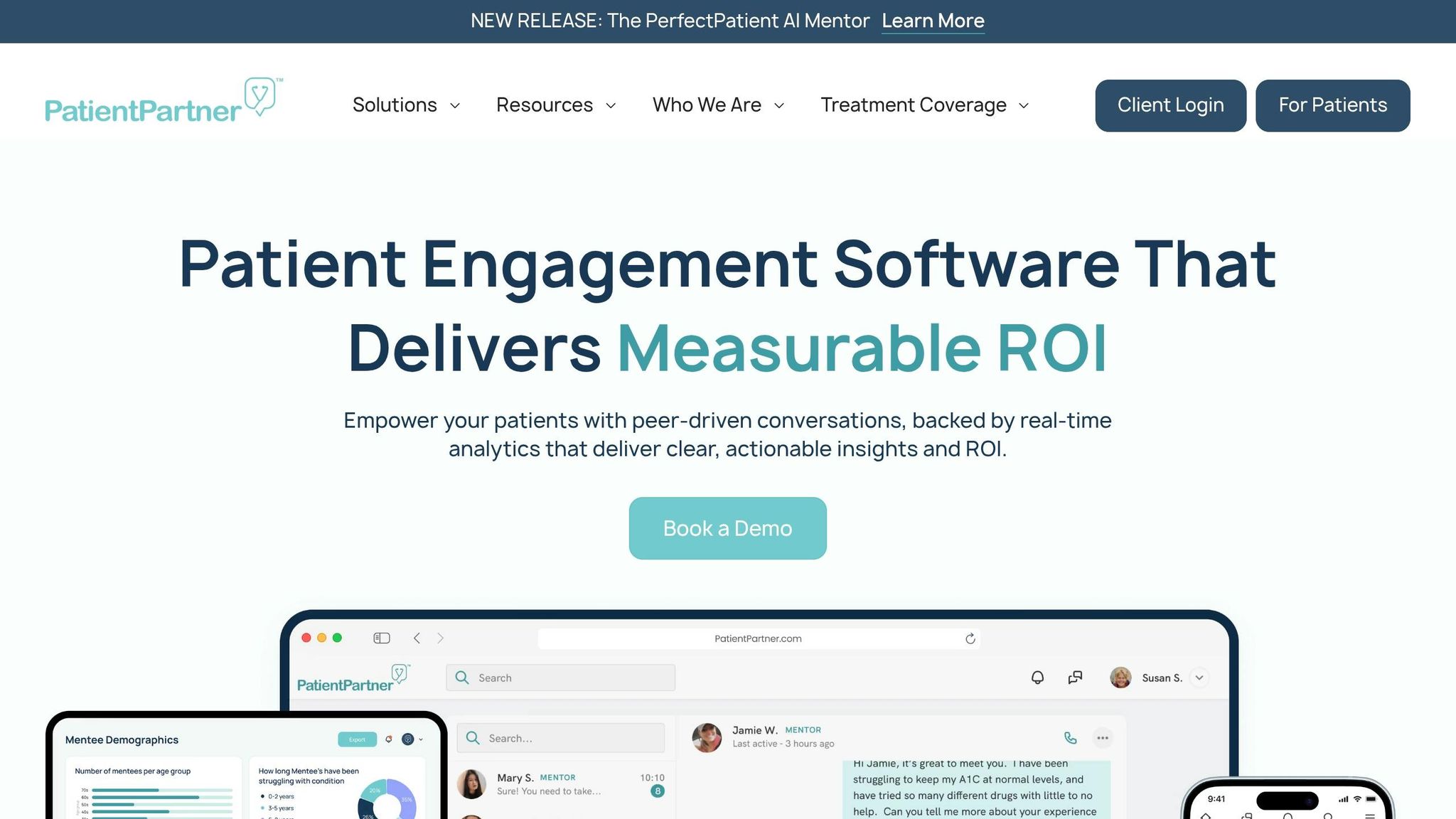
PatientPartner offers a unique solution to bridge the gap between diagnosis and treatment adoption. The platform connects patients considering new therapies, medications, or surgeries with mentors who have already undergone similar experiences. This peer-to-peer support happens in real time, providing unbiased guidance as patients weigh their options.
For pharmaceutical and med-tech companies, this mentorship model encourages patients to start and stick with their treatments. By fostering an ongoing supportive relationship, the platform helps patients overcome initial doubts, navigate the early stages of treatment, and tackle any challenges that arise. Additionally, PatientPartner uses sentiment analytics to help enterprise clients identify common patient struggles. This insight allows companies to fine-tune their educational content and support programs, creating a personalized experience that works alongside scalable SaaS solutions to engage larger patient groups.
Benefits of Scalable SaaS Solutions for Patient Engagement
Enterprise SaaS platforms make it possible to deliver tailored patient engagement on a large scale. For instance, hospitals using patient-focused financial tools have seen impressive results: a 40% patient revenue collection rate - double the typical 20% benchmark - paired with a 96% patient satisfaction rate and a 100% increase in revenue.
The value of digital engagement goes beyond just operational improvements. Scalable platforms provide tools like self-service options, AI-powered educational content, and two-way communication channels. These features adapt to individual patient needs, making it possible to support thousands of patients without requiring a proportional increase in staff. This combination of personalization and efficiency transforms how healthcare organizations connect with and support their patients.
Conclusion: What's Next for Cross-Sector Patient Engagement
The future of patient engagement lies in the effective use of integrative technologies. Success will depend on creating smooth connections between healthcare organizations and technology providers, supported by well-organized data and adaptable content that stays relevant across various industries. Data-driven decision-making is a game-changer - organizations that leverage it are 23 times more likely to attract customers than those that don’t. This highlights the undeniable edge a solid data infrastructure provides in staying competitive.
AI is also reshaping compliance processes. Tools now offer exceptionally high accuracy in identifying regulatory errors and predicting approval chances. This automation tackles a significant issue: patient treatment abandonment, which costs pharmaceutical companies about 37% of their potential yearly revenue. By combining AI-driven compliance with predictive analytics, companies can pinpoint patients at risk of dropping out - a critical move since fewer than 50% of patients continue therapy after their first year.
The growing focus on patient activation requires a shift in mindset, treating patients as active participants rather than passive recipients. Stacey Wasserman, CCO at Medisafe, emphasizes this shift:
"Even patients with the same conditions can have dramatically different motivations and needs".
This approach calls for engagement strategies that use behavioral data to optimize the timing of interactions. AI-powered tools like segmentation and behavioral nudging are already paving the way for these personalized approaches.
However, technology alone isn’t enough to overcome engagement challenges. The most effective solutions combine AI’s analytical power with the empathy only humans can provide. This combination builds trust and captures the subtleties that algorithms might miss. Instead of focusing solely on product features, organizations need to address the emotional and practical challenges patients face in managing their conditions. This balance of technology and human connection aligns with the broader trend of personalized, patient-centered care discussed earlier.
Key Takeaways for Industry Leaders
To stay ahead in cross-sector patient engagement, leaders should focus on these critical strategies:
- Modular Content Strategies: Break materials into reusable blocks so AI can easily adapt them for different markets and channels.
- 24/7 Regulated Chatbots: Offer instant, evidence-based guidance at any time, reducing the risk of patients relying on unregulated AI for health advice.
- Omnichannel Synchronization: Use AI to determine the best communication channel - whether app, web, or chatbot - for each patient interaction.
- AI Integration with Digital Asset Management Systems: Ensure consistency across platforms by reusing pre-approved assets, streamlining engagement efforts.
FAQs
How do healthcare, pharma, and tech teams share patient data in real time?
Healthcare, pharmaceutical, and tech teams now collaborate more effectively by sharing patient data in real time through integrated digital platforms. These platforms are designed to ensure smooth interoperability between systems such as electronic health records (EHRs), medical devices, and other healthcare tools. They rely on standardized data formats and secure communication protocols to keep updates flowing without disruption.
Adding to this, mobile apps, wearable devices, and telehealth solutions play a key role in enabling instant and secure data exchange. These technologies ensure that patient information moves quickly while staying in line with privacy regulations like HIPAA, safeguarding sensitive data every step of the way.
What makes AI personalization safe and trustworthy in patient engagement?
AI personalization in patient engagement can be safe and trustworthy when it focuses on protecting data, respecting privacy, and adhering to ethical standards. Some key measures include HIPAA compliance, secure encryption methods, role-based access controls, and tamper-proof audit logs. These steps ensure that sensitive patient information is handled responsibly.
To build further trust, it's important to address biases, honor individual differences, and be transparent about how AI systems function. Regular monitoring and validation also play a critical role in ensuring that AI tools operate ethically and stay in line with regulations. This approach helps create fairer interactions and supports better outcomes for patients.
What should a patient engagement platform do to stay HIPAA- and GDPR-compliant?
To meet the requirements of HIPAA and GDPR, a patient engagement platform needs to have solid protections in place.
For HIPAA compliance, this means implementing:
- Encryption to secure sensitive data.
- Access controls to ensure only authorized personnel can view or modify information.
- Audit logging to track data access and changes.
- Business Associate Agreements (BAAs) with third-party vendors handling protected health information.
On the GDPR side, platforms must:
- Obtain explicit patient consent before collecting or processing data.
- Ensure secure data transfer to prevent breaches.
- Provide tools that allow patients to access, correct, or delete their data when requested.
Both regulations prioritize transparency, patient rights, and strong security measures. These safeguards are essential for protecting sensitive data and maintaining trust with patients.