


Key Patient Engagement KPIs for Pharma Success

Key Takeaways
Author


Patient engagement KPIs are critical for pharmaceutical companies to measure how well they connect with, support, and retain patients across their healthcare journey. These metrics help companies improve outcomes like treatment adherence, patient satisfaction, and time-to-treatment initiation. With regulatory bodies like the FDA and EMA prioritizing patient involvement, tracking these KPIs is no longer optional - it’s essential for success.
Key insights from the article include:
- Time-to-Treatment Initiation (TTI): Measures the time between diagnosis and starting therapy, crucial for conditions like oncology.
- Medication Adherence: Tracks how consistently patients follow prescribed treatments, improving long-term health outcomes.
- Patient Awareness and Engagement: Focuses on educating patients and involving them in their care decisions.
- Engagement Platform Utilization: Analyzes how often and effectively patients use engagement tools, providing insights for improvement.
Platforms like PatientPartner stand out for using real-time mentorship to address common challenges, while other systems rely on data-driven analytics to improve adherence and reduce hospital readmissions. Despite progress, the industry still faces challenges like fragmented data and inconsistent metrics, highlighting the need for proven engagement strategies.
Pharma companies must prioritize KPIs that measure patient outcomes, not just operational efficiency, to align with future patient engagement trends.
Capturing Actionable Metrics to Improve Patient & Brand Outcomes
sbb-itb-8f61039
1. PatientPartner
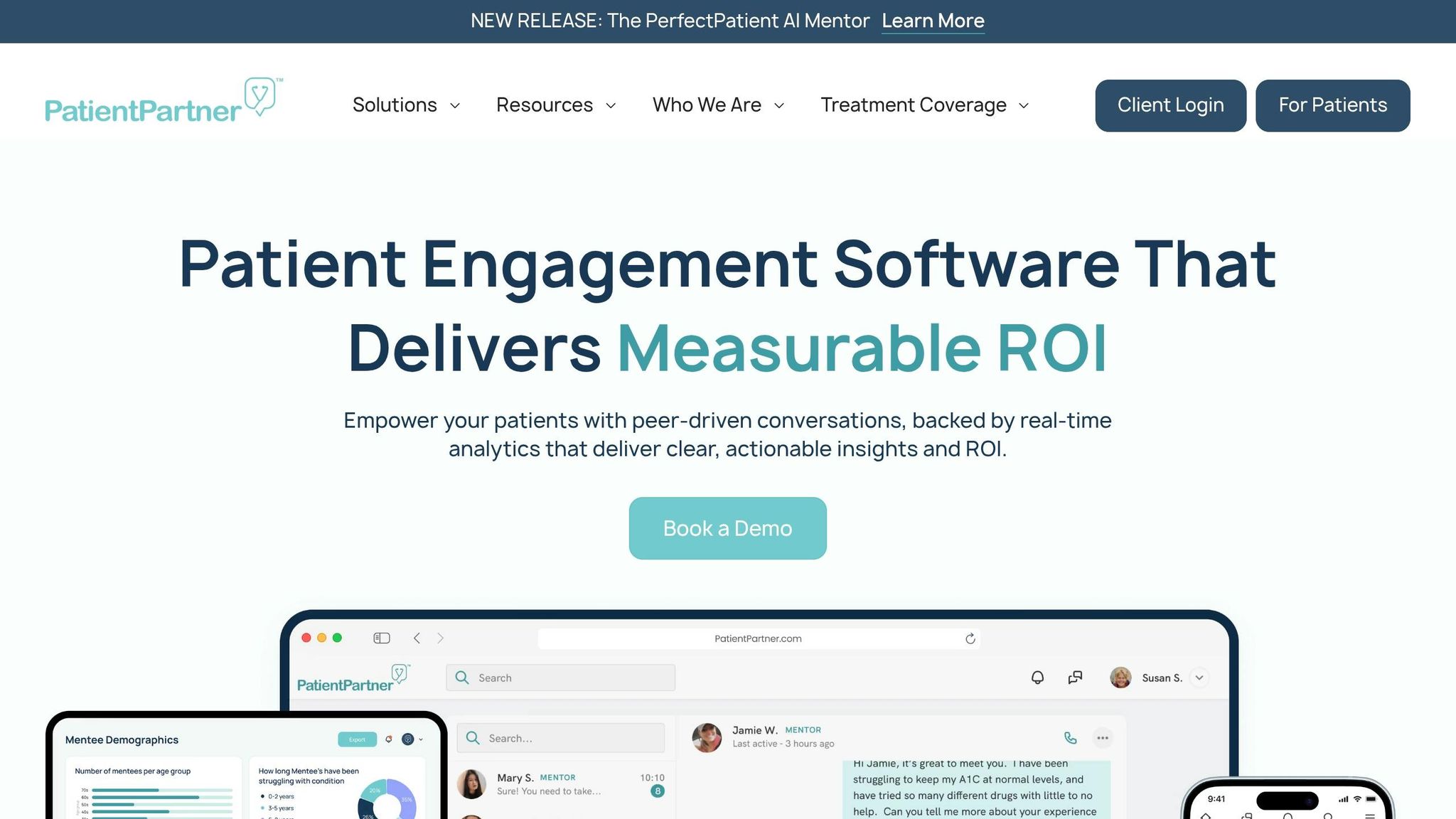
PatientPartner uses a real-time mentorship approach to improve patient engagement metrics. By connecting potential patients with experienced mentors, the platform helps drive better outcomes throughout the patient journey.
Time to Treatment Start
Time-to-Treatment Initiation (TTI) tracks the time between a diagnosis and the start of therapy. This is especially important in oncology, where delays can have serious consequences. PatientPartner addresses these delays by tackling "time toxicity" - the hassles of care like travel, parking, and waiting. Through mentor connections, patients get practical advice on navigating these challenges, helping them start treatment sooner.
Medication Adherence
Keeping patients on their prescribed medications over the long term can be tough. PatientPartner’s mentor-matching system provides ongoing support, even after the first prescription. Mentors offer tips and strategies for managing treatment hurdles, which helps improve patient retention and medication adherence - crucial for both patients and pharmaceutical companies.
Patient Awareness and Engagement
The platform fosters better understanding of conditions and treatment options by enabling conversations with mentors who have been through similar experiences. This empowers patients to take a more active role in their care, shifting them from passive observers to engaged participants.
Engagement Platform Utilization
PatientPartner tracks key usage metrics like mentor–patient connection rates, conversation frequency, and session length. These insights help pharmaceutical companies understand patient engagement trends across various treatments and demographics. The platform also maintains a compliance framework to document interactions, providing clear data on return on investment (ROI).
These measurable outcomes highlight PatientPartner's effectiveness and lead into a discussion of other engagement platforms in the following section.
2. Other Patient Engagement Platforms
The pharmaceutical industry is grappling with a measurement problem when it comes to patient engagement. Most frameworks lack solid, quantitative metrics - only 27% provide measurable data.
Medication Adherence Rate
Many platforms rely on data-driven analytics to track medication adherence, leading to a 17% boost in adherence rates across different patient groups. For instance, AstraZeneca's adherence platform achieved a 23% improvement in compliance among cardiac patients in 2021. This success also resulted in a 16% drop in emergency readmissions. These platforms often use behavioral analytics and cluster analysis to predict patient adherence patterns, paving the way for similar metrics like time-to-treatment initiation.
Time to Treatment Start
Some platforms break down time-to-treatment initiation (TTI) data by patient demographics and condition types, setting specific improvement goals. For example, certain platforms aim to increase confirmation rates by 10% within a 90-day period. However, many still prioritize operational metrics - like staying on budget or meeting deadlines - over measuring the actual impact on patient health outcomes.
Patient Activation Measure (PAM) Scores
PAM scores assess a patient's knowledge, skills, and readiness to manage their own healthcare. Platforms use tools like natural language processing (NLP) and sentiment analysis to gather insights from patient interactions. In 2021, Mount Sinai Health System used behavioral analytics to identify patients who were 3.2 times more likely to miss follow-up appointments. Targeted reminders reduced no-shows by 42%. Additionally, advanced engagement analytics have been linked to a 22% reduction in hospital readmissions. These kinds of metrics naturally tie into evaluating how well platforms are being utilized.
Engagement Platform Utilization
The industry is shifting toward Key Impact Indicators (KIIs) that focus on measurable and meaningful outcomes for patients. A pharma representative explained:
I would encourage stakeholders to measure KIIs that are quantifiable, consistent, and meaningful for patients.
For example, Cleveland Clinic introduced visualization dashboards in 2022, cutting data analysis time by 28% and improving the identification of at-risk patients by 35%. Despite these advances, most metrics remain qualitative. A 2022 roundtable with 30 experts from pharma, healthcare, and patient advocacy groups highlighted the "universal need" for standardized and validated metrics.
Advantages and Disadvantages

Patient Engagement Platform Comparison: PatientPartner vs Traditional Platforms
When analyzing KPIs, it becomes clear that the way success is measured plays a major role in shaping patient engagement outcomes. The primary distinction between patient engagement platforms lies in their approach to measuring success. Take PatientPartner, for instance - it emphasizes real-time mentorship by connecting prospective patients with experienced mentors who guide them through treatment decisions. This approach highlights the importance of educating healthcare providers (HCPs) about patient support programs. As Naveed Masood, Head of Patient Services at Servier Pharmaceuticals, explains:
Patients still learn about PSP [patient support programs] from their HCPs. So the ability to educate those HCPs about the services, tools, and resources is clearly the leading indicator.
Mentorship not only tracks prescription-to-start conversion but also builds patient confidence along the way.
In contrast, traditional platforms often struggle with engagement, which directly affects the ability to track KPIs effectively. For example, portal activation rates are typically low (below 25%), and email open rates hover around 20–25%, making it difficult to gather meaningful data on patient activation and satisfaction. Jennifer Lichtman, Vice President of Market Access and Patient Services at Acadia Pharmaceuticals, underscores the importance of measurable outcomes:
I tell my team all the time, please don't implement anything unless you can measure the success.
This lack of engagement data raises critical questions about how outcomes are being evaluated.
A key difference lies in the timing of insights. While traditional platforms rely on retrospective data, PatientPartner provides real-time updates on patient sentiment and readiness to start therapy. This dynamic approach encourages companies to view patient support as a strategic function rather than just a cost.
However, both models face the challenge of fragmented data. Patient information is often scattered across various systems such as EHRs, texting platforms, and phone systems, making it difficult to create a unified view of engagement. A centralized mentorship platform like PatientPartner offers a solution by tracking the entire patient journey - from initial inquiries to sustained adherence at six, nine, and twelve months. This holistic perspective helps companies pinpoint critical "moments that matter" throughout the patient experience.
Traditional multi-channel outreach also tends to be resource-intensive. It demands ongoing A/B testing, audience segmentation, and quarterly audits to maintain high delivery rates. In contrast, PatientPartner’s mentor-based model focuses its resources on meaningful human interactions, aligning its KPIs with its core strength: fostering direct and continuous mentorship. This targeted approach enhances key patient engagement metrics more effectively than traditional methods.
Conclusion
Mentorship-driven platforms bring a fresh perspective to improving and tracking patient engagement. Traditional methods often miss the mark, leaving companies with an incomplete understanding of how patients truly interact with and respond to their care.
PatientPartner's real-time mentorship model fills this gap by fostering consistent touchpoints throughout the patient journey. This approach captures immediate feedback on patient sentiment and readiness for therapy, moving the focus from process-based metrics to outcomes that truly matter. These outcomes align with industry calls for standardized measures that reflect patient awareness and satisfaction with support programs. This shift allows for a more patient-focused strategy.
To make patient engagement a strategic priority, pharmaceutical companies need to focus on tracking what counts - awareness, satisfaction, and adherence. These metrics are key to driving meaningful results.
FAQs
Which patient engagement KPIs matter most for my therapy area?
When it comes to measuring patient engagement in your therapy area, the key performance indicators (KPIs) you focus on will vary based on the type of treatment and the specific patient population you're working with. However, some metrics are commonly important across the board:
- Patient adherence: Tracking how consistently patients follow prescribed treatments or medication schedules is crucial. It directly impacts the effectiveness of therapy and overall outcomes.
- Engagement with digital tools: Monitoring how patients interact with apps, portals, or other digital resources can provide insights into their level of involvement and access to care.
- Patient-reported outcomes: Collecting feedback directly from patients about their health, symptoms, and quality of life helps you understand the real-world impact of the treatment.
Using data-driven approaches and tailoring support to individual needs can help improve these metrics, leading to better results and sustained success over time.
How is time-to-treatment initiation measured accurately?
Time-to-treatment initiation refers to the duration between a diagnosis or patient identification and the beginning of treatment. Measuring this effectively requires real-time data collection and close monitoring of key engagement metrics, like treatment initiation rates. This ensures patients receive care promptly and efficiently.
How can pharma connect engagement metrics to real patient outcomes?
Pharmaceutical companies can connect engagement metrics directly to patient outcomes by creating a standardized approach to measure critical data points like patient behaviors, adherence to treatments, and overall experiences. By analyzing this data, they can better understand its influence on health outcomes and treatment effectiveness. Standardized measurement ensures more reliable insights, ultimately leading to improved patient care and long-term health benefits.