


Integrating GDPR into Digital Health Platforms
Key Takeaways
Author


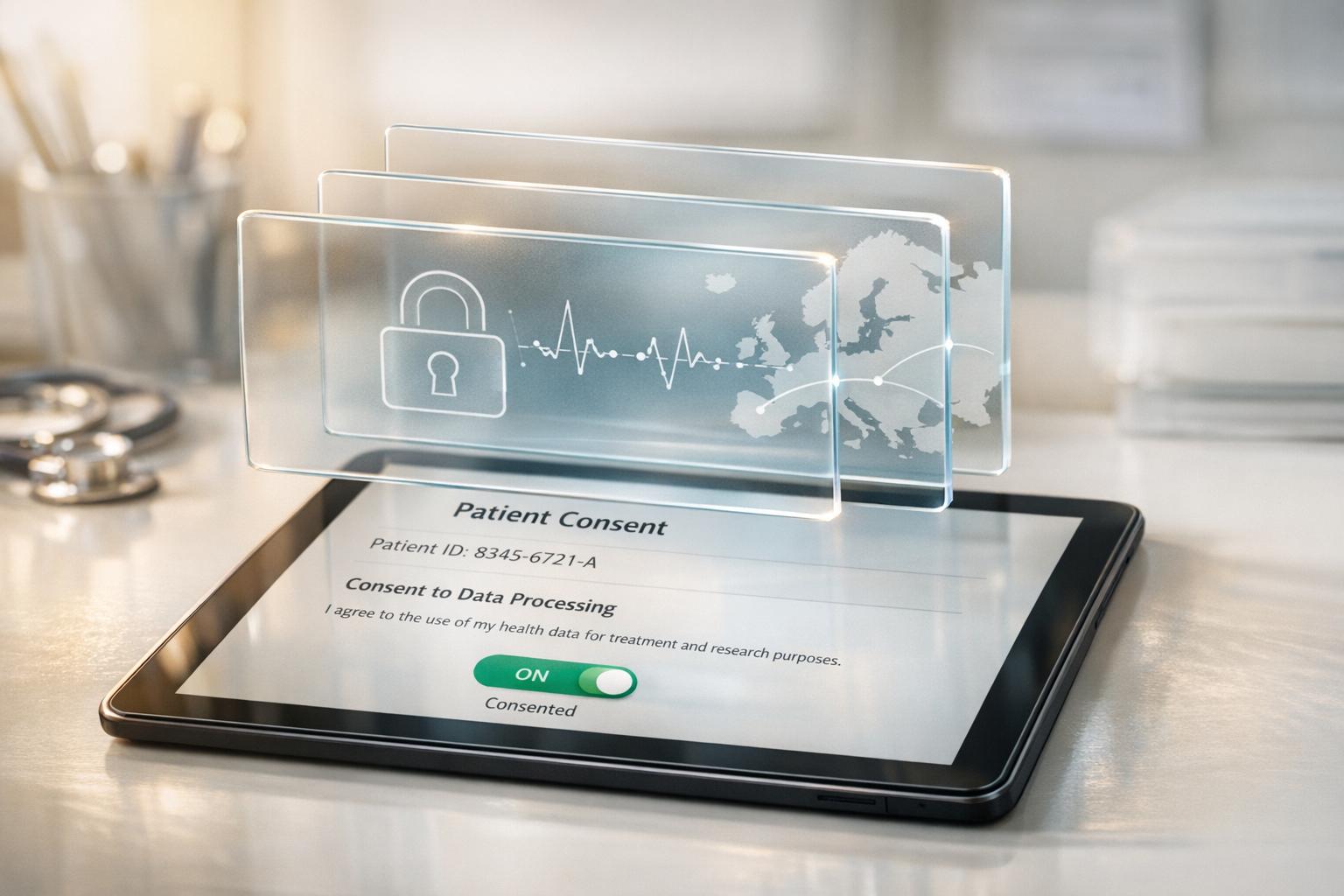
Handling health data comes with strict rules under GDPR. If your platform processes data from EU residents, compliance isn't optional - it’s mandatory, regardless of your company's location. GDPR covers sensitive information like heart rates, medical histories, and wearable sensor data, classifying these as "special category" data that require extra safeguards.
Key takeaways:
- Explicit Consent Required: Health data processing needs clear, affirmative user consent.
- Privacy by Design: Platforms must build in encryption, access controls, and data minimization from the start.
- Fines Are Severe: Non-compliance can lead to fines up to €20 million or 4% of global annual revenue.
The article explains how to meet GDPR requirements while ensuring secure, real-time analytics, including methods like pseudonymization, consent management, and cross-border data handling. Platforms that prioritize these practices not only avoid penalties but also build trust with users.
Understanding the General Data Protection Regulation in the Context of Clinical Research
Key GDPR Requirements for Digital Health Platforms
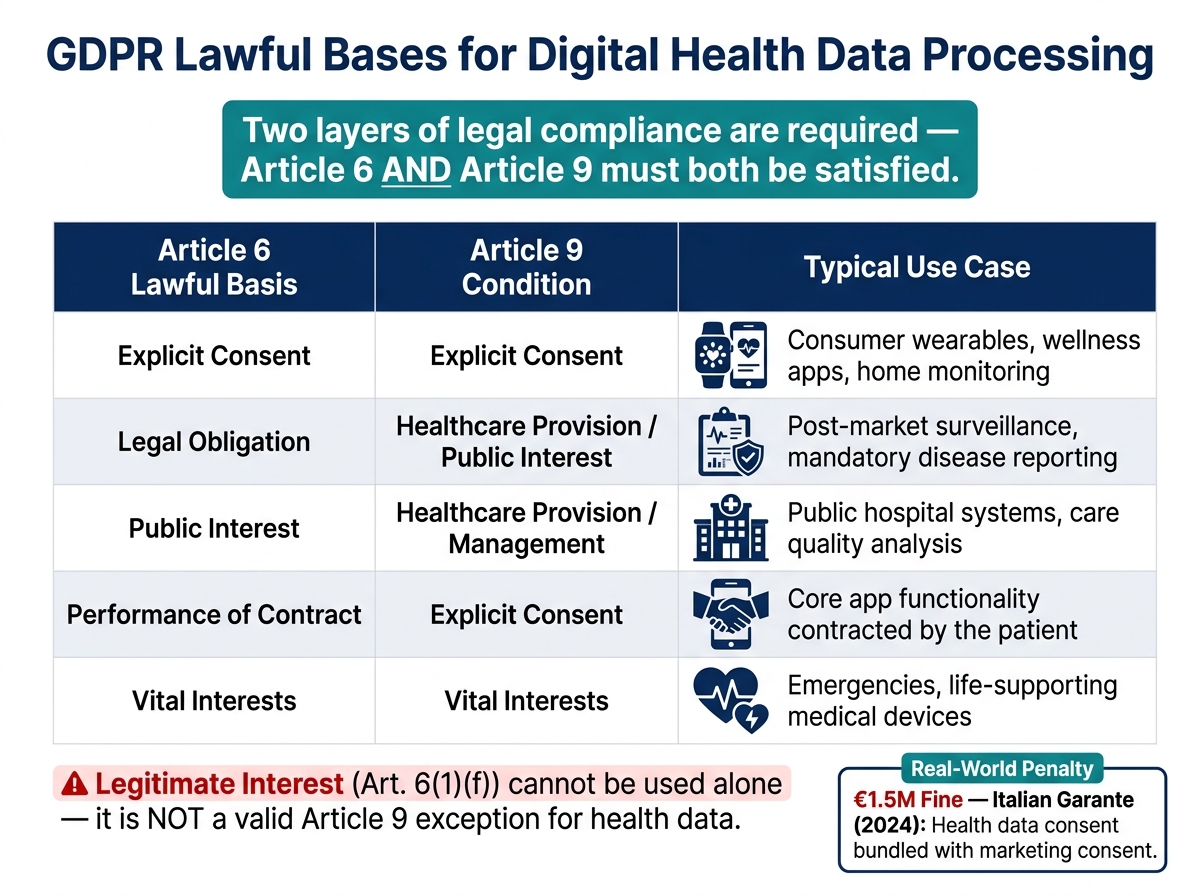
GDPR Lawful Bases for Digital Health Data Processing
Special Category Data: Handling Health Information
Under GDPR Article 9, health data is classified as "special category" data, which means it gets the highest level of protection unless a specific legal exception applies. This includes more than just medical records - it covers genetic data, biometric information, wearable sensor data, and even app usage patterns that might reveal health-related details.
"Health data is 'special category' personal data - the most protected classification. Processing is prohibited unless a specific exception applies." - Luca Berton, CEO at Open Empower
If you're processing large volumes of data or using AI for analysis, you're required to appoint a Data Protection Officer (DPO) and conduct a Data Protection Impact Assessment (DPIA) during the design phase.
Lawful Bases for Processing Patient Data
Digital health platforms must meet two layers of legal requirements when handling patient data: a general lawful basis under Article 6 and a specific exception under Article 9 for health-related data. Meeting only one of these is not enough.
For most consumer-focused tools - like wearables, wellness trackers, or remote monitoring devices - explicit consent is the go-to legal basis. This consent must be clear, affirmative, and explicitly mention the categories of health data being processed.
Here’s a quick look at how Article 6 lawful bases align with Article 9 conditions and their typical applications:
| Article 6 Basis | Article 9 Condition | Typical Use Case |
|---|---|---|
| Explicit Consent | Explicit Consent | Consumer wearables, wellness apps, home monitoring |
| Legal Obligation | Healthcare Provision / Public Interest | Post-market surveillance, mandatory disease reporting |
| Public Interest | Healthcare Provision / Management | Public hospital systems, care quality analysis |
| Performance of Contract | Explicit Consent | Core app functionality contracted by the patient |
| Vital Interests | Vital Interests | Emergencies, life-supporting medical devices |
It’s important to note that legitimate interest (Article 6(1)(f)) cannot be used alone for health data processing, as it’s not a valid exception under Article 9. Similarly, while contract performance may justify administrative tasks like billing, explicit consent is still mandatory for handling health-related information.
For example, in 2024, the Italian Garante fined a health app €1.5 million for bundling health data consent with marketing consent. This case underscores the importance of keeping health data consent separate from general terms, marketing preferences, or third-party tracking.
By adhering to these legal frameworks, digital health platforms can ensure they process data securely while respecting patient rights. The next step involves limiting data collection and clearly defining its use.
Data Minimization and Purpose Limitation
Beyond legal compliance, technical measures like data minimization and purpose limitation are essential for protecting patient data. This means only collecting data that has a clear clinical or functional purpose under GDPR.
Purpose limitation ensures that data collected for one reason - like monitoring glucose levels - cannot be used for unrelated tasks, such as marketing or other analytics, without obtaining new consent. A practical way to enforce this is through data tagging, where each piece of data is labeled with its intended purpose at the time of collection. This approach helps maintain strict boundaries and supports compliance in real-time analytics.
Another helpful strategy is automating data lifecycle management. By embedding expiry rules into your data systems, you can ensure records are automatically deleted or anonymized once their purpose is fulfilled. This reduces the risk of human error, keeps your platform compliant, and strengthens the reliability of your data handling processes.
Building GDPR-Compliant Real-Time Analytics
Pseudonymization and Anonymization Methods
Once you've established what data can be collected under GDPR, the next step is safeguarding patient identities while still extracting meaningful insights. Two key approaches help achieve this: pseudonymization and anonymization.
Pseudonymization involves replacing identifiable details - like names or patient IDs - with tokens or reference codes. However, since these tokens can be linked back to the original data using a separate "key", pseudonymized data is still classified as personal data under GDPR. On the other hand, anonymization permanently removes all identifying information, which means the data no longer falls under GDPR regulations. As Luca Berton, CEO at Open Empower, explains:
"Truly anonymous data is outside GDPR scope. But: re-identification risk in health data is high (small populations, rare conditions)."
To minimize risks, store the pseudonymization key in a separate, highly secure system, completely isolated from the analytics environment. If you're sharing pseudonymized datasets with third-party vendors, make sure contracts explicitly ban re-identification and confirm the vendor has no access to the key.
Consider leveraging privacy-enhancing technologies like differential privacy and federated learning. Differential privacy works by adding controlled noise to outputs, making it nearly impossible to trace data back to an individual. Federated learning, on the other hand, trains machine learning models locally across different systems - like hospitals or devices - without centralizing raw patient data. For example, a June 2025 study showed that an anonymization pipeline could boost k-anonymity from 1 to 110 in a 1,000-row healthcare dataset, all while maintaining a utility score of 69.05%.
These methods ensure patient privacy while enabling secure, real-time analytics.
Data Security in Live Analytics Pipelines
GDPR mandates technical safeguards to protect personal data throughout its lifecycle, as outlined in Article 32. Implementing these safeguards is essential for securing patient data during live analytics.
For data at rest, use AES-256 encryption, and for data in transit, rely on TLS 1.3 for secure transmission. A split-identity architecture can further enhance security by storing personal identifiers and health data in separate encrypted silos, only linking them temporarily through short-lived tokens.
For mobile analytics, tools like SQLCipher ensure data security with 256-bit AES encryption, generating session-specific keys that are wiped when the app closes. Role-based access controls (RBAC) add an extra layer of protection, ensuring that non-clinical staff - like billing administrators - cannot access sensitive medical data. This is critical, as demonstrated by a 2024 case where the Dutch Data Protection Authority fined a healthcare provider $400,000 for inadequate access controls that allowed unauthorized internal access to patient records.
| Data State | Protection Standard |
|---|---|
| On device (at rest) | AES-256 full-disk or file-level encryption |
| In transit (device to cloud) | TLS 1.3 with mutual authentication |
| In cloud (at rest) | AES-256 with customer-managed keys |
| In analytics pipelines | Pseudonymized or anonymized data |
These measures ensure that patient data remains secure at every stage of processing.
Balancing Compliance with Reporting Needs
With robust data protection measures in place, the next hurdle is balancing GDPR compliance with the need for fast, actionable analytics. Meeting these dual demands can be tricky.
"The fusion of GDPR and real-time analytics is far from straightforward. One prioritizes the speed and agility of data-driven insights; the other sets boundaries and constraints for the responsible handling of information." - GDPR Advisor
One effective strategy is to design compliance into your data architecture from the beginning. For instance, separate personal data streams from anonymized ones right at the ingestion layer. Sensitive data can then be routed through GDPR-compliant processing channels, while non-sensitive data flows through faster, unrestricted paths. This keeps analytics agile without compromising privacy.
Another practical approach is edge computing. By processing data closer to its source - on devices or local servers - platforms can filter or anonymize data before it enters the main analytics pipeline. This reduces the amount of personal data transmitted and cuts down on delays caused by compliance checks. Additionally, activating analytics only after receiving a valid consent signal ensures no data is processed without proper authorization, eliminating the risk of premature data leakage.
sbb-itb-8f61039
Patient Rights and Consent Management
Managing Patient Rights: Access, Correction, and Deletion
Patients should have easy ways to access, correct, and delete their records. Features like a "Download My Data" button, in-app correction forms, and clear deletion options can make this process straightforward. These tools also ensure compliance with GDPR's 30-day response timeframe. For data portability, using interoperability standards such as HL7 FHIR ensures records can be shared across digital health platforms in a standardized, machine-readable format.
However, it's important to note that the right to erasure isn't absolute in healthcare. Certain data may be retained under research exemptions. Legal counsel should evaluate which data can be kept and ensure those rules are built into the deletion workflow.
These tools and processes also lay the groundwork for dynamic consent management, integrating seamlessly with real-time compliance systems.
Capturing and Withdrawing Consent
Obtaining explicit consent requires a clear and affirmative action from the user, specifying each type of health data being processed. A two-step process can help achieve this: first, present granular toggles for specific data categories (e.g., heart rate, sleep data, or research sharing), and then provide a summary screen where users can confirm their choices.
Withdrawing consent should be just as simple. Under Article 7(3), the process for revoking consent must match the ease of granting it. For example, if a user provides consent with a single tap, they should be able to withdraw it just as easily. Once consent is revoked, the platform must immediately stop processing the associated data, initiate deletion or anonymization where relevant, and inform any third-party processors promptly. Additionally, health data consent must not be bundled with unrelated agreements, such as marketing preferences or general terms of service. This practice has led to significant penalties, including a €1.5 million fine by the Italian Garante.
Audit Trails and Preference Management
After rights management and consent capture, maintaining a detailed audit trail is critical for compliance and trust. Every consent-related interaction should be logged with key details, such as the user ID, consent category, data types, purposes, status, consent text version, method of consent, and timestamp. Here's an example:
| Field | Description | Example |
|---|---|---|
user_id |
Unique identifier for the data subject | usr_8f3a2b |
consent_type |
Category of consent | health_data_processing |
scope |
Data types and purposes | heart_rate, sleep; purpose: health_monitoring |
status |
Current state | granted / withdrawn |
consent_version |
Version of the consent text presented | v2.3 |
method |
How consent was given | two_step_confirmation |
timestamp |
ISO 8601 timestamp | 2026-02-17T14:30:00Z |
If your platform updates its processing purposes, prior consent may no longer be valid. Always store the exact version of the consent text the user agreed to and initiate a re-consent process when significant changes occur. Audit logs should also be exportable via API, enabling compliance teams to verify what users saw and agreed to during regulatory reviews. This level of detail is essential - failure to implement proper consent mechanisms has led to major fines, such as the €12 million penalty issued by the Swedish Data Protection Authority in 2024.
Data Security and Cross-Border Data Transfers
Data Security Controls for Health Platforms
Protecting data in health platforms isn't just about meeting GDPR requirements - it's also about ensuring the reliability of the real-time analytics that patients and providers depend on. Beyond securing live data pipelines, platforms need to safeguard data at rest and in transit. This means using AES-256 encryption for stored data and TLS 1.3 for data being transmitted. These are foundational measures outlined in GDPR Article 32.
Access control is another cornerstone of data security. Implementing Multi-Factor Authentication (MFA) and Role-Based Access Control (RBAC) ensures that only authorized personnel access sensitive information, following the principle of least privilege. For emergencies, "break-glass" protocols allow temporary elevated access, but they must leave behind a detailed audit trail. A failure in access management can have serious consequences - just ask the healthcare provider fined €400,000 by the Dutch Data Protection Authority in 2024 for allowing unauthorized access to patient records.
Other critical measures include continuous log monitoring for all data interactions, network segmentation, and keeping systems updated with regular patches. To ensure data availability, platforms should maintain immutable backups and test disaster recovery plans regularly.
Once these local controls are in place, the next challenge is ensuring compliance when data crosses borders.
Cross-Border Transfers and Vendor Compliance
After securing data within the platform, the focus shifts to managing it across borders. Transferring EU patient data outside the EEA triggers strict GDPR rules, as the regulation prioritizes the individual's data protection over the physical location of servers.
"GDPR does not care where your servers are or where your company is incorporated. It follows the person, not the infrastructure." - Garvita Amin
For straightforward compliance, organizations can rely on an adequacy decision by the European Commission. Countries like the UK, Japan, Israel, and US companies participating in the EU–US Data Privacy Framework meet these criteria. For destinations without adequacy status, businesses must use Standard Contractual Clauses (SCCs) and conduct a Transfer Impact Assessment to ensure local laws don’t compromise GDPR protections.
The risks of non-compliance are steep. In 2024, a telehealth platform in the US faced a €2.3 million fine from the Irish Data Protection Commission for routing EU patient data through a London-based partner without proper transfer mechanisms. To avoid such pitfalls, many platforms now store EU patient data exclusively in EU cloud regions, like AWS Frankfurt or Azure Netherlands. Additionally, all third-party vendors, from EHR systems to cloud providers, must sign Data Processing Agreements (DPAs) outlining specific security obligations and granting audit rights.
Incident Response and Breach Notification
One of GDPR's most challenging rules is the 72-hour breach notification window, which begins as soon as an organization becomes aware of a breach - not when the investigation is complete. This is far stricter than HIPAA's 60-day timeline. If the breach poses a high risk to individuals - something almost guaranteed with health data - affected patients must be informed immediately.
Given this tight deadline, relying on manual breach detection isn't practical. Automated systems for log monitoring and anomaly detection are critical for identifying incidents quickly. Platforms are also required to maintain a breach register to document every incident, its scope, and the steps taken to address it - a key accountability measure under GDPR.
Preparation is key to managing breaches effectively. A written incident response playbook should cover detection, containment, risk evaluation, and pre-drafted notification templates to streamline the process. Regular tabletop exercises and red team simulations focused on clinical workflows ensure the response plan stays sharp.
A well-coordinated breach response not only meets GDPR standards but also helps maintain patient trust in the platform's security practices.
Conclusion: Building Trust with GDPR-Compliant Digital Health Platforms
Key Takeaways for Digital Health Leaders
Ensuring GDPR compliance in digital health isn't a one-time task - it’s a continuous process woven into every element of platform design and operation. The stakes are high, with penalties reaching up to €20 million or 4% of annual global revenue. Real-world examples, like the hefty fines imposed in 2024 for issues such as inadequate consent protocols and improper cross-border data handling, highlight the importance of getting it right.
When compliance is part of the platform's DNA - from how data is collected to how breaches are managed - it does more than just mitigate legal risks. It creates a bedrock of trust, enabling real-time patient data analytics to thrive.
Here are three core principles digital health leaders should prioritize:
- Privacy by design, not as an afterthought. Encryption, pseudonymization, and strong access controls must be integral to the platform from the start. Giving users tools for data portability, access, and deletion - automated and self-serve - further strengthens trust.
- Consent as infrastructure. Consent management isn't optional; it requires a dedicated service layer with versioning, timestamps, and detailed, purpose-specific records.
- Breach readiness is non-negotiable. With GDPR's 72-hour breach notification rule, automated monitoring and a tested incident response plan are essential.
PatientPartner embodies these principles with its compliance-first approach to platform development.
How PatientPartner Supports GDPR Compliance
PatientPartner takes these principles and translates them into action with a secure, continuously monitored platform. Certified for GDPR, HIPAA, ISO 27001, and AICPA SOC, the platform incorporates SSL/TLS enforcement, hard-disk encryption, multi-factor authentication (MFA), and daily database backups. Instead of relying solely on annual audits, PatientPartner tests its security controls every 12 hours. Any unresolved issues are flagged for immediate review within 14 days, directly aligning with GDPR's accountability requirements while supporting real-time analytics.
The platform's MentorConnect program, which pairs patients with experienced mentors, operates within this highly secure environment. Sensitive interactions are safeguarded with the same rigor as clinical data. Additionally, user identity and consent data are managed separately to uphold data minimization principles. A dedicated Incident Response Team and a comprehensive Disaster Recovery Plan ensure the platform is prepared for any breach notification mandates.
"The teams that build successful RPM apps in Europe are not the ones that treat compliance as a constraint. They approach it as a design requirement, on par with clinical functionality and user experience." - Raj Kewlani, Project Manager, Zealous System
For pharmaceutical and med-tech companies navigating GDPR while striving to enhance patient outcomes, PatientPartner proves that responsible data management and meaningful patient engagement can go hand in hand.
FAQs
When do I need a DPO and a DPIA for a digital health app?
If processing health data (considered a special category of data) is a core part of your operations - particularly on a large scale - you’ll need a Data Protection Officer (DPO). This role provides independent oversight and reports directly to management, ensuring compliance with privacy regulations.
Additionally, a Data Protection Impact Assessment (DPIA) is essential before starting any high-risk processing activities. For example, if you're implementing data warehouses or running pilot projects that could pose significant privacy concerns, a DPIA helps pinpoint potential risks and outlines strategies to address them, ensuring alignment with GDPR requirements.
What’s the difference between anonymized and pseudonymized health data under GDPR?
Under GDPR, pseudonymized data swaps out direct identifiers with artificial ones. However, because it can still be traced back to individuals using additional, separate information, it is still classified as personal data. On the other hand, anonymized data is processed in such a way that individuals cannot be identified by any means that could reasonably be used. This type of data is no longer considered personal data and falls outside the scope of GDPR.
How can we run real-time analytics without processing health data before consent?
To implement real-time analytics while respecting consent for health data, consider using a consent-as-a-runtime-gate strategy. This involves collecting explicit, versioned consent and storing it in a ledger. A policy engine ensures analytics are only performed for approved purposes. At the point of data ingestion, enforce machine-readable consent and apply auditable minimization techniques - like pseudonymization or aggregation - to keep sensitive data secure. This ensures the data doesn’t leave its original domain without proper consent.