


Role of DPOs in Healthcare SaaS Compliance
Key Takeaways
Author


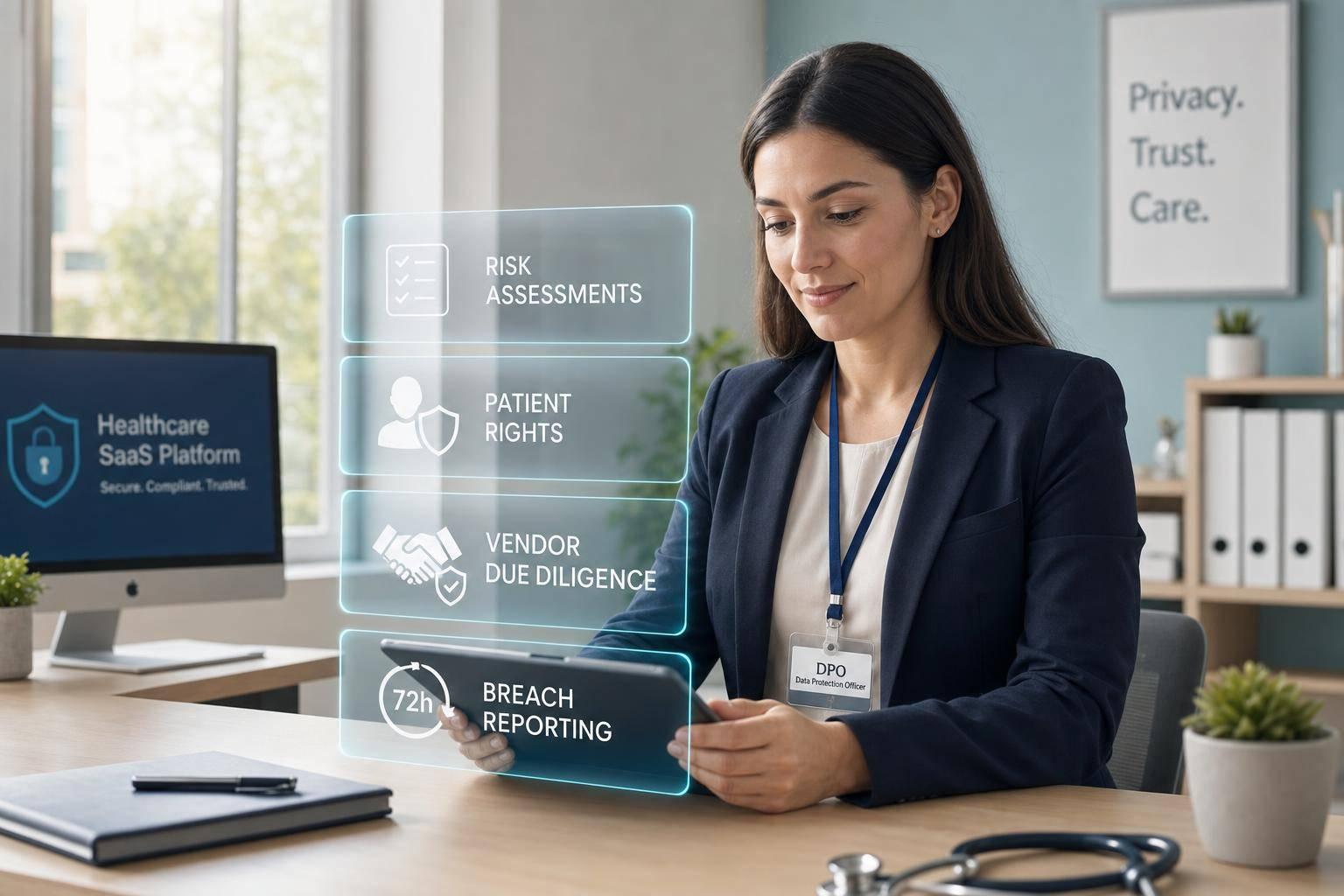
If your healthcare SaaS product handles EU patient data at scale or tracks people over time, you may need a DPO under GDPR. And that role is not just paperwork: it covers DPIAs, patient rights, vendor checks, breach response, and direct reporting to leadership.
Here’s the short version:
- GDPR can require a DPO when your main service involves large-scale health data processing or regular monitoring of people.
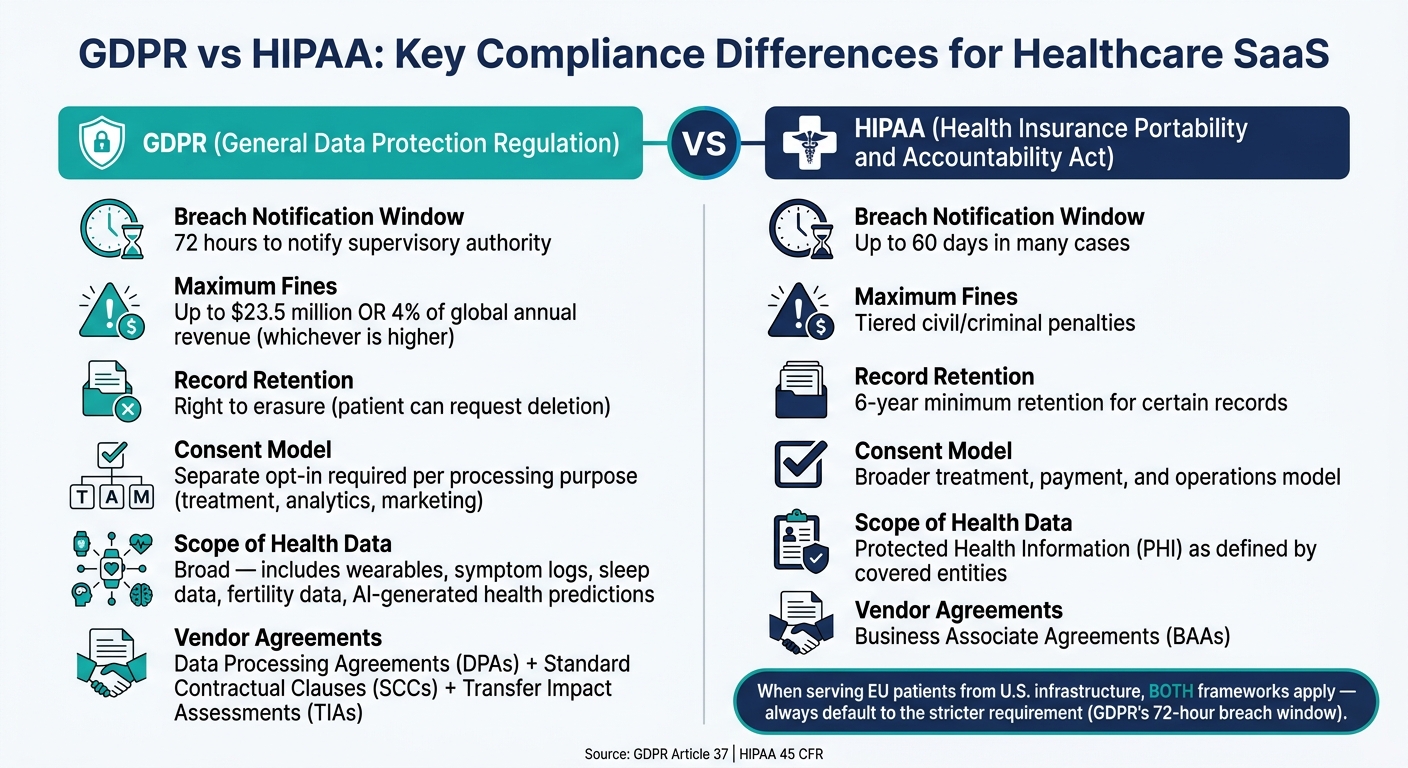
- HIPAA and GDPR are not the same. One clear example: GDPR breach notice can be due in 72 hours, while HIPAA allows up to 60 days in many cases.
- Health data is broader than medical charts. It can include wearables, symptom logs, sleep data, fertility data, and AI-based health predictions.
- The DPO advises and monitors. Product, security, legal, support, and engineering teams do the day-to-day work.
- Key areas under DPO review include consent records, RoPA, access logs, retention rules, vendor contracts, SCCs/TIAs, and breach drills.
- Independence matters. A DPO should not be the CEO, CTO, CIO, CISO, or Head of Product because those roles help decide how data is used.
A few numbers make the risk plain:
- GDPR fines can reach $23.5 million or 4% of global annual revenue at current exchange rates, whichever is higher.
- GDPR may require notice of a reportable breach within 72 hours.
- HIPAA often requires record retention for 6 years.
I’d sum it up like this: if you sell software into healthcare and touch EU patient data, the DPO is the person who checks whether your privacy rules match how the product, vendors, and incident process work in practice.
Read this article as a clear guide to when a DPO is required, what the role covers, which controls need review, and how leadership should set the role up so it can do its job.
Everything you Need to Know about The Data Protection Officer Role
sbb-itb-8f61039
When a DPO is required under GDPR
GDPR Article 37 makes a DPO appointment mandatory when an organization’s core activities involve large-scale processing of special category health data or regular and systematic monitoring of individuals. If your core activities hit either trigger, you need to appoint a DPO.
Large-scale processing of health data
Core activities are the functions built into the service itself, not back-office tasks like payroll or HR. For healthcare SaaS, that usually means products where health data sits at the center of the service, such as digital therapeutics, mental health platforms, or remote monitoring tools.
Regulators look at a few factors here: volume, number of people affected, duration, and geographic reach. There’s no fixed user-count threshold.
Regular and systematic monitoring in digital health
This trigger covers ongoing observation of people over time. In digital health, that can include tracking through wearable devices, location tracking in mobile apps, behavioral analytics, and patient engagement workflows that follow health status over time.
Health data is also broader than many teams assume. It’s not just clinical records. It can also include symptom logs, fitness tracker data, sleep patterns, heart rates, fertility cycles, and AI-generated clinical predictions.
Controller, processor, and shared responsibility questions
The DPO rule applies to both controllers and processors when their own core activities meet the threshold. In SaaS, that means looking at both the vendor and the client.
For example, a vendor that processes patient data for a pharmaceutical client is often acting as a data processor. But if that processing is central to the vendor’s product and done at scale, the vendor still needs its own DPO, no matter what the client has done.
The DPO must stay independent and can’t be directed to take a legal position.
If neither trigger applies, document the assessment and keep it on file. That threshold question then feeds into the DPO’s oversight role.
Once the trigger is clear, the DPO’s job is to oversee compliance, not handle day-to-day operations.
Core DPO responsibilities in healthcare SaaS
Once you've confirmed a DPO is required, the next step is figuring out what that person actually does each day, and how that job differs from a standard compliance manager. In healthcare SaaS, the role touches product updates, patient data flows, and incident response. The DPO oversees the controls. The teams on the ground carry them out.
Advising leadership and monitoring compliance
The DPO’s main job is to keep leadership up to date on data protection duties. That includes briefing executives on GDPR requirements, pointing out control gaps in patient data workflows, and tracking a small set of core metrics, like closed audit findings and DSAR turnaround time.
The DPO also has to stay independent. They can’t hold a role that decides how processing happens, such as CEO, CTO, or Head of Product. They need direct access to senior leadership and the ability to flag unresolved risks without pushback.
DPIAs, training, and patient rights oversight
This work starts before launch, while high-risk features are still on the drawing board. If a healthcare SaaS company rolls out a new high-risk feature, such as an AI-driven triage tool or a remote patient monitoring workflow, the DPO advises on and reviews a Data Protection Impact Assessment (DPIA) before it goes live.
The DPO also oversees role-based privacy training for developers, clinicians, and sales teams. And they set up a rights-request workflow that balances erasure requests with legally required record retention. That balance matters a lot in healthcare, where deleting data isn’t always as simple as a customer asking for it.
Regulator cooperation and incident response
The same oversight carries into breaches, complaints, and regulator questions. The DPO serves as the main contact for the supervisory authority, tracks regulator correspondence, and coordinates responses.
When a breach happens, the DPO coordinates triage, containment, and forensic review. Then they assess whether the event is reportable and lead the notification process. Under GDPR, the supervisory authority must be notified within 72 hours of becoming aware of a reportable breach. After the incident, the DPO leads root-cause analysis and keeps an eye on corrective actions so the same problem doesn’t happen again.
The compliance controls a DPO must oversee
GDPR vs HIPAA: Key Differences for Healthcare SaaS Compliance
After oversight comes control design. The DPO has to keep an eye on the safeguards that keep patient data compliant in day-to-day use. In healthcare SaaS, that means watching how patient data moves through the system, who can get to it, and what happens if something goes off the rails.
Data lifecycle controls for patient information
When consent is the lawful basis, each processing purpose needs its own opt-in. That includes treatment support, analytics, and marketing. It should not be bundled into HIPAA’s broader treatment, payment, and operations model. The DPO oversees a dedicated consent record that shows what the patient agreed to, when they agreed, which version of the privacy notice they saw, and whether they later withdrew consent.
The DPO also monitors the Record of Processing Activities (RoPA). This record tracks where data enters the platform, where it is stored, which vendors receive it, and when it is deleted. It has to match the product as it exists NOW, not just during an audit.
Access control is another big one. Role-based access control, multi-factor authentication, and just-in-time temporary emergency access, sometimes called "break-glass", all need to be in place and checked on a regular basis. Audit logs should cover:
- Authentication events
- PHI read, write, and export actions
- Permission changes
- API calls
Those logs should be immutable and kept under a documented policy.
There’s also a tricky issue the DPO has to handle with care: HIPAA requires six-year retention for certain records, while GDPR gives patients the right to erasure. One common way to deal with that is anonymization or masked retention. Personal identifiers are removed, while the underlying clinical record stays in place for legal compliance. The DPO sets this policy and checks whether engineering has put it into practice the right way.
Vendor management, transfers, and breach readiness
Internal controls only go so far. The DPO also has to govern third parties and cross-border transfers.
Vendor and subprocessor relationships should be covered by Business Associate Agreements (BAAs) under HIPAA and Data Processing Agreements (DPAs) under GDPR. The DPO oversees due diligence by reviewing vendor security questionnaires, checking that DPA terms include audit rights and subprocessor flow-down obligations, and confirming that data return or deletion protocols are ready when a contract ends.
If a platform serves EU patients from U.S. infrastructure, cross-border transfers need Standard Contractual Clauses (SCCs) and transfer assessments such as Transfer Impact Assessments (TIAs).
On breach readiness, the DPO’s job is to make sure the incident playbook follows the 72-hour GDPR notification window, not the 60-day HIPAA timeline. That means running tabletop exercises with clinical, IT, legal, and communications teams. The DPO checks escalation paths and notification triggers so no one is guessing in the middle of an incident.
DPO responsibilities vs. operational owner responsibilities
The DPO advises and monitors. Operational teams build and run the controls. Keeping that line clear helps avoid gaps in accountability and conflicts of interest. Here’s how that split looks across the controls that matter most in healthcare SaaS:
| Control Area | DPO Oversight (Monitoring/Advising) | Operational Owner (Implementation) |
|---|---|---|
| Vendor Review | Reviews DPA/BAA terms; validates subprocessor lists | Procurement, legal, and IT security execute contracts and perform vendor assessments |
| Patient Rights (DSARs) | Monitors SLA adherence; ensures legal timelines are met | Support and operations locate data, apply redactions, and deliver files |
| Retention & Deletion | Defines policy; audits deletion evidence | Engineering implements automated deletion workflows and archival schedules |
| Access Control | Audits RBAC logs; reviews access policies | IT and security configure MFA, SSO, and IAM systems |
On patient engagement platforms like PatientPartner, the DPO needs visibility into how engagement data is classified, who can access it, and when it is deleted. Those controls only hold up when the DPO has clear oversight across product, security, legal, and operations - the base for the governance model covered in the next section.
How to build a DPO-led governance model in healthcare SaaS
Positioning the DPO for independence and authority
Once controls are in place, governance is the next job: who makes the call, who checks the work, and who has the standing to push back.
The DPO must report to top management and have access to all personal data and processing activities.
The reporting line alone isn't enough. Conflict-of-interest safeguards matter just as much. Any role that decides the purposes and means of data processing, such as the CEO, CTO, CIO, CISO, or Head of Product, should not serve as DPO. The same goes for any role with clashing legal or day-to-day duties.
A formal DPO charter should spell out the mandate, access rights, and protection from retaliation. It also helps to pair that charter with a RACI matrix. In that setup, the DPO is Consulted or Informed across product development, vendor onboarding, and incident response, while the teams that own the work handle execution. That split matters. The DPO advises and reviews; operating teams do the work.
The role also needs backing in plain terms: budget, tools, time, and a risk register with named owners and deadlines.
That setup matters even more when patient data moves through live product workflows.
Applying DPO oversight to patient engagement platforms
This matters most on platforms that handle patient interactions all the time.
On a PatientPartner-style platform, the DPO should oversee how mentor messages, engagement data, pseudonymization, access, and retention are handled before any analytics or AI use.
Conclusion: What executives should take away
For executives, the test is simple: can the DPO stop a launch, inspect the processing, and escalate unresolved risk?
The controls that need the closest executive attention are usually the ones most likely to drift: privacy-by-design approvals, vendor governance, and incident playbooks tested against the 72-hour GDPR notification window. A DPO-led model only works when oversight is built into product sign-offs, vendor reviews, breach drills, and monthly control reviews. Put plainly, the DPO sets oversight, and operational teams execute.
FAQs
How do we know if our SaaS needs a DPO?
Your SaaS may need a Data Protection Officer (DPO) if its core activities involve large-scale processing of special category data, such as health information, or large-scale systematic monitoring of individuals.
For PatientPartner, health data looks central to the platform’s operations, not incidental. Team size and revenue are not the legal test. The key issue is the scale of sensitive data processing.
Can one person handle both HIPAA and GDPR compliance?
Yes, but it’s usually discouraged because it can create conflicts of interest.
A DPO needs to stay independent when advising on GDPR compliance. A HIPAA Privacy Officer, on the other hand, often manages internal policy enforcement.
When one person handles both jobs, staying objective can get harder. That’s why many organizations keep the roles separate for stronger oversight. Smaller organizations may still combine them.
What should a DPO review before a product launch?
Before launch, a Data Protection Officer at PatientPartner should review a few key compliance areas.
That review should cover:
- DPIAs for high-risk processing
- Legal bases for processing health data
- Privacy-by-design measures, such as data minimization
- ROPA and data-flow mapping
- Vendor data processing agreements
- The process for handling data subject requests