


AI Feedback Insights for Patient Adherence

Key Takeaways
Author


Half of all U.S. patients don’t follow their prescribed treatments. This leads to 50% of treatment failures, 10% of hospitalizations, and over 125,000 deaths annually. AI is now helping healthcare providers and pharmaceutical companies understand why patients stop treatment and how to keep them on track. By analyzing behavior, conversations, and interactions, AI offers targeted solutions that go beyond simple reminders.
Key Takeaways:
- Personalized Interventions: AI tailors support to individual needs, improving therapy initiation rates by 16% and increasing days on therapy by 19%.
- Real-Time Monitoring: Predictive analytics identify risks early, with tools achieving up to 97.7% accuracy in predicting adherence issues.
- Sentiment Analysis: AI uncovers emotional and practical barriers, like concerns over side effects or financial challenges.
- PatientPartner Example: Combines AI with peer mentorship, connecting patients to mentors who provide emotional and practical support.
Pharmaceutical companies benefit too - AI helps decode unstructured data, predict patient needs, and improve adherence rates, saving billions in healthcare costs. Platforms like PatientPartner and Medisafe are already showing results, with some programs increasing adherence from 55% to 82%. This technology is reshaping patient care, reducing non-adherence, and improving outcomes.

AI Impact on Patient Medication Adherence: Key Statistics and Outcomes
Improving Medication Adherence with AI Solutions w/ AllazoHealth CEO, William Grambley
sbb-itb-8f61039
AI Features That Improve Patient Adherence
AI is reshaping how we approach patient adherence, turning what was once a passive process into a proactive system. By moving beyond self-reported data, which often suffers from recall issues, AI tools now use real-time insights to pinpoint risks before they escalate.
Real-Time Monitoring and Predictive Analytics
Today’s AI systems boast a predictive accuracy of 97.7%, thanks to their ability to analyze factors that traditional methods might overlook. These include everything from the complexity of a dosing schedule to socio-economic variables like zip code and employment status, as well as demographic details. This technology doesn’t wait for patients to fall behind - it proactively identifies those at risk, sometimes even before treatment begins.
Advanced tools now integrate computer vision and IoT sensors to enhance monitoring. For instance, smartphone cameras can verify medication ingestion, while smart devices track access to medication, sending immediate alerts if a dose is missed.
The impact is undeniable. In a 12-week study involving stroke patients, those using AI platforms for daily monitoring achieved 100% adherence, compared to just 50% in the control group. Broadly speaking, AI-based monitoring has been shown to boost adherence rates by 6.1% to 32.7% over traditional methods. Dr. Michelle Thompson highlights this transformation, saying:
"AI has allowed me, as a physician, to be 100% present for my patients".
While these tools excel at predicting adherence issues, understanding the emotional reasons behind non-adherence requires a different set of capabilities.
Sentiment Analysis for Understanding Patient Behavior
Knowing when adherence might falter is just part of the equation. AI-powered natural language processing (NLP) dives deeper to uncover why patients stop taking their medications. By analyzing texts, app interactions, and conversations with support systems, these tools identify emotional and practical barriers that traditional surveys often miss.
For instance, chatbot data can reveal concerns about side effects, financial constraints, or simple forgetfulness. These insights allow healthcare providers to craft targeted solutions that address specific problems rather than relying on one-size-fits-all approaches.
Personalized Patient Support and Coaching
AI platforms go a step further by delivering tailored interventions based on each patient’s unique behavior, communication style, and risk factors. Instead of generic reminders, these systems adapt messages to resonate with individual needs.
Personalized text reminders alone have driven compliance improvements of more than 20% in certain groups, such as breast cancer patients. In clinical settings, 83.3% of patients rated AI platforms as "extremely good" for helping them manage medications and fostering stronger doctor-patient relationships. By automating tasks like data collection and adherence tracking, AI frees healthcare providers to focus on deeper, more meaningful interactions with their patients. This combination of personalized support and actionable insights is making a tangible difference in keeping patients on track with their care plans.
How PatientPartner Improves Patient Adherence
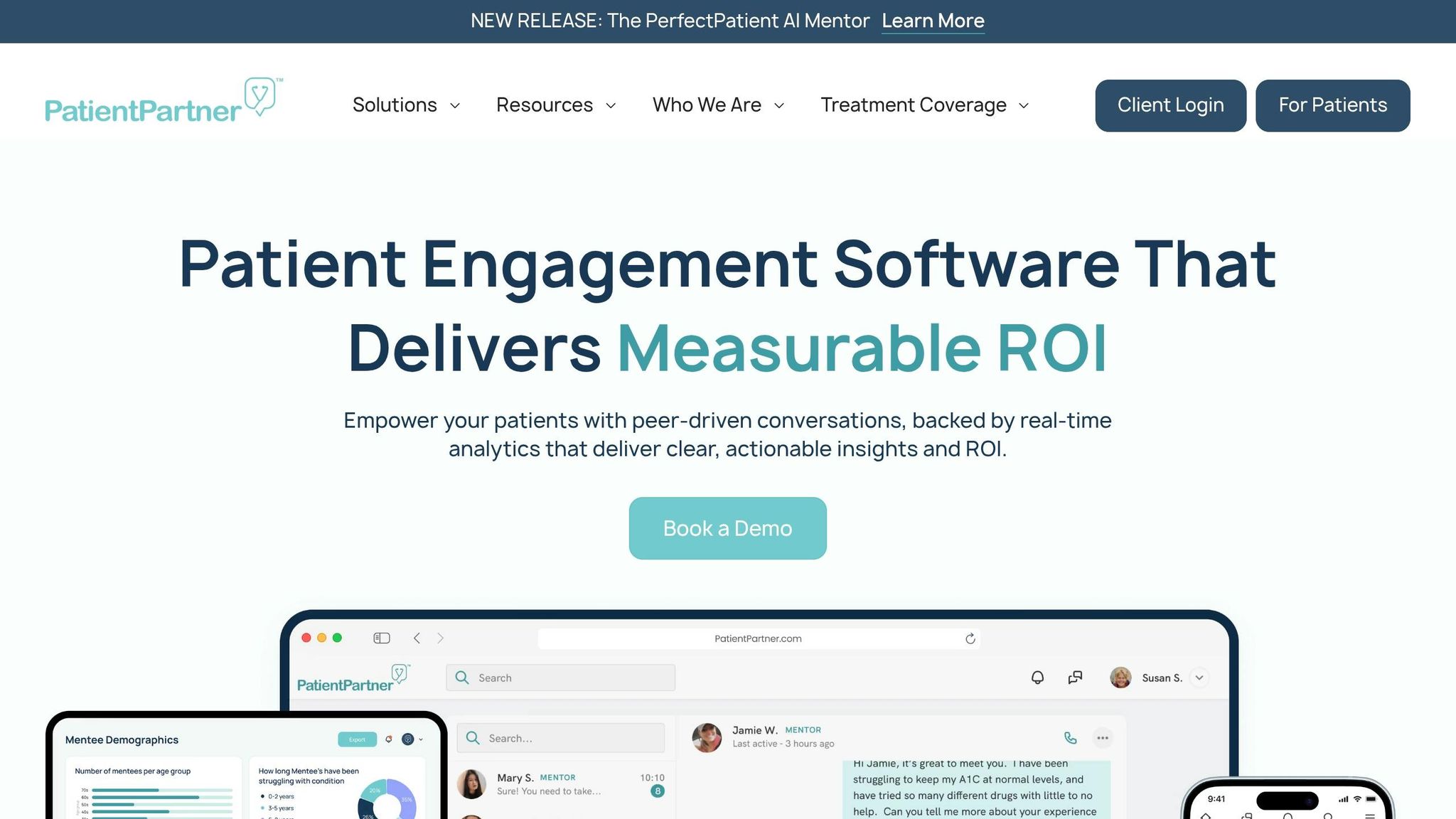
Patient adherence is about more than just following instructions - it's about addressing emotional and practical hurdles that patients face throughout their treatment journey. PatientPartner combines AI-driven insights with real-time human mentorship to create a support system that bridges these gaps.
Real-Time Patient Mentorship and Support
PatientPartner connects patients with mentors who have firsthand experience with similar treatments. This peer-to-peer approach is highly personalized, matching patients with mentors based on their individual needs and preferences. These mentors provide ongoing guidance, offering both emotional reassurance and practical advice that extends from the start of treatment to long-term adherence.
The platform uses AI to evaluate patient needs and ensure the mentor pairing is as effective as possible. It predicts critical moments - like therapy initiation or refill adherence - and prompts mentors to step in when their support is most needed. This proactive approach ensures patients receive help at the right time, tailored to their unique circumstances.
By analyzing real-time interactions, PatientPartner continuously improves its mentorship strategies, creating a dynamic support system that evolves alongside the patient.
Data-Driven Insights from Mentor Interactions
Every conversation between mentors and patients generates valuable data. Using natural language processing (NLP), the platform categorizes feedback into themes like communication quality, staff performance, or facility issues. These insights help pharmaceutical and medical technology companies identify the specific barriers affecting patient adherence.
When the system detects potential issues, such as irregular prescription refill patterns or signs of non-adherence, it alerts mentors to intervene immediately. This blend of human empathy and AI-driven precision ensures that patients receive the right support at the right time, creating a responsive and adaptable care network.
Scalable and Compliance-Ready Platform
PatientPartner doesn’t just focus on individual support - it also offers scalability for larger healthcare organizations. Built on a compliance-ready SaaS infrastructure, the platform allows pharmaceutical and med-tech companies to roll out patient support programs while meeting strict regulatory requirements. It also provides actionable patient sentiment analytics, helping companies improve their strategies for marketing and innovation.
Benefits of AI Feedback for Pharmaceutical Stakeholders
Better Patient Engagement and Retention
AI feedback analytics have become a game-changer for pharmaceutical stakeholders by addressing critical issues like treatment discontinuation. With roughly 80% of healthcare data being unstructured - spanning phone calls, chat logs, and emails - traditional analytics often miss the mark. AI steps in to decode this unstructured data, uncovering barriers such as confusion over prior authorizations, misunderstandings about coverage, or unclear instructions that lead patients to stop therapy.
By predicting individual patient needs rather than relying on generic outreach, AI enables pharmaceutical companies to make personalized interventions. This tailored approach directly boosts therapy initiation and retention rates. As CEO Bill Grambley puts it:
"If we can actually make that program more relevant to us as individuals, more patients will get the benefit of those programs, and more patients therefore will start and stay on therapy".
AI also improves medication adherence by pinpointing the best channels and timing to engage patients. This reduces treatment failures and potentially prevents unnecessary deaths caused by non-adherence. These advancements not only enhance patient engagement but also open the door for pharmaceutical companies to refine their marketing and innovation strategies.
Actionable Insights for Marketing and Innovation Teams
AI is reshaping how marketing and innovation teams approach patient-centered strategies. Tools like natural language processing (NLP) analyze patient feedback from forums, apps, and other platforms, uncovering underlying concerns that can strengthen brand loyalty. While over 90% of customer experience leaders rely on survey-based metrics, only 6% find these metrics sufficient for confident decision-making. AI bridges this gap by continuously capturing patient signals, eliminating the delays and limitations of traditional surveys.
Michael Armstrong, Chief Technology Officer at Authenticx, explains:
"Some of the highest-value insights often hide in the least polished moments - the off-script questions, the frustrated pauses, the 'one last thing…' a patient mentions before hanging up".
These insights empower teams to fine-tune communication scripts, update website content, and clarify eligibility language, addressing recurring patient concerns. Even minor adjustments like these can lead to significant improvements in adherence. In oncology, for instance, AI algorithms have been shown to improve patient identification accuracy by 15 times and healthcare provider (HCP) linkage by 10 times, enabling companies to focus resources on high-risk patients before they disengage. Beyond engagement, these insights also help ensure compliance with regulatory standards.
Supporting Compliance and Regulatory Goals
AI platforms are invaluable for meeting the pharmaceutical industry's stringent regulatory requirements while improving patient care. Advanced, pharma-specific AI tools can detect off-label inquiries or adverse event mentions within unstructured data, ensuring these interactions are appropriately flagged and documented according to regulatory guidelines. Unlike generic analytics systems, these tools are designed to understand the therapeutic and regulatory complexities unique to the pharmaceutical sector.
AI also simplifies compliance auditing by monitoring documentation practices in real time and identifying potential HIPAA or regulatory risks before they escalate. This creates a reliable audit trail of patient-provider communications, capable of securely processing millions of conversations at scale. The transparency in AI's decision-making processes ensures accountability during audits and helps reduce biases in data analysis.
The Future of AI-Driven Patient Adherence
Scalable Solutions for Patient Adherence
AI is transforming patient adherence programs by moving away from traditional, reactive models toward predictive, scalable platforms. Instead of relying on periodic check-ins, AI now tracks individual behavior in real time, identifying potential adherence risks and offering tailored interventions on a large scale - all without driving up costs.
Non-adherence is a massive issue, costing the U.S. healthcare system between $100-300 billion annually. AI-powered solutions have the potential to cut these costs by 20-30% using predictive analytics. The impact is already evident: between 2023 and 2024, Novartis implemented an AI-driven adherence app in partnership with Medisafe for 12,000 heart failure patients. This initiative boosted adherence rates from 55% to 82% within a year, saving $15 million in healthcare costs. By analyzing daily check-ins through AI sentiment analysis, Novartis could predict and address adherence challenges before they escalated. Mark Reilly, Novartis VP of Patient Engagement, spearheaded this effort [Medisafe Case Studies, Novartis Impact Report 2024].
Platforms like PatientPartner are advancing this approach by blending AI analytics with real-time mentorship. This hybrid model pairs patients with experienced mentors while using AI to analyze interaction data, uncover adherence challenges, and recommend targeted solutions. This combination of scale and personalization allows pharmaceutical companies to engage thousands of patients effectively - something manual methods alone cannot achieve.
These advancements give pharmaceutical companies clear pathways to enhance patient adherence, leveraging scalable and personalized solutions to address a long-standing challenge.
Next Steps for Pharmaceutical Companies
Pharmaceutical companies aiming to harness AI-driven adherence tools should begin by focusing on high-burden therapies where adherence issues are most pressing, such as oncology or chronic disease management. For instance, in early 2024, Pfizer piloted an AI-powered program for rheumatoid arthritis. By analyzing app feedback from 5,200 patients, the program provided personalized coaching through SMS and chatbots, leading to a 28% improvement in adherence and an 18% reduction in hospitalizations within just three months. Dr. Elena Vasquez, Pfizer's Digital Health Director, led this initiative [IBM Watson Health Case Study, Pfizer Collaboration Report, April 2024].
The regulatory landscape is also becoming more favorable. The FDA’s 2025 guidance on AI and machine learning in Software as a Medical Device (SaMD) predicts a 50% increase in approved AI devices by 2028 [FDA.gov, "AI/ML Guidance 2025"]. To stay ahead, companies should focus on compliance-ready platforms that meet HIPAA and FDA standards from the outset, avoiding the need for costly retrofits later. PatientPartner is a strong example, offering a platform designed with regulatory compliance in mind. Its infrastructure not only meets security and legal requirements but also generates actionable insights from mentor-patient interactions, enabling continuous improvement in adherence strategies.
FAQs
How does AI know when I’m likely to stop treatment?
AI uses predictive models and real-time data to pinpoint when you might be at risk of stopping treatment. By identifying patterns that signal potential non-adherence or discontinuation, it enables timely interventions to help you stay on track and achieve better health results.
What patient data does AI use for adherence insights?
AI uses patient-specific data, predictive models, and real-time information to deliver insights aimed at improving treatment adherence. By analyzing patterns and trends, it enables personalized support, helping patients achieve better health outcomes.
How does PatientPartner blend AI with human mentors?
PatientPartner blends AI-powered insights with the warmth of personalized human mentorship by linking patients with seasoned mentors. These mentors help patients navigate their healthcare experiences, offering guidance that encourages lasting adherence and improved health results. This approach ensures patients benefit from both data-driven recommendations and compassionate, human-focused support.