


GDPR Consent in Pharma: Best Practices
Key Takeaways
Author


Managing patient data under GDPR is complex but essential for pharmaceutical companies. Here's what you need to know:
- Why it matters: GDPR requires explicit consent for processing health data, classified as a "special category." Non-compliance can lead to fines of up to €20 million or 4% of global revenue.
- Key rules: Consent must be freely given, specific, informed, unambiguous, and easily withdrawable. Practices like bundling unrelated consents or using pre-checked boxes violate GDPR.
- Challenges: Issues like fragmented consent signals and poor record-keeping can erode trust and trigger penalties.
- Solutions: Use clear consent interfaces, limit data collection to necessary purposes, and invest in Consent Management Platforms (CMPs) for tracking, real-time updates, and audit readiness.
Bottom line: Strong consent systems aren't just about avoiding fines - they're about building trust and influencing patient decisions and ensuring compliance with global data privacy laws.
Understanding the General Data Protection Regulation in the Context of Clinical Research
sbb-itb-8f61039
GDPR Requirements for Patient Data Consent
Pharmaceutical companies navigating GDPR compliance must meet strict consent standards, especially when dealing with patient health data.
Under Article 9 of GDPR, health data is classified as a "special category" of personal data, requiring explicit consent - a step beyond the general unambiguous consent needed for other data types. This means patients must actively agree, leaving no room for misinterpretation.
For consent to be valid under GDPR, it must meet several criteria: it must be freely given, specific, informed, unambiguous, properly documented, and easily withdrawable. Non-compliance can result in severe penalties - up to €20 million or 4% of a company’s global annual revenue, whichever is greater. Even administrative lapses, like poor record-keeping, can lead to fines of up to €10 million or 2% of annual turnover.
Freely Given and Specific Consent
Consent must always be voluntary and free from pressure. GDPR Recital 42 makes this clear:
"Consent should not be regarded as freely given if the data subject has no genuine or free choice or is unable to refuse or withdraw consent without detriment."
This principle is particularly relevant in healthcare, where power dynamics between patients and providers can make consent feel less than voluntary. Practices like "tied consent" - where patients must agree to unrelated data processing to access essential services - are prohibited. Such safeguards are critical for maintaining patient trust through clinical trial engagement software. This trust is further strengthened by how patient engagement platforms work to facilitate transparent communication.
Consent must also be specific to each processing purpose. Grouping multiple purposes, such as clinical research, marketing, and third-party sharing, into a single consent request violates GDPR standards. A notable example is the €50 million fine imposed on Google by the French data protection authority (CNIL) in January 2019. The violation? Google’s consent mechanism was deemed neither specific nor unambiguous, as it included pre-ticked boxes for personalized ads.
Informed and Unambiguous Consent
Patients must have access to clear, easy-to-understand information before giving consent. This includes details like the identity of the data controller, the exact purpose of data processing, the type of data being collected, and the right to withdraw consent. The CNIL investigation into Google found that spreading critical information across multiple documents left users inadequately informed.
Consent forms should avoid technical jargon and use straightforward language. Moreover, the process of giving consent must involve a clear affirmative action - silence, inactivity, or pre-ticked boxes are not acceptable. Systems must block non-essential trackers or pixels until active consent is granted.
Documenting and Managing Consent Withdrawal
Effective consent management also requires thorough documentation.
Pharmaceutical companies must maintain a secure, tamper-proof record of each consent, tied to its specific privacy policy version and timestamp. This record should include details such as who gave consent, when it was provided, what information was shared, how consent was obtained, and whether it has been withdrawn.
Equally important, withdrawing consent must be as straightforward as giving it. Article 7(4) of the GDPR emphasizes this:
"It shall be as easy to withdraw as to give consent."
For example, a single-click consent mechanism should allow for a single-click withdrawal. Companies can implement simple solutions like a persistent "Privacy Settings" link on every page or a one-step phone process. Once consent is withdrawn, all data processing must stop immediately, and any third-party processors must be notified promptly. With more than 80% of health apps in European app stores relying on user consent for data processing, having a smooth withdrawal process is not just a legal obligation - it’s a necessity.
How to Implement GDPR-Compliant Consent Mechanisms

GDPR Consent Requirements and Common Compliance Failures in Pharma
Ensuring compliance with GDPR involves creating consent mechanisms that are both effective and easy for users to navigate.
Designing User-Friendly Consent Interfaces
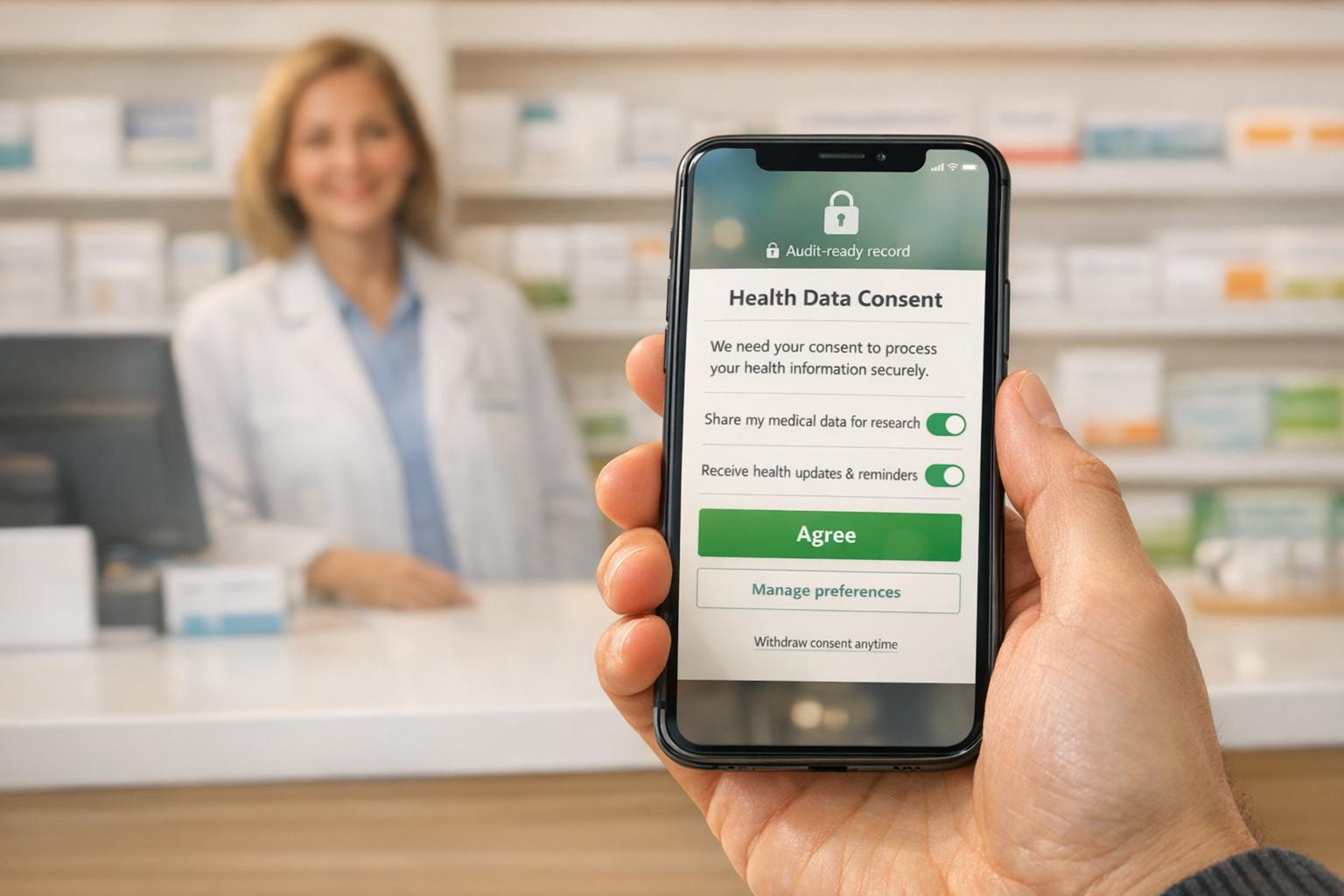
A well-thought-out consent interface should include granular toggles for each processing purpose. Instead of a single "Accept All" button, pharmaceutical websites should allow users to choose separately for activities like strictly necessary cookies, analytics, healthcare professional (HCP) ad-targeting, and patient engagement programs. Each toggle must be independently adjustable, giving users real control over their data.
Equally important is the inclusion of a "Reject All" option that’s just as accessible as the "Accept All" button. This should only require a single click, avoiding the frustration of navigating through multiple menus. Pre-ticked boxes or assuming consent through passive browsing are not acceptable under GDPR. Remember, compliance extends beyond the visible banner - it includes backend systems, audit logs, and handling data subject requests.
| GDPR Consent Element | Requirement for Interface Design | Common Failure to Avoid |
|---|---|---|
| Freely Given | Users must not face penalties for refusing consent; consent can't be a condition of service | Bundling consent with terms and conditions or mandatory access |
| Specific | Separate checkboxes for different processing purposes | Using a single checkbox for unrelated activities |
| Informed | Provide clear information about who is collecting data, why, and user rights | Using vague or hard-to-find privacy language |
| Unambiguous | Require clear affirmative action (opt-in) | Using pre-ticked boxes or treating "continued browsing" as consent |
To avoid overwhelming users, use layered information and progressive disclosure. Start with essential details - who is collecting the data, its purpose, and how users can withdraw consent - then provide links for more detailed explanations. Plain, straightforward language is key; skip the legal jargon and use intuitive controls. For sensitive health data, include two-step confirmation patterns: first, a selection screen with toggles, followed by a summary confirmation screen. This helps meet the "explicit" consent standard required under Article 9.
The next step is to focus on limiting data collection to only what is necessary.
Data Minimization and Purpose Limitation
Pharmaceutical companies need to collect only the data that is essential for clearly defined purposes. Start by conducting thorough data mapping to identify all collection points and ensure every piece of data serves a legitimate, stated purpose.
Consent requests should be contextual - presented at the moment they’re relevant. For example, ask for consent to play a video only when the user clicks to activate it, or request location access when a feature like a clinic finder is being used. This approach ensures users understand why their data is needed and can make informed decisions.
Avoid linking consent to multiple, unrelated purposes. For instance, the Italian Garante issued a €1.5 million fine to a health app in 2024 for bundling health data consent with marketing consent. This serves as a reminder that regulators are actively enforcing purpose limitation requirements.
By focusing on clear and minimal data collection, you can create a consent system that respects user rights while meeting GDPR standards.
Real-Time Consent Updates and Adaptation
Once you’ve set up user-friendly interfaces and minimized data collection, it’s essential to maintain dynamic consent management. This includes a persistent preference center that allows users to adjust their settings at any time. Features should include independent toggles for specific activities - such as heart rate monitoring, marketing communications, or sharing data with research partners.
Real-time updates are critical. If a user withdraws consent, that change must immediately propagate across all systems - CRMs, CDPs, analytics tools, and ad-tech platforms - so data processing stops without delay. APIs are essential for synchronizing consent states with third-party tools.
If the purpose of data processing changes significantly, you must trigger re-consent flows for affected users. Don’t assume prior consent still applies. Ensure audit logs capture key details like the user ID, timestamp, scope of consent, and the exact version of the consent text the user viewed. With over 80% of health apps in European app stores relying on user consent as their primary Article 9 justification, having a reliable consent infrastructure is essential for maintaining trust and compliance.
Using Consent Management Platforms in Pharma
Keeping track of consent manually is no longer feasible for pharmaceutical companies navigating the strict requirements of GDPR. Consent Management Platforms (CMPs) simplify this process by centralizing consent collection, tracking user preferences in real time, and maintaining records that are ready for audits. Roman Vinogradov, VP of Products at Improvado, explains it well:
"A consent management platform is the control surface that makes all of this audit-ready instead of a spreadsheet prayer."
For pharma companies operating globally, CMPs are essential. They manage compliance across diverse privacy laws such as GDPR for EU users, HIPAA for U.S. patients, and even state-specific laws like Washington's My Health My Data Act - all within a single system. Below are the critical features a CMP needs to meet GDPR standards.
Key CMP Features for GDPR Compliance
Pharma-ready CMPs must go beyond basic cookie banners by offering granular consent controls. For example, instead of a blanket "accept all" button, they should include separate toggles for specific purposes like analytics, HCP ad-targeting, and patient engagement. These toggles must allow users to revoke consent for any category at any time. Pre-ticked boxes or consent inferred from browsing activity are a no-go under GDPR .
Another key feature is the automatic blocking of non-essential scripts, cookies, and pixels - such as Google Analytics or Meta Pixel - until users explicitly opt in. If a user withdraws their consent, the CMP needs to update all connected systems instantly, including CRMs, CDPs, email tools, and ad platforms .
Audit-ready records are a must. A compliant CMP captures detailed, timestamped logs showing the version of the interface displayed, an IP surrogate, the specific consent string, and the purposes for which consent was granted. These records are crucial for regulatory inspections and handling Data Subject Access Requests (DSAR) efficiently .
For EU-based programmatic HCP campaigns, support for IAB TCF v2.2 is essential. This ensures consent strings are valid and flow correctly through ad exchanges . Additionally, CMPs should monitor cross-border data transfers, flagging when data moves to non-EU regions like U.S.-based servers, to comply with Standard Contractual Clauses. If the CMP processes data on behalf of a HIPAA Covered Entity, it’s also important to confirm the vendor is willing to sign a Business Associate Agreement (BAA).
Benefits of Using CMPs in Pharma
These advanced features offer more than just compliance - they bring operational and financial advantages. CMPs not only streamline workflows but also build trust with patients, which can directly impact business performance.
Trust is a powerful driver of success. Companies viewed as trustworthy outperform their competitors by 250%, while 75% of consumers say they won’t buy from organizations they don’t trust with their data . By providing transparent and user-friendly consent options, CMPs help pharma companies foster the trust needed for lasting patient relationships.
The financial upside is also clear. For every dollar spent on data privacy, organizations see an average return of $2.70. Some CMP users have reported saving between $5,000 and $20,000 per jurisdiction on legal fees by using built-in regulatory templates. A unified consent system also prevents "trust breakers" - ensuring that when a patient opts out in one channel, their preference is reflected across all systems like email marketing, analytics, and CRMs.
Kevin King, Partner at Credera, sums it up perfectly:
"Consent is no longer a passive checkbox. It's becoming the foundation for sustainable engagement."
While cookie banners might seem like the most visible part of consent management, they’re only 20% of the equation. The real value lies in ensuring consent signals are seamlessly integrated into server-side events, data warehouses, and CRM suppression lists. Quarterly audits of banner versions and consent logs are also essential to keep technical implementations aligned with current privacy policies .
Patient-Centered Compliance: Using Platforms Like PatientPartner
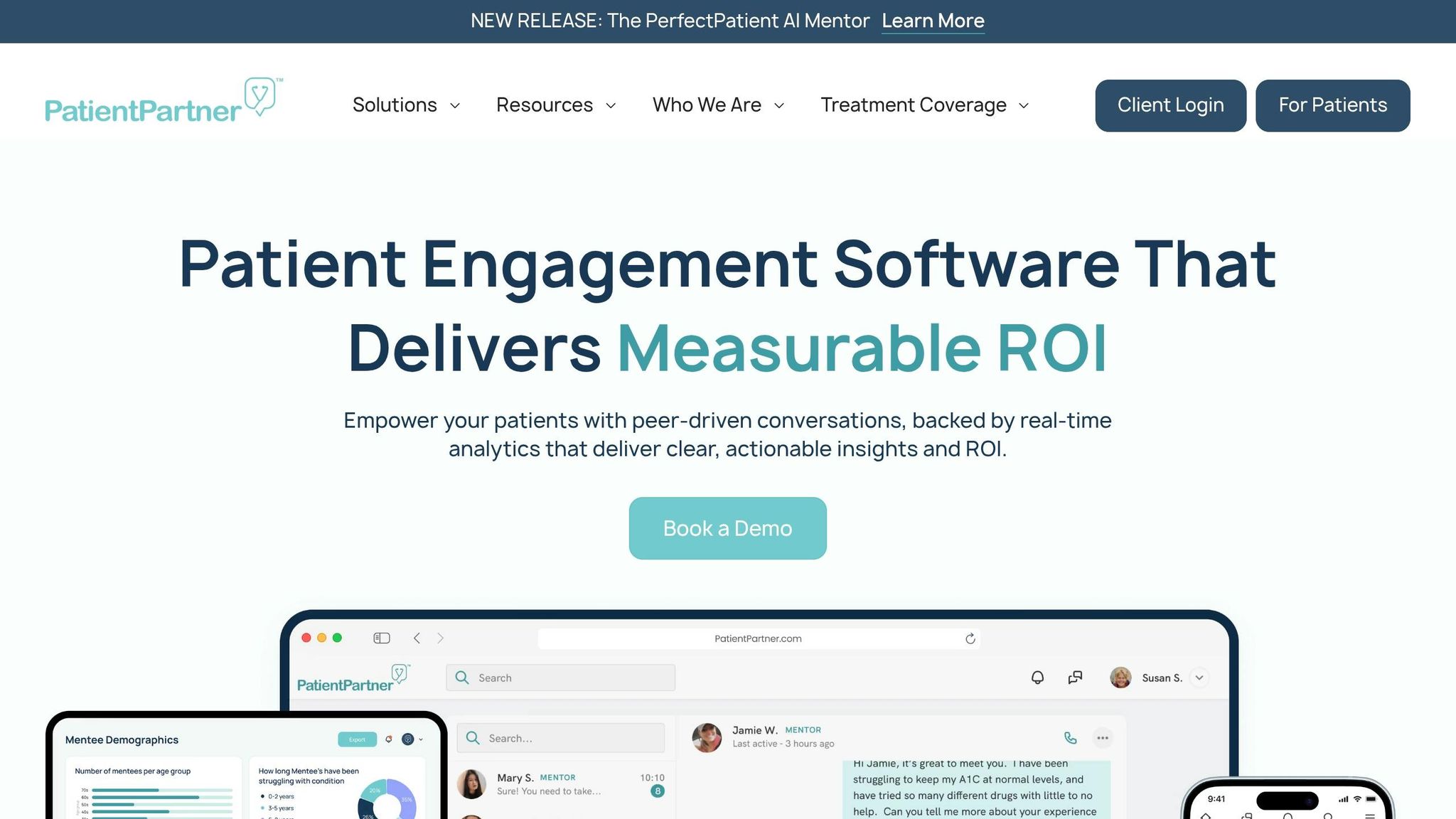
While CMPs handle the technical side of compliance, pharmaceutical companies need tools that actively engage patients while adhering to strict regulations. PatientPartner is designed to meet GDPR standards, offering real-time mentorship and personalized support. The platform connects patients with experienced mentors who assist with treatment decisions, medication routines, and recovery - all while respecting detailed consent preferences. This patient-first strategy works hand-in-hand with the technical systems discussed earlier.
Building on GDPR's explicit consent requirements, PatientPartner provides purpose-level consent options. Patients can choose to engage in key mentorship activities - like medication reminders or recovery updates - while opting out of optional features, such as data sharing for research or third-party analytics. By aligning mentorship programs with stringent consent rules, the platform ensures compliance goes beyond just ticking boxes.
Real-time synchronization is another critical feature, preventing issues where consent withdrawal isn't consistently applied. PatientPartner's unified consent system ensures that if a patient opts out of a mentorship activity, that decision is updated instantly across all connected systems, including CRMs, email tools, and analytics platforms. This avoids the inconsistencies that have previously led to hefty fines.
PatientPartner also reduces unnecessary data collection by focusing only on what’s relevant for patient recovery. For instance, if a patient is recovering from surgery, the platform tracks metrics like sleep patterns or heart rate to provide tailored recovery advice - without repurposing that data for unrelated marketing. This approach adheres to GDPR's purpose limitation principle while fostering trust. By being transparent about data use, the platform enhances personalization and builds a stronger, more collaborative relationship with patients.
Conclusion
GDPR compliance in the pharmaceutical industry goes beyond simply avoiding penalties - it's about building trust with patients. The regulations demand clear, detailed consent and seamless integration across systems. By adhering to these standards, pharmaceutical companies can transform compliance into an opportunity to strengthen patient relationships and improve healthcare outcomes.
Recent regulatory actions highlight the steep financial and reputational costs of non-compliance. These cases serve as a reminder of the importance of maintaining strong consent systems. Relying on fragmented processes or assumptions not only risks hefty fines but also undermines the trust that is crucial for patient adherence and effective treatment.
The most successful pharmaceutical companies make GDPR compliance a core part of their operations. They implement unified consent systems with features like versioned records, user-friendly two-step confirmations, and automated data deletion when consent is withdrawn. Instead of overwhelming patients with legal jargon, they offer accessible preference centers that make opting out as easy as opting in.
As outlined throughout this article, GDPR's requirements align with a patient-first philosophy. By giving patients clear control over how their data is used, companies can shift from mere compliance to fostering meaningful partnerships in healthcare.
FAQs
When do pharma teams need explicit consent vs another legal basis under GDPR?
Pharmaceutical teams must obtain explicit consent under GDPR when dealing with special categories of health data. This means they need a clear and affirmative statement that directly acknowledges the specific health data being processed. Such consent is particularly crucial for activities that fall outside the scope of direct patient care, as GDPR imposes strict regulations on managing sensitive health information.
What proof do we need to keep to show consent was valid and versioned?
To prove that consent was valid and appropriately documented, keep thorough records that detail the date, time, and version of the consent obtained. Also, ensure you have clear evidence showing that the individual gave informed agreement in line with relevant regulations.
How do we make consent withdrawal instantly stop tracking across all tools?
To promptly stop tracking when consent is withdrawn, use a centralized consent management platform (CMP). This platform should handle withdrawal requests in real time, issuing commands to stop data processing across all connected tools. It's also crucial to make the withdrawal process straightforward for users, with clear steps and minimal delays. Remember, under GDPR, withdrawing consent must be just as simple as giving it.