


Cultural Competency Training: Best Practices for Compliance

Key Takeaways
Author


Healthcare providers in the U.S. must address the needs of a diverse population. With nearly 68 million Americans speaking a language other than English at home, miscommunication can lead to incorrect diagnoses, legal risks, and financial losses. Training equips staff to deliver care that respects patients' backgrounds while meeting federal and state regulations.
Key Takeaways:
- Legal Requirements: Federal laws (e.g., Section 1557 of the Affordable Care Act) and state mandates now require cultural competency training for healthcare professionals.
- Financial Impact: Non-compliance can result in penalties, EEOC settlements ($40,000–$250,000), or high turnover costs (75–150% of a replaced employee's salary).
- State Variations: Training requirements differ by state. For example, Illinois mandates 1 hour of training for license renewal, while Nevada requires 2 hours focusing on specific groups like veterans and LGBTQ+ individuals.
- Best Practices: Effective programs include tailored content, flexible delivery methods (e-learning, case studies), and regular evaluations to measure impact.
- Technology's Role: Tools like Learning Management Systems (LMS) help track compliance, manage training, and provide measurable outcomes.
Cultural competency training isn’t just about compliance - it directly impacts patient safety, satisfaction, and organizational success.
Cultural Competency- For Providers
sbb-itb-8f61039
Key Compliance Frameworks for Cultural Competency
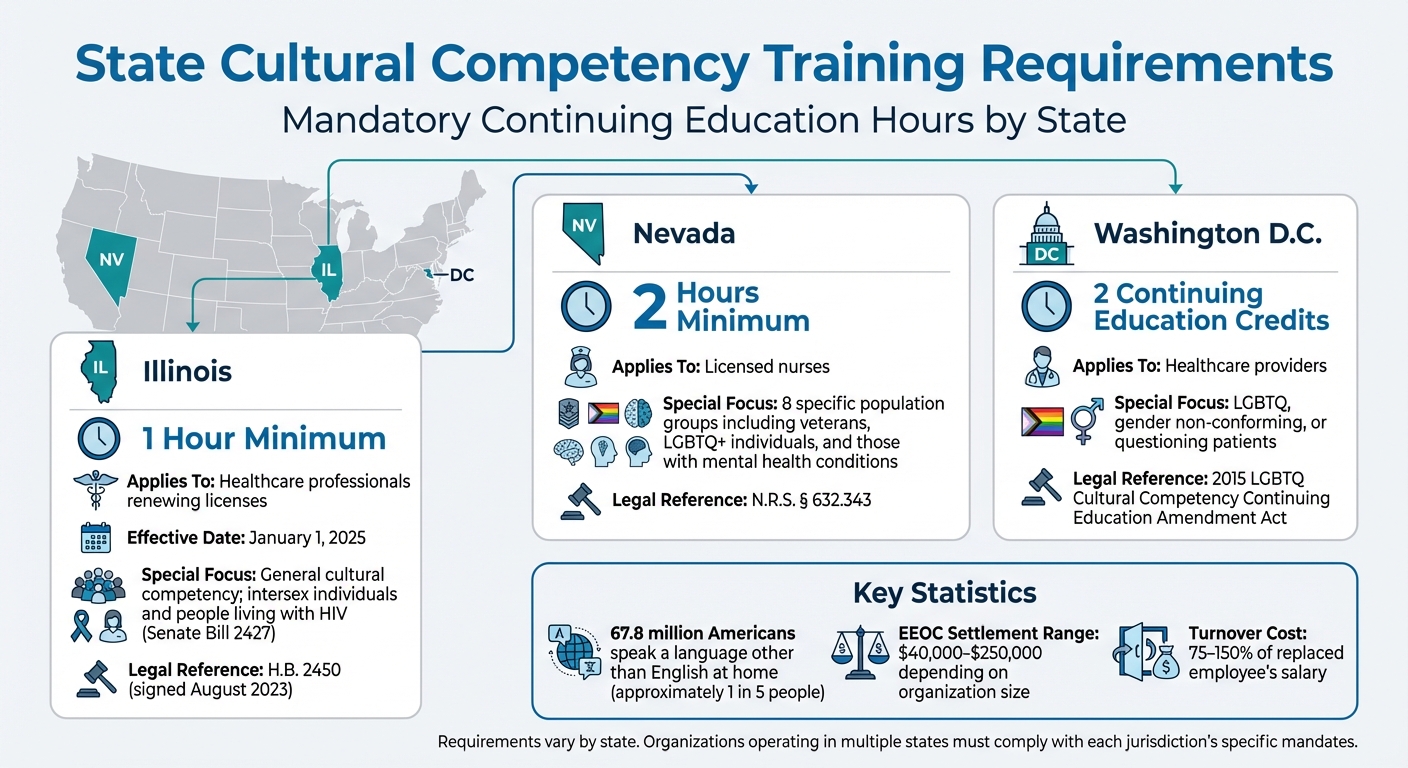
State-by-State Cultural Competency Training Requirements for Healthcare Professionals
Healthcare organizations need to navigate both federal and state frameworks when designing cultural competency training programs that meet compliance standards.
National CLAS Standards
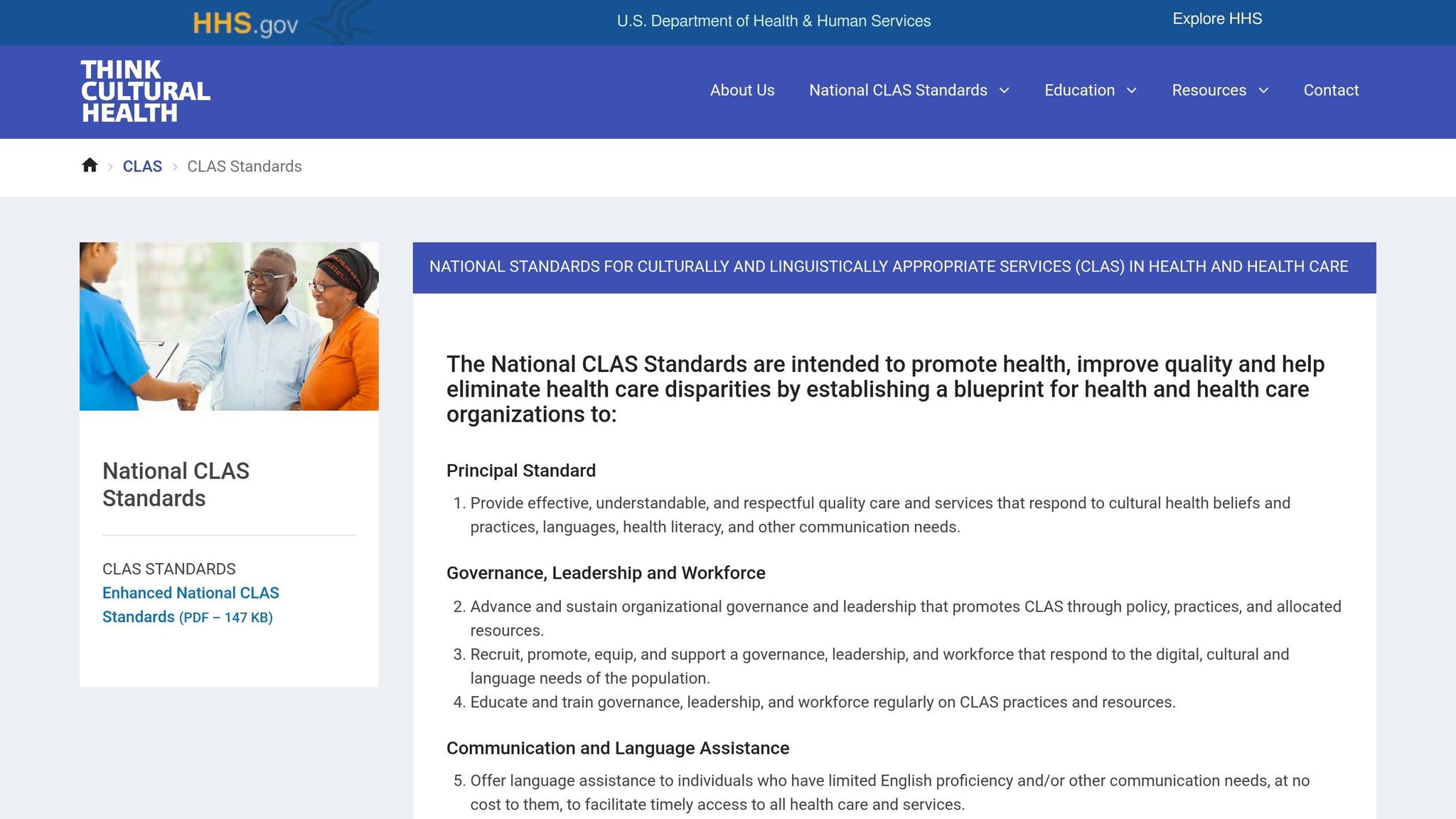
The National CLAS Standards (Culturally and Linguistically Appropriate Services) serve as the primary federal guidelines for cultural competency in healthcare. Developed by the U.S. Department of Health and Human Services, these standards outline 15 actionable steps that healthcare providers can follow to ensure care is respectful and responsive to diverse patient needs.
"CLAS is about respect and responsiveness: Respect the whole individual and Respond to the individual's health needs and preferences." - U.S. Department of Health & Human Services
These standards address critical areas such as patients' cultural health beliefs, preferred languages, health literacy levels, and communication needs. By using the 15 steps as a framework, organizations can design, implement, and evaluate training programs that align with federal expectations. The ultimate goal is to eliminate disparities in healthcare access and outcomes.
While these federal guidelines establish a baseline, state regulations add another layer of complexity to compliance efforts.
CMS and State-Specific Regulations
Although the National CLAS Standards provide overarching guidance, state-specific requirements vary widely, creating challenges for healthcare organizations operating in multiple states. These differences often include variations in training hours, targeted professions, and patient populations, making compliance a nuanced task.
For example, in August 2023, Illinois Governor J.B. Pritzker signed H.B. 2450 into law, requiring at least 1 hour of cultural competency training for healthcare professionals renewing licenses on or after January 1, 2025. Illinois defines cultural competency as "a set of integrated attitudes, knowledge, and skills that enables a health care professional or organization to care effectively for patients from diverse cultures, groups, and communities".
Other states have stricter mandates. Nevada's N.R.S. § 632.343 requires licensed nurses to complete a minimum of 2 hours of training, addressing eight specific population groups, including veterans, LGBTQ+ individuals, and those with mental health conditions. Meanwhile, Washington D.C. has a targeted requirement under its 2015 LGBTQ Cultural Competency Continuing Education Amendment Act, mandating healthcare providers earn 2 continuing education credits focusing on LGBTQ, gender non-conforming, or questioning patients.
For organizations working across state lines, managing these varying requirements - such as training hours and renewal cycles - is essential for maintaining compliance. Even in states without formal mandates, implementing cultural competency training can reduce legal risks tied to discrimination and improve patient satisfaction metrics.
Best Practices for Designing Cultural Competency Training
Designing cultural competency training requires thoughtful planning to effectively serve diverse patient populations while adhering to regulatory requirements.
Developing Inclusive Content
To create meaningful training, it's essential to include the six Minority Health Social Vulnerability Index themes: socioeconomic status, household composition and disability, minority status and language, housing type and transportation, health care infrastructure and access, and medical vulnerability. This framework ensures the training addresses real-world challenges rather than abstract concepts.
The definition of protected populations is constantly evolving. For example, Illinois Senate Bill 2427 mandates training on affirming care for intersex individuals and people living with HIV, highlighting the need for programs to address specific clinical needs beyond general diversity topics. Additionally, organizations should analyze their patient demographics and seek input from patient and family councils to determine which cultural groups need focused attention.
Linguistic competency is another key area. As the U.S. population grows more diverse, training must include guidance on using interpreters and translation services effectively to bridge language gaps. Incorporating culturally informed approaches to diagnosis and treatment planning ensures providers can consider cultural factors in their clinical decisions.
These strategies lay the groundwork for flexible training delivery methods.
Using Scalable and Flexible Training Methods
Successful training combines different formats to meet the varied schedules and learning preferences of staff. For example:
- E-learning modules: Provide accessible, on-demand training.
- In-person lectures: Allow for deeper exploration of complex topics.
- Interactive case studies: Enable staff to apply cultural principles in real-world scenarios.
Guest panels featuring patient stories can add a personal touch, making the training more relatable. Leveraging a Learning Management System (LMS) can streamline course delivery, track participation, and offer refresher courses in multiple languages. Multi-disciplinary committees, including both administrative and clinical staff, can help identify barriers to implementation and ensure consistent messaging across departments.
Training frequency is also a key consideration. Instead of biennial sessions, experts recommend refresher courses every 6–12 months to maintain proficiency. Incorporating cultural competency into onboarding for all new hires - including contract staff and business associates - ensures everyone starts with the same foundational knowledge.
These adaptable methods align well with digital tools, which are discussed further in later sections.
Evaluation and Continuous Improvement
To ensure training remains effective and compliant with evolving standards, robust evaluation is crucial. A three-pronged approach works best:
- Qualitative data: Gather insights through interviews and focus groups.
- Quantitative data: Use organization-wide surveys to measure outcomes.
- Archival data: Review policies to assess alignment with training goals.
The American Evaluation Association stresses the importance of "reflexivity" - encouraging trainers and evaluators to examine their own cultural assumptions and biases. As one evaluation framework explains:
"To ensure recognition, accurate interpretation, and respect for diversity, evaluators should ensure that the members of the evaluation team collectively demonstrate cultural competence".
Organizations should compare post-training metrics - such as patient satisfaction scores, health outcomes, staff retention rates, and complaint levels - with pre-training data to measure impact. The concept of "cultural safety" emphasizes that success should be judged by patients themselves, rather than external standards. Regularly reviewing training materials can help eliminate language bias and ensure compliance with ethical guidelines.
Given that EEOC settlements can range from $40,000 to $250,000 depending on the organization’s size, effective evaluation not only improves care but also protects the organization financially.
Implementation Strategies for Healthcare Organizations
Rolling out cultural competency training requires a well-thought-out plan that aligns with both compliance requirements and the organization's values. To make this work, the focus should be on two key areas: securing leadership support and embedding the training into daily operations. These efforts naturally tie into everyday workflows, which will be explored further in the next section.
Engaging Leadership and Stakeholders
Getting leadership on board is critical for ensuring the training has a lasting impact on patient care and compliance. Without leadership buy-in, cultural competency efforts risk becoming a mere box-checking exercise. One effective method is to establish a multidisciplinary committee that includes both administrative and clinical staff. This approach helps identify potential roadblocks and ensures the training fits seamlessly into real-world operations.
When pitching the idea to leadership, it’s helpful to present cultural competency as more than just a regulatory need - it’s a business advantage. For instance, 76% of job seekers factor in diversity when choosing employers. A diverse workforce doesn’t just enhance compliance; it can also boost the organization’s brand, foster patient loyalty, and improve operational efficiency. Plus, reducing employee turnover - which can cost 75% to 150% of a departing employee’s salary - becomes an added benefit.
Leadership can also gain valuable insights by tapping into patient and family councils. These groups can provide direct feedback from diverse racial, ethnic, and LGBTQ+ communities, offering qualitative data to guide decision-making. Additionally, offering continuing education (CE) credits or certifications can encourage participation while helping meet state-specific licensure requirements. For example, Illinois will require at least one hour of cultural competency CE for license renewal starting January 1, 2025.
Integrating Training into Organizational Processes
For cultural competency training to succeed, it needs to become part of the organization’s regular workflow rather than a standalone effort. Including it in the onboarding process for all new hires sets the tone early, ensuring that every employee - from permanent staff to contractors - starts with the same foundational knowledge.
Regular refresher courses, held every six to twelve months, can keep the training relevant. Using a Learning Management System (LMS) allows staff to complete these modules at a pace that fits their schedules. To keep the topic front and center, cultural competency can also be incorporated into monthly staff meetings or daily huddles, blending it into routine operations without causing disruptions.
Aligning training with state CE requirements can serve dual purposes, meeting compliance needs while reinforcing staff development. Organizations can save time and resources by using established tools like the HHS "Think Cultural Health" program, which offers video tutorials and online courses, rather than creating materials from scratch.
Tracking key performance metrics - such as patient satisfaction scores, health outcomes, and staff retention rates - before and after implementing training provides clear evidence of its impact. This data-driven approach not only demonstrates value to stakeholders but also supports ongoing improvements, complementing the evaluation methods discussed earlier.
The Role of Technology in Supporting Cultural Competency
Technology is playing a pivotal role in delivering cultural competency training that meets compliance requirements, tracks state-specific mandates, and ensures staff retain essential knowledge. Healthcare organizations are using these tools to navigate differing regulations across states while effectively measuring outcomes. These solutions integrate seamlessly with training programs, offering a streamlined approach to addressing cultural competency.
Using Digital Platforms for Training
Learning Management Systems (LMS) are tackling compliance challenges by automating the tracking of continuing education credits to meet diverse state requirements. These platforms also support specialized training programs tailored to meet the needs of various populations. Many states are now expanding their focus beyond ethnic and linguistic diversity to include areas like LGBTQ+ affirming care, support for individuals living with HIV, veterans, and people with disabilities.
Organizations can further enhance their efforts by using digital surveys to identify knowledge gaps within their workforce. This data-driven approach enables them to roll out targeted training programs that address specific weaknesses.
However, measuring cultural competency remains a complex task. As Healthcare Compliance Pros explains:
"At its core, cultural competency analyzes values and attitudes to provide inclusive care".
Digital tools help simplify this process by offering measurable metrics such as training completion rates, assessment scores, and even changes in patient satisfaction levels, ensuring continuous improvement.
PatientPartner: Supporting Patient-Centric Care
Technology's role in cultural competency goes beyond training - it extends into patient care, emphasizing the human aspect of compliance strategies. PatientPartner, for instance, enhances cultural competency by connecting patients with mentors who understand their unique cultural and healthcare needs. This approach aligns with the concept of cultural humility, which Tervalon & Murray-Garcia define as:
"Cultural humility is best defined not by a discrete endpoint but as a commitment and active engagement in a lifelong process... using patient-focused interviewing and care".
This mentorship-based model addresses a critical need, especially considering that approximately 1 in 5 people in the United States (67.8 million individuals) speak a language other than English at home. By pairing patients with mentors who share their cultural context and healthcare concerns, PatientPartner helps pharmaceutical and med-tech companies improve patient adherence and overall health outcomes.
Conclusion and Key Takeaways
In several states, cultural competency training is now a mandatory requirement for healthcare professionals, with specific continuing education hours needed for license renewal. Failing to comply with these requirements can lead to expensive EEOC settlements and increased turnover costs.
The concept of cultural competency has grown to address a broader range of patient needs, including specialized care for diverse populations. For example, healthcare providers in Washington, D.C., are required to complete a minimum of two continuing education credits focused on LGBTQ cultural competency to maintain their licensure.
However, compliance isn’t just about checking a box. To ensure long-term effectiveness, organizations should conduct refresher training every 6–12 months. Establishing a multi-disciplinary committee that includes both administrative and clinical staff can help pinpoint challenges and maintain consistent communication across the organization. Additionally, digital platforms offer scalable solutions by automating CE credit tracking and providing measurable data, such as training completion rates and patient satisfaction scores.
Incorporating technology and mentorship into these efforts can enhance both compliance and patient care. With approximately 67.8 million people in the U.S. speaking a language other than English at home, healthcare organizations need tools that bridge cultural and linguistic divides. Patient mentorship programs, which connect individuals with culturally aligned support systems, show promise in improving patient adherence and health outcomes.
As the regulatory environment continues to shift, with the HHS Office of Civil Rights ramping up enforcement under its Equity Action Plan, healthcare organizations must fully integrate cultural competency into their operations. By committing to regular training, leveraging data for evaluation, and embracing technology, organizations can not only meet compliance standards but also provide inclusive, patient-centered care for today’s diverse communities.
FAQs
What cultural competency training is required in my state for license renewal?
In Illinois, healthcare providers are now required to complete cultural competency training as part of their license renewal process. This mandate has been in place since September 2023. Be sure to review your state’s specific licensing guidelines to stay compliant.
How can we prove cultural competency training actually improved outcomes?
To show the impact of cultural competency training, it's essential to track specific indicators both before and after the training. Focus on metrics such as patient satisfaction, particularly among minority groups, as well as engagement levels and the quality of communication between patients and providers. You can also monitor clinical outcomes like treatment adherence, appointment attendance, and progress toward health goals. Evaluating these areas systematically can highlight how the training improves trust, strengthens communication, and boosts overall health outcomes.
What should we track in an LMS to stay audit-ready for compliance?
To stay compliant and prepared for audits, it's crucial to keep detailed records of training activities. This includes tracking training completion, assessment results, user progress, certification statuses, and timestamps for all activities. These records not only serve as clear evidence of compliance but also help meet regulatory demands effectively.