


How Algorithms Match Patients with Mentors

Key Takeaways
Author


Key Takeaways:
- Manual matching struggles: It's time-consuming, prone to bias, and often overlooks deeper compatibility factors like values and communication styles.
- Algorithmic solutions: These systems evaluate multiple factors - such as experience, communication preferences, and goals - to deliver matches with over 98% satisfaction rates.
- Benefits: Programs using algorithm-driven platforms report lower early match closures (10.87% vs. 29.41% for manual methods) and higher retention rates.
Algorithms not only save time but also improve outcomes by ensuring patients receive personalized support tailored to their unique needs.

Manual vs Algorithm-Driven Patient-Mentor Matching: Key Performance Metrics
Problems with Manual Patient-Mentor Matching
Time-Consuming and Resource-Intensive Processes
As mentorship programs grow, manual matching becomes a logistical nightmare. For programs with more than 50 participants, administrators often feel buried under the workload of pairing, managing, and following up on each match. The numbers quickly spiral out of control: a program with 100 participants creates around 2,500 possible pairings to evaluate, while 200 participants generate close to 10,000 options. Sorting through these combinations manually can take weeks, often requiring endless spreadsheet juggling.
To cope, some coordinators resort to makeshift methods. For example, the Legal Geek Mentoring Program in 2026 relied on Post-it notes spread across kitchen tables to organize hundreds of profiles. While algorithmic platforms can process these tasks in minutes, human teams face weeks of grueling labor. These delays often frustrate participants, leading some to drop out before the process is complete. Worse, the rush to meet deadlines can result in lower-quality matches, opening the door to errors and bias.
Poor Matches and Patient Dissatisfaction
The challenges of manual matching don’t stop at logistics - they also affect the quality of the pairings. Pressed for time, program managers often fall back on biases, such as favoring participants with similar traits or prioritizing surface-level factors like shared demographics or diagnoses. This approach overlooks deeper compatibility markers, such as communication preferences, shared values, or specific support needs, which are far more critical to a successful mentoring relationship.
The consequences are clear. In March 2026, the Zing Programme in Spain compared manual matching by experienced staff with algorithmic matching through MentorPRO. The findings were stark: manually matched pairs had a 29.41% premature closure rate, nearly triple the 10.87% rate of algorithmic matches. Prematurely ending a match can be especially harmful for patients, particularly those from marginalized groups who may already struggle with trust issues. Research also shows that negative mentoring experiences leave a stronger emotional impact than positive ones, further highlighting the risks of poor matches.
No Access to Data-Driven Insights
Manual matching also falls short in providing the data needed to improve over time. Without analytical tools, coordinators can’t explain their pairing decisions to stakeholders or pinpoint why specific matches fail. Studies show that even basic algorithms outperform expert judgment when multiple factors need to be considered simultaneously.
Another major limitation is the inability to learn from past experiences. Manual systems don’t track which matches yield the highest satisfaction, making it impossible to refine intake questions or improve future pairings. They also lack real-time monitoring, leaving organizations blind to struggling matches until it’s too late to intervene. This lack of feedback wastes resources and prevents programs from evolving. The gap is striking: while 76% of professionals recognize the importance of mentorship, only 37% have access to one - largely because manual systems can’t keep up with demand.
sbb-itb-8f61039
How Algorithms Improve Patient-Mentor Matching
Matching Criteria Used by Algorithms
Algorithms analyze registration data to pair patients with mentors based on several factors: experience, skills, goals, motivation, logistics, and affiliations. For instance, experience considers how long a mentor has managed a specific treatment, while discipline or function ensures compatibility in terms of diagnosis or expertise. Skills and goals align the mentor's abilities with the patient's needs, and motivation captures why both parties joined the program. Logistics cover practical aspects like language, location, and time zone, while affiliations reflect shared connections such as organizational ties or support groups.
Administrators can tweak these matching rules by setting required or recommended criteria and assigning different levels of importance to each. This flexibility allows the system to adapt to the specific needs of various patient populations. These criteria feed into machine learning models, which continuously improve the quality of matches over time.
Machine Learning in Patient-Mentor Matching
Machine learning enhances matching by going beyond surface-level similarities. It processes structured data - like career goals, skills, and personal objectives - to uncover deeper compatibility. Initially, the system relies on general frameworks to address "cold start" challenges, gradually refining its performance as it gathers data on successful matches. Feedback loops further improve the algorithm, enabling it to adjust based on which pairings achieve long-term success and positive patient outcomes.
Studies show that machine learning reduces the likelihood of premature closures in these mentoring relationships. The algorithm also considers factors like clinical situations, socio-demographics, and interpersonal dynamics to create more enduring pairings. For example, it can differentiate between patients who prefer mentors offering practical solutions versus those who simply need empathetic listeners. As Loes Knaapen and colleagues from Supportive Care in Cancer note:
Using an artificial intelligence (AI) matching algorithm has the potential to improve peer matching by achieving complex, preference-based matching.
Real-Time and Large-Scale Matching
By combining refined criteria and adaptive learning, these systems can scale to handle large volumes of matches while maintaining personalization. Algorithms process thousands of pairings in minutes, a task that would take weeks if done manually. This speed is crucial for growing programs. For example, 100 participants generate around 2,500 possible pairings, while 200 participants create nearly 10,000 combinations - far beyond what humans could realistically manage.
Real-time matching doesn’t sacrifice quality. A great example is OpalBuddy, a digital peer support service developed by McGill University Health Centre in March 2025. Integrated into the Opal patient portal, this platform uses AI to connect cancer patients based on preferences like clinical similarities and communication styles, as identified through stakeholder interviews. The system balances complex criteria with instant recommendations, proving that automation can deliver both speed and personalization.
Industry data backs this up: algorithm-based platforms report success rates as high as 99% for creating matches, with satisfaction rates reaching 98% among users. This approach eliminates the delays of manual matching, ensuring patients receive timely and personalized support.
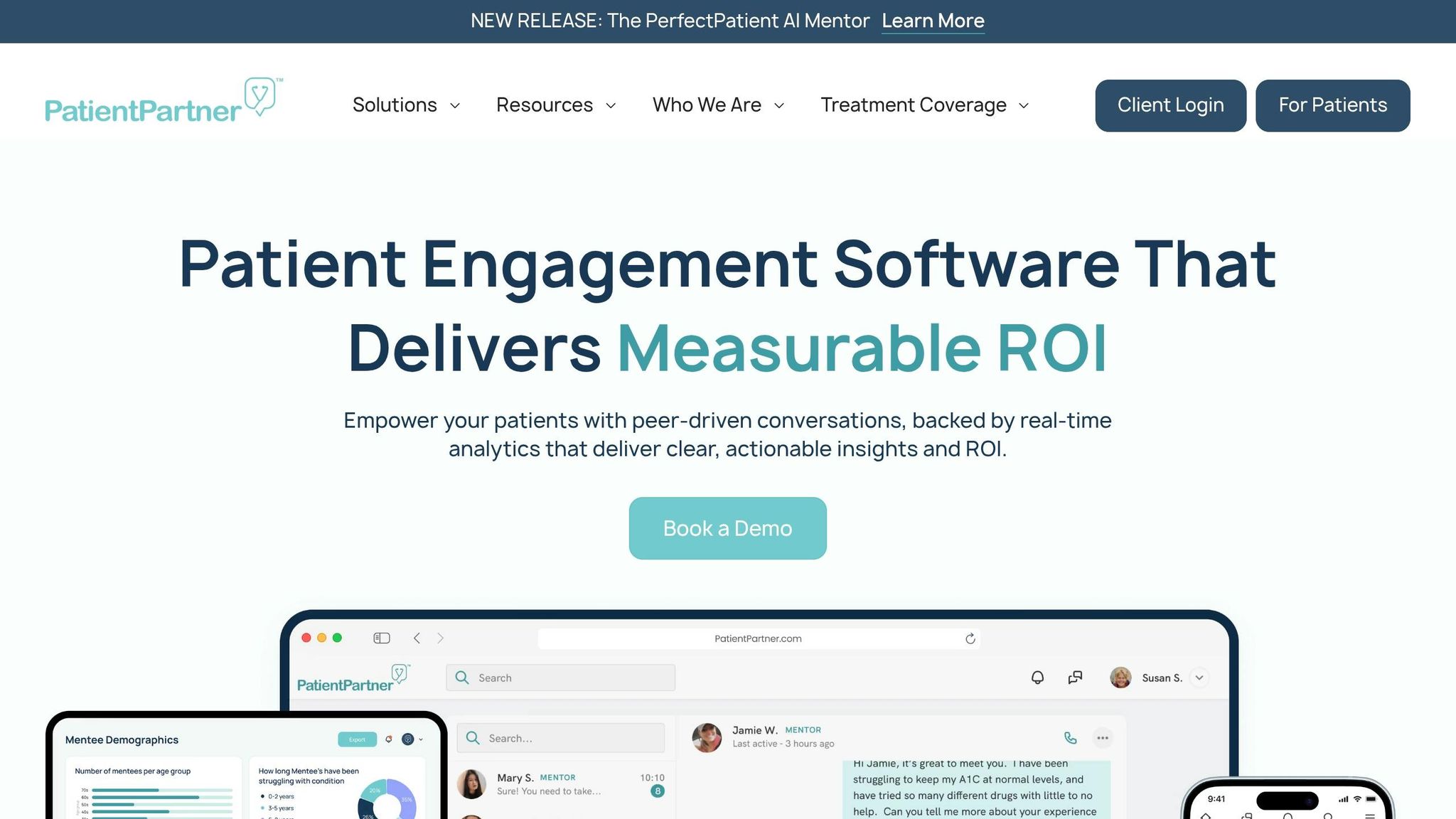
PatientPartner's Algorithm-Driven Matching Platform
Personalized Matching for Better Patient Outcomes
PatientPartner uses AI to connect patients with mentors who have shared similar healthcare journeys. This pairing considers not just health history and demographics but also personal traits like psychological factors and background. By focusing on these deeper connections, the platform addresses individual patient needs in real time.
The system allows patients to quickly connect with mentors, offering peer-to-peer support during challenging moments like preparing for new treatments or surgeries. This immediate access helps ease anxiety and build confidence. Companies using PatientPartner have reported a 30% increase in treatment adoption rates and a 20% boost in patient adherence within just one year. George Kramb, CEO and Co-Founder of PatientPartner, highlights the platform's impact:
Our focus on peer-to-peer connections builds trust and ensures patients feel confident and supported throughout their healthcare journey.
To back these personalized services, the platform operates within a secure and compliant framework that prioritizes patient data protection.
HIPAA-Compliant Infrastructure
Patient data security is at the core of PatientPartner's operations. The platform complies with HIPAA, SOC 2, and ISO 27001 standards, ensuring all interactions meet strict regulatory requirements. Key security measures include end-to-end encryption and role-based access controls, which limit data access to authorized users only. These safeguards protect sensitive patient information while maintaining seamless mentor-patient interactions.
Using Data to Improve Matching
PatientPartner doesn’t stop at initial pairings. The platform uses advanced data analytics to refine its matches over time. By monitoring patient concerns, engagement patterns, and adherence risks, it generates actionable insights that enhance matching accuracy. Additionally, clinical trial participants who successfully complete their treatments can become mentors, creating a feedback loop. Their experiences and data help guide new patients, offering valuable insights to pharmaceutical and med-tech companies for refining engagement strategies.
The platform also integrates with existing systems like CRM, HUB, or internal tools, ensuring patient engagement data is centralized and easy to manage.
Measuring Success and Future Improvements in Matching Algorithms
Key Performance Metrics
Understanding the effectiveness of matching algorithms starts with the right metrics. One crucial measure is early closure rates, which reflect the percentage of prematurely ended matches. For example, the Zing Programme study highlighted how algorithmic matching can significantly lower early closures, emphasizing the role of data-driven strategies in maintaining strong patient-mentor connections.
Other important indicators include participant satisfaction and retention rates. Mentoring programs with structured matching boast satisfaction levels exceeding 90% and higher retention rates compared to those without matched participants. Platforms like PatientPartner go further by tracking goal completion rates, ensuring patients meet specific health milestones set during intake. They also evaluate deep-level similarities - focusing on values, communication styles, and personal preferences - which have shown to predict success more reliably than basic demographic data. These findings are essential for refining algorithms and boosting their effectiveness.
Planned Algorithm Improvements
Advancements in matching algorithms are leaning toward hybrid models that blend AI's efficiency with human oversight. These "human-in-the-loop" systems allow algorithms to generate recommendations that administrators can review and adjust.
Preference-based AI is another area of growth. A great example is "OpalBuddy", developed by Opal Health Informatics Group in March 2025. This digital peer support tool matches cancer patients based on clinical conditions, socio-demographics, and interpersonal affinity. It even considers whether a patient prefers a mentor who is solution-oriented or someone who excels at empathetic listening. Building on feedback from real-world use, these systems are further refined using outcome-based scoring, which evaluates how well matches perform. Some platforms are now utilizing gradient-boosted decision trees to predict match success, achieving AUCs as high as 0.91.
Impact on Patient Outcomes and Industry Growth
The ripple effects of better algorithms are felt in both patient care and business performance. Improved matching leads to measurable benefits: organizations with structured mentoring programs have reported 18% more revenue and 11% higher retention rates. Over a five-year period, a study of 1,000 participants found that mentees were promoted five times more often than those without mentoring.
For pharmaceutical and med-tech companies, these advancements mean improved treatment adherence and better health outcomes for patients. By aligning patients with the right mentors, platforms like PatientPartner not only enhance individual experiences but also contribute to broader industry growth, staying true to their mission of connecting patients with experienced mentors.
Building a GenAI powered mentorship matching tool | Let's Talk About Data
This technology is particularly impactful for personalized peer-to-peer mentorship in the rare disease community.
Conclusion
The move from manual to algorithm-driven patient-mentor matching is reshaping how healthcare organizations provide critical support. With algorithmic systems, early relationship closures drop significantly - down to 10.87% compared to 29.41% in manual matching - while satisfaction rates soar past 90%.
These systems analyze thousands of potential pairings using structured data like goals, values, and communication styles. This level of analysis goes far beyond what human administrators can handle. By eliminating unconscious biases and cutting administrative work from weeks to just minutes, the process becomes faster, more equitable, and highly effective. The result? Better pairings that directly improve patient decision making and care and organizational efficiency.
FAQs
What information do patients and mentors need to provide for matching?
Patients and mentors share information such as demographics, medical history, and health conditions to help ensure a good match. They might also include preferences related to language, cultural background, logistical considerations, and financial factors. Platforms like PatientPartner take this data, along with availability and specific needs, to create personalized mentor-patient pairings. These matches aim to enhance outcomes and encourage adherence by connecting individuals with shared experiences and support requirements.
How do matching algorithms reduce bias in patient-mentor pairings?
Matching algorithms help create fairer connections by automating the pairing process. Instead of relying on subjective judgment, these algorithms consider shared backgrounds and characteristics, leading to more balanced and tailored matches. This approach ensures patients receive connections that truly meet their needs.
How is patient data kept private and HIPAA-compliant during matching?
Patient information remains confidential and compliant with HIPAA regulations through the use of secure platforms specifically designed to meet these standards. These platforms safeguard data by enabling secure interactions and maintaining centralized control, all while adhering to stringent security policies and guidelines.