


NLP in Pharma: Clinical Insights from Text Data
Key Takeaways
Author


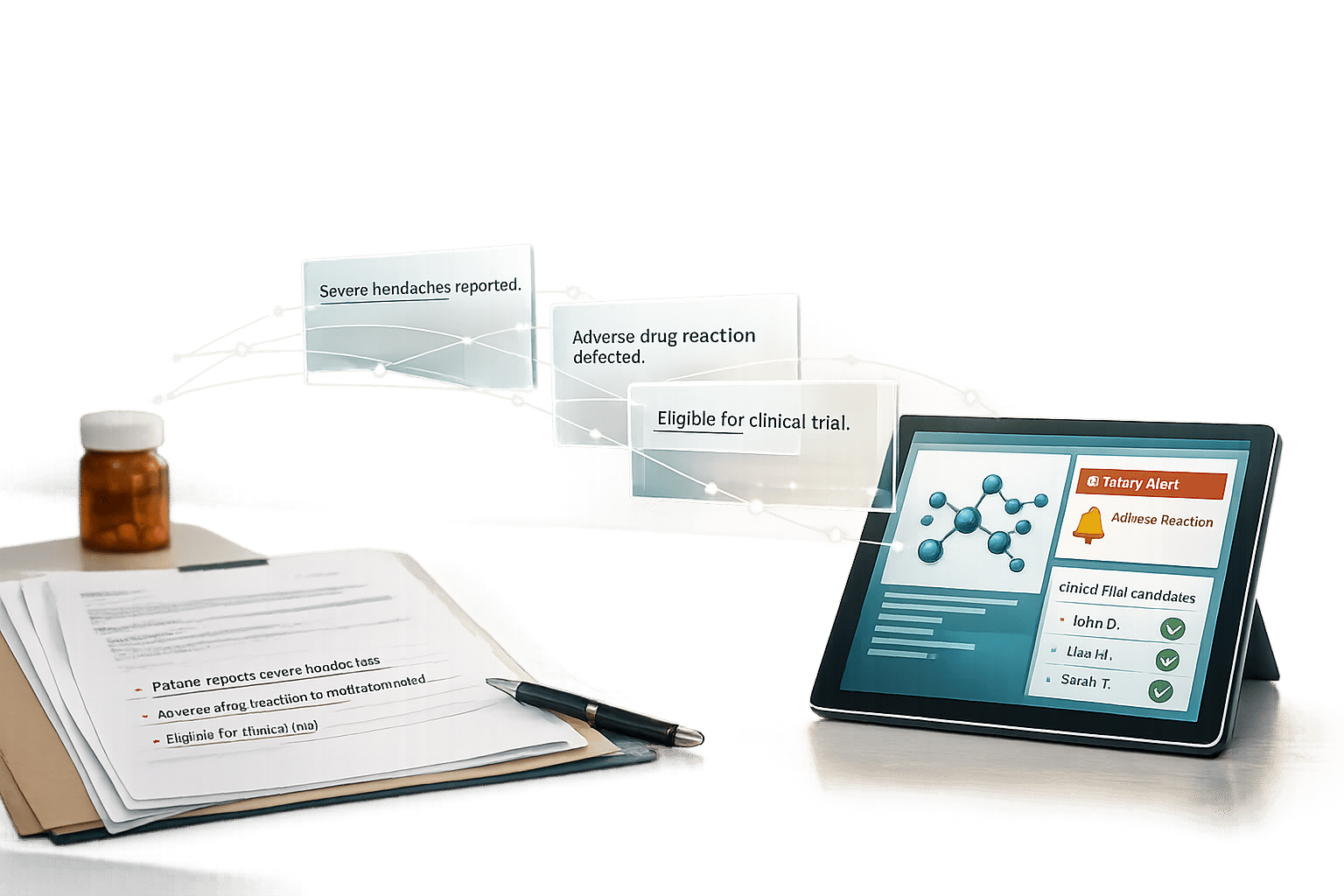
Natural Language Processing (NLP) is transforming the pharmaceutical industry by turning unstructured clinical text - like physician notes, discharge summaries, and patient narratives - into actionable data. Here’s why it matters:
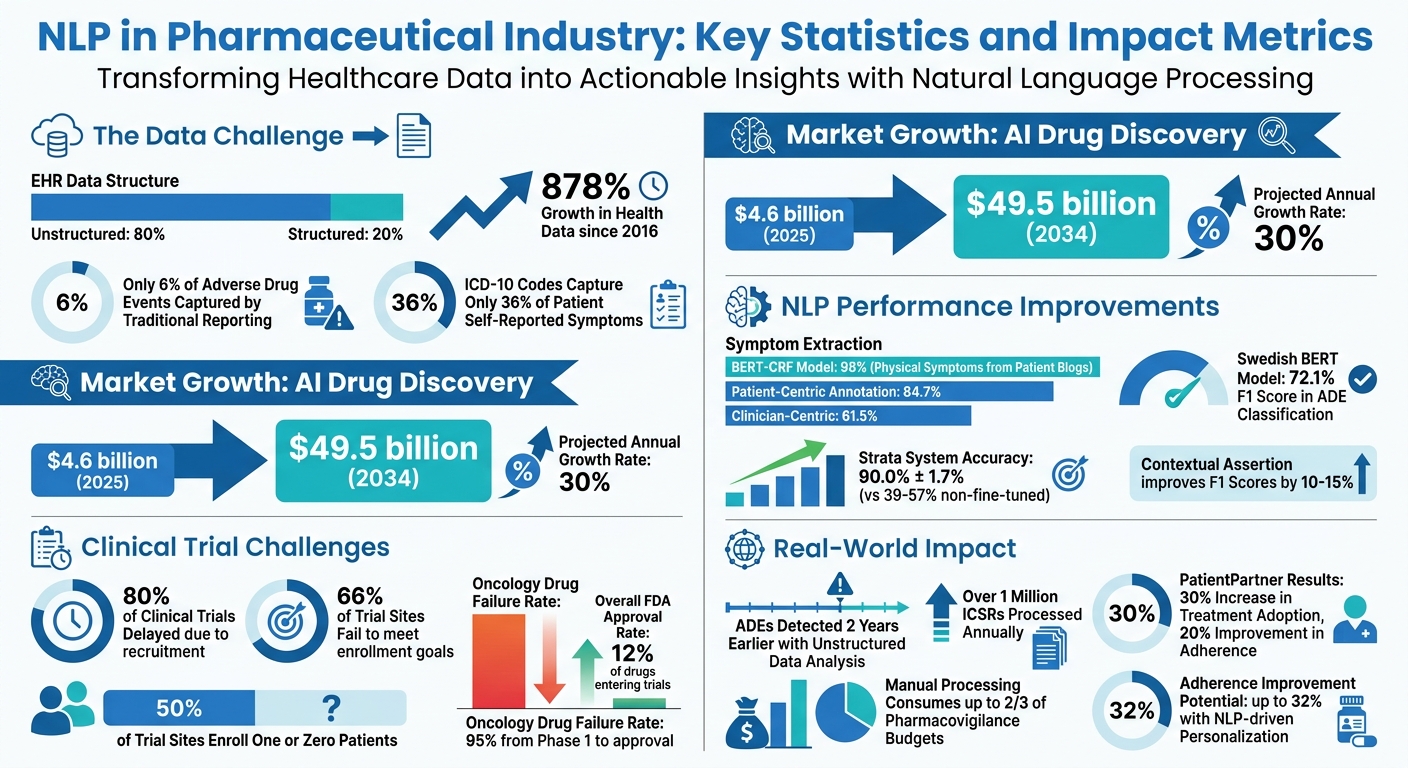
- 80% of EHR data is unstructured and often overlooked, yet it contains critical clinical insights.
- NLP enables faster drug discovery, better safety monitoring, and improved patient engagement strategies by analyzing this data.
- Companies like Pfizer and Bristol-Myers Squibb are already saving thousands of person-hours and improving trial outcomes using NLP.
- Techniques like Named Entity Recognition (NER), negation detection, and sentiment analysis extract meaningful insights from messy text.
- Tools such as Bio_ClinicalBERT and scispaCy are helping to identify symptoms, adverse events, and patient demographics more effectively.
Pharma companies are using NLP to streamline processes, detect adverse drug events earlier, and enhance patient engagement trends through platforms like PatientPartner. The result? Faster insights, improved safety, and better patient outcomes.
NLP in Pharma: Key Statistics and Impact Metrics
Information Extraction of Clinician Notes Using NLP
sbb-itb-8f61039
Core NLP Techniques for Clinical Text Analysis
Clinical text can be messy and inconsistent. Physician notes often include abbreviations like "SOB" for shortness of breath or "hx" for history, along with misspellings and institution-specific jargon. To make sense of this, preprocessing pipelines must handle these variations while retaining the clinical context. From there, specialized NLP techniques extract meaningful, structured insights from these narratives. Let’s explore some of the key methods used to transform unstructured clinical text into actionable data.
Named Entity Recognition (NER)
NER is all about identifying and categorizing specific clinical concepts within free text. This includes medications, diagnoses, procedures, genes, proteins, and even patient demographics. In the pharmaceutical world, NER lays the groundwork for converting clinical notes into structured data that can be analyzed on a large scale.
Tools like scispaCy use pretrained biomedical models to link different terms - like "heart attack" and "MI" - to standardized concepts in the Unified Medical Language System (UMLS). This step is especially important when working across multiple institutions or clinical trial sites, as it ensures consistency in data interpretation.
Here’s an example: Between October and December 2020, researchers at Nakajima Pharmacy in Japan developed a BERT-CRF model trained on 1,054 pharmaceutical care records from 314 patients prescribed anticancer drugs. The model achieved an F1 score above 0.8 and extracted 98% of physical symptoms from external patient blogs on the "Life Palette" platform - a 20% improvement over the MedNER-CR-JA model. Interestingly, ICD-10 codes captured only 36% of patient self-reported symptoms, underscoring the value of NER in capturing comprehensive data from clinical text.
"Advanced NLP techniques are essential for navigating the data-rich Life Sciences landscape." - CapeStart
Negation and Uncertainty Detection
This technique ensures accurate interpretation of clinical text by distinguishing between concepts like "no fever" and "fever." Negation detection identifies when a symptom or condition is absent, while uncertainty detection flags cases where a diagnosis is suspected but not confirmed - like "possible pneumonia".
These methods classify medical concepts into assertion categories such as present, absent, possible, conditional, hypothetical, past, or even associated with someone else (e.g., family history). Misinterpreting a negated symptom can lead to incorrect diagnoses or treatments. By incorporating contextual assertion techniques, models can improve F1 scores by 10–15% compared to standard deep-learning models.
"Accurately detecting these assertions is crucial, as negated or uncertain mentions of medical concepts can significantly impact diagnosis and treatment decisions." - Yigit Gul, John Snow Labs
A practical way to handle this involves using scope windows - limiting the search for negation or uncertainty keywords to a specific number of tokens (usually 2–5) around the medical entity. Delimiters like commas or specific keywords help define boundaries, ensuring the model doesn’t mistakenly apply context across unrelated clauses.
Sentiment and Assertion Analysis
This technique takes things a step further by not only identifying medical concepts but also understanding how patients experience their conditions and treatments. It classifies extracted symptoms as positive, negative, or uncertain, providing a clearer picture of a patient’s actual condition.
Patient-centric annotation (PCA) offers a broader perspective, capturing 84.7% of symptom-related expressions compared to the 61.5% extraction rate of clinician-centric models. This is particularly useful for analyzing patient-generated content, where informal language like "frequent trips to the bathroom" replaces medical terms like "polyuria". By analyzing patient sentiment, NLP bridges the gap between raw text and clinical strategies.
Models like Bio_ClinicalBERT enable deeper analysis by capturing the semantic meaning of narrative text. These embeddings can be combined with structured EHR data for predictive tasks, such as assessing mortality or readmission risks. Additionally, section segmentation - dividing clinical notes into parts like Chief Complaint, History, Assessment, and Plan - allows for targeted analysis within specific contexts.
These techniques form the backbone of how pharmaceutical companies apply NLP in areas like drug discovery, safety monitoring, and improving patient engagement.
How Pharma Companies Use NLP
Pharmaceutical companies handle an overwhelming number of documents every year - research papers, clinical trial reports, patient safety records, and electronic health records. To manage this massive volume of unstructured text, many are turning to NLP (Natural Language Processing) to extract meaningful insights. By doing so, they can enhance drug development, monitor safety more effectively, and streamline patient recruitment processes. The AI drug discovery market, for instance, is expected to grow from $4.6 billion in 2025 to $49.5 billion by 2034, with a projected 30% annual growth rate. Add to this the staggering 878% growth in health data since 2016, and it’s clear that manual analysis is no longer a viable option. Let’s explore how NLP is reshaping drug discovery, safety monitoring, and patient recruitment.
Drug Discovery and R&D
NLP is speeding up drug development by mining vast amounts of literature, patents, and clinical reports to uncover potential drug targets and predict synthesis pathways. Researchers use it to sift through thousands of studies, identifying biological pathways and mechanisms that might otherwise take years to discover.
For example, synthetic chemistry is now being approached as a sequence-to-sequence translation problem, using SMILES strings to predict synthesis pathways. In April 2024, Purdue University researchers, led by Associate Professor Gaurav Chopra, introduced SCINET (Scientific Communication Interaction NETwork). This AI-driven system allows scientists to design drugs for specific targets and plan molecule synthesis using natural language. SCINET even identifies lab resources and automates experiment workflows.
"The agent manager is like ChatGPT for the lab, and it works with the individual agents for each instrument or for domain-specific knowledge."
- Gaurav Chopra, Associate Professor, Purdue University
Despite these advancements, drug development remains risky. For example, oncology drugs face a 95% failure rate from Phase 1 trials to approval, and only about 12% of drugs that enter clinical trials ultimately receive FDA approval. NLP helps mitigate these risks by structuring pre-clinical data, improving disease modeling, and enabling better-informed decisions.
Pharmacovigilance and Safety Monitoring
Ensuring patient safety and meeting regulatory standards requires pharmaceutical companies to detect adverse drug events (ADEs) quickly. Each year, they review over a million Individual Case Safety Reports (ICSRs), with manual processing consuming up to two-thirds of pharmacovigilance budgets. NLP streamlines this process by extracting structured data - such as patient details, drug names, dosages, and reactions - from unstructured sources like narrative case reports, electronic health records, and scientific articles.
The challenge is immense: fewer than 5% of ADEs are reported through official channels. Most are hidden in free-text formats like emails, social media, and clinical notes. NLP scans these unconventional data sources to flag serious cases for human review. Machine learning classifiers further prioritize events like hospitalizations or fatalities.
In January 2021, the French Health Authority rolled out an AI tool using TF-IDF and LightGBM models to automate the identification and coding of adverse drug reactions in patient reports. This system achieved an AUC (area-under-the-ROC-curve) of 0.97 and was particularly effective in monitoring COVID-19 vaccine safety. Similarly, Pfizer piloted three NLP/ML systems to extract critical elements from ICSR documents. The best-performing system achieved a composite F1-score of 0.74, proving AI’s viability in supporting pharmacovigilance workflows.
During a clinical trial for the IDH1-inhibitor AG120, Agios deployed NLP to identify differentiation syndrome (DS), a rare and life-threatening condition. By clustering MedDRA terms linked to DS, the system helped clinicians identify at-risk patients in near-real time by analyzing co-occurring symptoms.
"AI should augment, not substitute, human experts in pharmacovigilance."
- Indian Pharmacovigilance Review
Patient Cohort Identification
NLP is also transforming how patients are matched to clinical trials, addressing a major bottleneck in drug development. Recruitment challenges delay 80% of clinical trials, with over 66% of trial sites failing to meet enrollment goals. Shockingly, half of all trial sites enroll only one or no patients. NLP tackles these issues by converting unstructured text from electronic health records, clinical notes, and patient narratives into structured data that identifies specific patient profiles.
Claims data often misses critical details about a patient’s journey. NLP fills in these gaps by extracting complex criteria like genomic variants, family history, social determinants of health, and specific tumor characteristics. Knowledge graphs further enhance this process by mapping relationships between symptoms, medications (using RxNorm codes), and patient histories, making it easier to query for cohorts like "patients with diabetes and chest pain".
For instance, Bristol-Myers Squibb (BMS) researchers applied NLP to analyze electronic medical records and imaging data from 900 heart failure patients. They extracted 40 elements, including demographics and clinical phenotypes, successfully stratifying the population into four distinct groups with varying mortality rates over one and two years.
NLP also optimizes trial protocols by testing inclusion and exclusion criteria against real-world datasets. This helps researchers predict patient eligibility and avoid recruitment delays before trials even begin. Additionally, NLP aids in site selection by pinpointing locations with the highest concentration of eligible patients, reducing the risk of under-enrollment.
These applications highlight how NLP bridges complex data with actionable insights, improving clinical practices and patient care. It’s a powerful tool that continues to shape the future of healthcare innovation.
NLP Results in Clinical Practice
Natural Language Processing (NLP) transforms unstructured clinical text into valuable insights, improving safety monitoring and decision-making in healthcare. Over 80% of patient information in electronic health records (EHRs) exists in unstructured formats like physician notes, discharge summaries, and nursing records, which are often overlooked. By extracting insights from this data, NLP enhances both safety protocols and clinical decision-making. The following case studies highlight how these advancements lead to earlier and more accurate detection of adverse events.
ADE Detection Case Studies
Traditional adverse event reporting systems capture only about 6% of all adverse drug events (ADEs). Many ADEs remain hidden within unstructured clinical text. NLP addresses this issue by analyzing unstructured data to detect safety signals up to two years earlier than traditional methods.
"Adverse events can be detected 2 years earlier with unstructured data."
- Lependu et al.
For instance, a 2024 study conducted in a Japanese hospital applied NLP to the EHRs of 44,502 cancer patients treated with drugs like platinum, taxane, and pyrimidine. The system flagged high-risk signals for adverse events that standard blood tests couldn't detect, such as taste abnormalities (Hazard Ratio: 4.71) and oral mucositis (Hazard Ratio: 3.85). These findings aligned with known drug risks, demonstrating that NLP can provide reliable early warnings.
In December 2023, the Swedish Medical Products Agency implemented a Swedish BERT-based NLP model to process 19,000 suspected adverse drug reaction reports. The model achieved a 72.1% F1 score, performing nearly as well as human evaluators in distinguishing serious from non-serious cases based solely on free-text narratives. This automation allowed pharmacovigilance teams to concentrate on the most critical cases.
Converting Clinical Notes to Data
NLP goes beyond adverse event detection by converting clinical narratives into structured data for deeper analysis. Clinical notes often contain abbreviations, typos, medical jargon, and informal language that traditional coding systems can't interpret. For example, one study found that ICD-10 codes captured only 36% of self-reported symptoms, whereas free-text extraction provided a much fuller picture. NLP bridges this gap by transforming narrative text into structured datasets suitable for large-scale analysis.
In 2025, researchers using the Strata system fine-tuned Llama-3 8B models on just 100 to 400 annotated pathology reports. This approach achieved an exact-match accuracy of 90.0% ± 1.7%, comparable to a second human annotator. In contrast, non-fine-tuned medical models achieved only 39% to 57% accuracy. This shows that even with limited training data, the right NLP architecture can deliver clinically reliable results.
"Unstructured text from EHRs could enrich pharmacovigilance programmes that have traditionally relied on other data sources."
- Drug Safety
NLP also excels at interpreting symptoms described in everyday language. For instance, patients might describe neuropathy as "tingling in my fingers" or nausea as "feeling queasy after meals." A BERT-CRF model fine-tuned on patient-centered narratives was able to extract over 98% of physical symptom entries from patient-generated blogs, capturing nuances that formal medical terminology often misses.
These advancements in converting text to data not only improve pharmacovigilance but also support more informed clinical decisions, ultimately contributing to better patient care and outcomes.
Using NLP Insights with PatientPartner
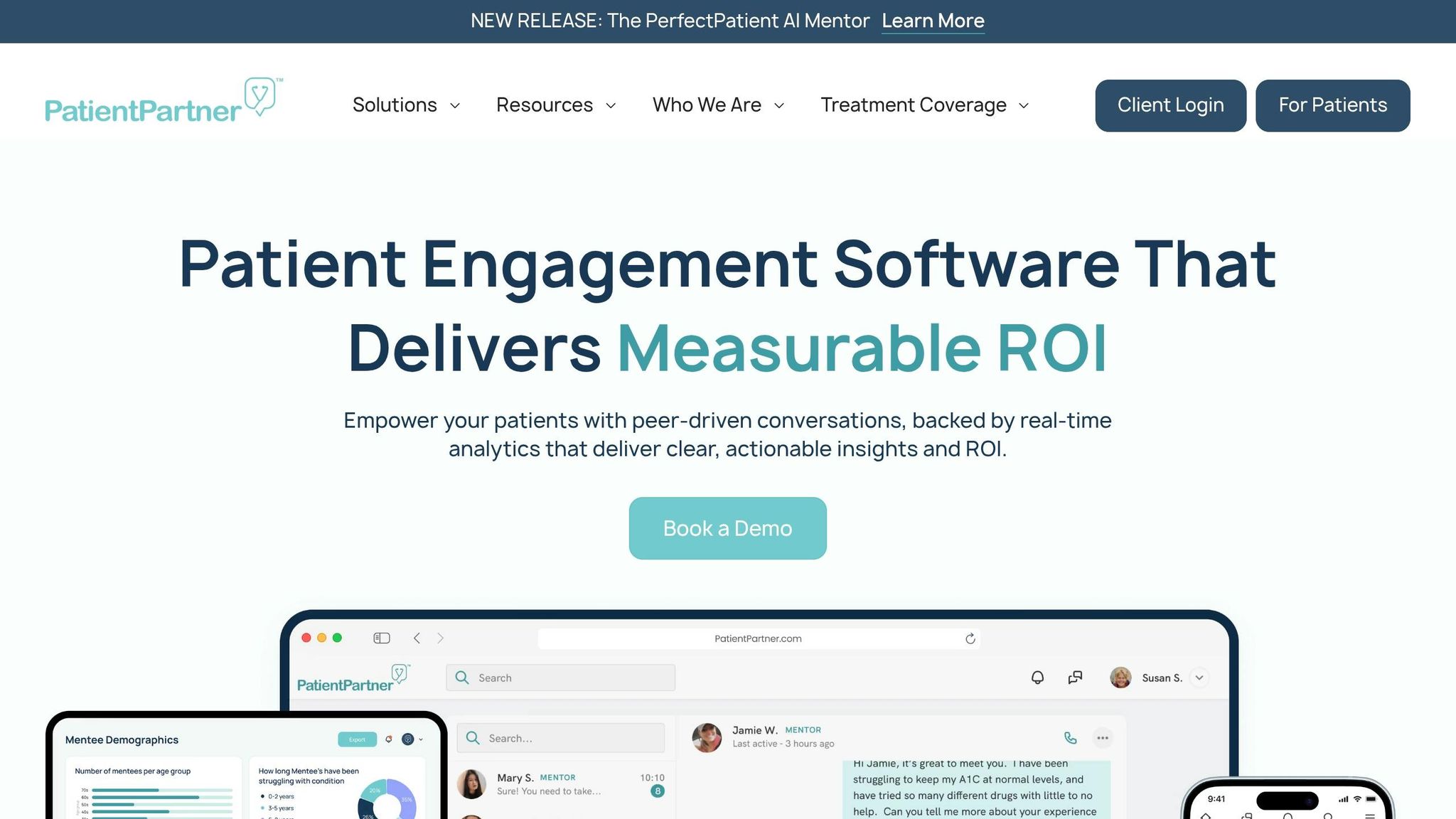
PatientPartner takes clinical insights and uses them to turn unstructured text into tailored patient support. By leveraging NLP (Natural Language Processing), it connects data analysis to patient care, creating a platform where insights from text analysis directly address the challenges patients face with starting or sticking to treatments. This approach transforms raw data into actionable guidance, helping patients overcome barriers to better health outcomes.
Personalized Patient Mentorship
PatientPartner dives deep into mentor–patient conversations, using NLP to analyze text data and uncover patient experiences, concerns, and expectations. This isn't just about surface-level feedback - it’s about identifying the subtle fears or uncertainties that patients might not openly express. By extracting sentiment insights, the platform pinpoints risks to adherence, trends in engagement, and specific patient worries.
To make these connections even more impactful, the system matches patients with mentors who share similar health histories, demographics, and psychological profiles. This shared experience builds trust and relatability. As George Kramb explains:
"PatientPartner is a mentor-driven patient engagement platform that connects patients with relatable mentors who have undergone similar healthcare journeys. Unlike traditional platforms focused on static content or generalized support, PatientPartner delivers real-time, personalized engagement that drives measurable results in patient recruitment, adherence, and satisfaction."
PatientPartner also prioritizes data security, adhering to HIPAA, SOC 2, and ISO 27001 standards to ensure that sensitive patient information and NLP-derived insights are handled securely.
This personalized mentorship model helps patients feel supported, leading to better adherence and smoother transitions into treatment.
Supporting Patient Adherence and Treatment Starts
Using NLP, PatientPartner can predict and address potential treatment abandonment by identifying patient concerns early. By integrating with CRM and HUB systems, the platform provides real-time updates on patient sentiment and treatment progress. This allows healthcare teams to step in at critical moments, offering timely interventions and support. It’s a clear example of how NLP can go beyond data analysis to drive meaningful patient engagement.
The results speak for themselves. Pharmaceutical partners have reported a 30% increase in treatment adoption and a 20% improvement in adherence within the first year. These outcomes are a direct result of the platform's ability to offer personalized, ongoing support tailored to each patient’s needs.
Brad A. from Mainstay Medical highlighted the platform's influence:
"Patient Partner has been influential in helping patients understand the benefits of our product."
Melissa B. from Sobi Pharmaceuticals also shared her perspective:
"Patient Partner is a unicorn in the industry. They are undoubtedly dedicated to the mission of positively impacting patients lives."
What’s more, the platform’s Treatment Ecosystem ensures that successful participants can become mentors themselves, creating a continuous loop of peer-to-peer support. Insights from these mentor interactions are then used to refine educational materials and improve recruitment strategies, making the entire process more effective over time.
Conclusion
Natural Language Processing (NLP) is reshaping pharmaceutical operations by turning vast amounts of unstructured healthcare data into actionable clinical insights. This shift minimizes the need for labor-intensive manual reviews, speeds up patient recruitment for clinical trials, and enables near-real-time pharmacovigilance. For instance, Bristol-Myers Squibb used NLP to effectively stratify heart failure patients, improving trial design. This evolution not only enhances the efficiency of clinical trial processes but also lays the groundwork for a more patient-focused approach in the pharmaceutical industry.
NLP's impact goes beyond operational improvements. It captures the "voice of the patient" from sources like calls, chats, and social media. By identifying real-world challenges - such as confusion around prior authorizations - NLP enables personalized solutions that can increase adherence rates by as much as 32%.
These insights are driving meaningful changes in patient outcomes. A great example is PatientPartner, which uses NLP to analyze mentor-patient conversations. By identifying subtle concerns and uncertainties, the platform matches patients with mentors who share similar health experiences. This approach has led to better treatment adoption and adherence for pharmaceutical partners.
As advanced models like BERT continue to refine these insights, they are being integrated with human interaction to enhance patient engagement. Michael Armstrong, Chief Technology Officer at Authenticx, highlights this gap in care strategies:
"What's missing from many care strategies today is the actual voice of the patient".
NLP not only transforms clinical processes by making sense of unstructured data but also strengthens patient engagement through personalized mentorship. By combining data-driven insights with human connection, these platforms are setting a new benchmark for improving patient engagement and clinical outcomes in the pharmaceutical world.
FAQs
What’s the fastest way to turn messy clinical notes into usable data?
The fastest way to turn disorganized clinical notes into structured, usable data is through Natural Language Processing (NLP). By automating the extraction, categorization, and organization of unstructured text - like clinical notes - NLP converts it into standardized formats. This not only saves time but also delivers insights that pharmaceutical companies can use to analyze large datasets more effectively, make informed decisions, and improve patient care.
How do NLP models handle negated or uncertain symptoms?
Natural Language Processing (NLP) models handle negated or uncertain symptoms through sophisticated assertion detection methods. These techniques help determine the status of medical facts - whether they are negated, uncertain, or hypothetical. By doing so, these models ensure that clinical data is interpreted and attributed correctly. This precision minimizes errors and boosts the dependability of the insights extracted from text.
How can NLP insights improve patient adherence and treatment starts with PatientPartner?
Natural Language Processing (NLP) offers valuable insights into patient behavior by analyzing unstructured clinical text. This helps identify patient needs and challenges, paving the way for personalized support. For instance, tools like PatientPartner provide real-time mentorship, encouraging stronger engagement, sustained adherence to treatment plans, and better overall health outcomes.