


HIPAA Encryption Standards for Healthcare APIs

Key Takeaways
Author


Encryption is a key requirement for protecting healthcare data under HIPAA. Here's what you need to know:
- HIPAA mandates encryption to safeguard electronic protected health information (ePHI) during transmission and storage.
- TLS 1.3 is recommended for secure data transfer, while AES-256 is the standard for encrypting stored data.
- A 2025 rule proposal aims to make encryption mandatory for all ePHI systems by mid-2026.
- Key management is critical - use tools like HSMs and KMS to securely handle encryption keys.
- Breaches are costly: Healthcare data breaches average $10.93M per incident. Proper encryption can exempt organizations from breach notifications.
Encryption ensures confidentiality, data integrity, and access control. It’s not just about compliance - it minimizes risks and financial losses tied to security breaches.
Empowering Healthcare with Google Cloud APIs and HIPAA Compliance
sbb-itb-8f61039
Encryption in Transit: Protecting Data During Transmission
When electronic protected health information (ePHI) is transferred between systems, it becomes vulnerable to interception. Encryption in transit ensures that even if transmissions are intercepted, the data remains unreadable.
A proposed rule from January 2025 requires the encryption of ePHI during transit, with final regulations anticipated by mid-2026. This change underscores the importance of robust Transport Layer Security (TLS) configurations.
Transport Layer Security (TLS) 1.2 and 1.3
HIPAA requires TLS 1.2 or newer to safeguard data in transit. By 2026, TLS 1.3 is recommended due to its stronger security features and better performance. TLS 1.3 eliminates weak ciphers, speeds up the handshake process, and provides better protection against downgrade attacks. Older protocols like SSL, TLS 1.0, and TLS 1.1 must be disabled as they contain vulnerabilities that fail to meet HIPAA standards.
Proper configuration of cipher suites is just as critical. Using cipher suites that support Perfect Forward Secrecy (PFS) ensures that even if an encryption key is compromised, past communications remain secure. For TLS 1.3, suggested ciphers include TLS_AES_256_GCM_SHA384 and TLS_CHACHA20_POLY1305_SHA256. Additionally, enabling HTTP Strict Transport Security (HSTS) prevents downgrade attacks and ensures all communication occurs over HTTPS.
| Protocol | HIPAA Status | Security Features |
|---|---|---|
| TLS 1.3 | Recommended | Stronger defaults, faster handshakes, eliminates weak cipher suites |
| TLS 1.2 | Acceptable | Requires disabling weak ciphers and enforcing PFS |
| TLS 1.1/1.0 | Non-Compliant | Vulnerable to attacks; must be completely disabled |
Mutual TLS (mTLS)
Mutual TLS (mTLS) builds on standard TLS by adding client authentication. While traditional TLS verifies only the server (e.g., confirming your browser is connecting to a legitimate healthcare provider), mTLS requires both the client and server to present and validate digital certificates.
According to AccountableHQ, "For service-to-service calls, consider mutual TLS to strongly authenticate clients and prevent token theft on the wire".
This two-way authentication is particularly useful for backend integrations and partner system connections. Without the necessary certificate, intercepted tokens become unusable.
Healthcare organizations are increasingly using mTLS for internal service-to-service communication within service meshes, rather than relying only on encryption for external API interfaces. For systems handling sensitive PHI or involving third-party partners, mTLS provides an added layer of identity verification, enhancing HIPAA compliance.
To avoid vulnerabilities, automate TLS certificate management, including issuance, rotation, and revocation. Manually managing certificates can lead to issues like expired or mismatched certificates. Additionally, using cryptographic libraries validated under FIPS 140-2 or FIPS 140-3 ensures that encryption algorithms meet federal security standards.
Encryption at Rest: Securing Stored ePHI
While encryption in transit protects data as it moves, encryption at rest ensures the safety of ePHI stored in databases, file systems, cloud environments, backups, and message queues within healthcare settings. This process converts plain data into ciphertext, rendering it unreadable even if storage systems are breached.
The HIPAA Security Rule (45 CFR § 164.312(e)) categorizes encryption as an "addressable" safeguard. This means that organizations must implement it if deemed reasonable and appropriate based on their risk assessments. The importance of this measure is underscored by the staggering numbers: in 2023 alone, the HHS Breach Portal recorded over 133 million exposed records due to hacking and unauthorized access. Healthcare data breaches are particularly costly, averaging $10 million per incident, with per-record expenses far exceeding those in other industries.
Encryption also offers a compliance advantage. Properly encrypted ePHI that is lost or stolen may not trigger breach notification requirements, saving organizations from potential legal and reputational fallout. As Gil Vidals, Founder and CEO of HIPAA Vault, explains:
"Encryption significantly reduces the probability of unauthorized disclosure, making it a preferred safeguard when storing or transmitting PHI".
To meet these needs, robust encryption methods like AES-256 are commonly used to secure stored ePHI.
Advanced Encryption Standard (AES-256)
AES-256, endorsed by NIST in Special Publication 800-111, is the go-to encryption standard for safeguarding ePHI at rest. It employs 256-bit encryption keys, offering strong protection and wide compatibility with databases, cloud storage, and backup systems.
Encryption can be applied at different levels depending on your infrastructure:
- Transparent Data Encryption (TDE): Automatically encrypts entire database files and backups at the database level.
- Field-level encryption: Focuses on encrypting specific sensitive data fields, such as Social Security numbers or birth dates, at the application layer.
- Full-disk encryption: Secures all data on a physical drive, protecting against hardware theft at the operating system or hardware level.
Modern NoSQL databases, like MongoDB Enterprise, support at-rest encryption using AES-256 through the WiredTiger engine. Regardless of the method, encryption keys should never be stored in the same environment as the encrypted database. Instead, keys should be kept in a dedicated Hardware Security Module (HSM) or a cloud-based Key Management Service (KMS).
It's also crucial to include secondary data stores in your encryption strategy. Backups, replication snapshots, and message queues often contain ePHI and require the same level of security.
Encryption Modes: Galois/Counter Mode (GCM) and XTS
Choosing the right encryption mode is just as important as selecting the algorithm. Galois/Counter Mode (GCM) is a preferred choice for securing data at rest because it provides both confidentiality and integrity. AES-GCM not only encrypts the data but also generates an authentication tag to ensure the data hasn't been altered. This dual layer of protection is especially critical for healthcare APIs, where maintaining both privacy and integrity is essential, following API integration best practices.
"HIPAA does not mandate specific algorithms; it requires appropriate encryption based on risk. In practice, use... AES-GCM (128- or 256-bit) for data at rest." - Kevin Henry, HIPAA Specialist, Accountable
For full-disk encryption, XTS mode (XEX-based tweaked-codebook mode with ciphertext stealing) is often used. It encrypts data in fixed-size blocks, making it ideal for storage devices. However, for database and application-level encryption, AES-GCM remains the preferred option.
Envelope encryption is another effective method for protecting ePHI. This involves encrypting the data encryption key (DEK) with a master key stored in a KMS or HSM. This technique is particularly useful for databases, object storage like Amazon S3, and message queues.
Finally, using FIPS 140-2 or FIPS 140-3 validated cryptographic modules ensures that your encryption meets federal security standards. These validations confirm that the cryptographic modules have been rigorously tested and certified, providing additional assurance for HIPAA compliance and audits.
Key Management: Best Practices for Encryption Keys
Even the most advanced encryption algorithms can fail if the keys protecting them are mishandled. For healthcare APIs managing electronic protected health information (ePHI), effective key management is essential for maintaining a strong security framework. Without secure key management, encryption becomes like a lock with no control over who holds the keys.
The HIPAA Security Rule outlines specific technical safeguards for handling keys, such as access control (§164.312(a)) and transmission security (§164.312(e)). This means keys should never be hardcoded into source code or stored in plain environment variables. Instead, a secure centralized system should oversee the entire key lifecycle: generation, usage, rotation, and destruction.
Hardware Security Modules (HSMs) and Key Management Services (KMS)
Hardware Security Modules (HSMs) and Key Management Services (KMS) are critical tools for protecting encryption keys. HSMs are physical devices designed to perform cryptographic operations in a secure, isolated environment, ensuring keys are never exposed in plaintext. KMS solutions, on the other hand, streamline key lifecycle management, covering everything from secure generation using strong entropy sources to rotation and eventual destruction.
Both HSMs and KMS enforce strict role-based access control (RBAC), limiting cryptographic operations to authorized personnel or services. They also maintain detailed audit logs, which track who accessed a key, when, and for what purpose - an essential feature for meeting HIPAA compliance requirements.
For healthcare APIs, it’s crucial to use cryptographic modules validated under FIPS standards. Specifically, all modules must transition to FIPS 140-3 by September 22, 2026, as FIPS 140-2 certifications will no longer be valid for new deployments after this date.
When choosing a KMS solution, consider how well it aligns with your infrastructure and operational needs. Here’s a quick comparison of popular options:
| Solution | Strengths | Weaknesses |
|---|---|---|
| Azure Key Vault | Integrates well with Azure, supports RBAC, and includes built-in encryption | Can have high latency for frequent access, manual rotation for certain key types, and a complex RBAC setup |
| AWS Secrets Manager | Offers multi-region support and automatic key rotation | Higher costs and reliance on the AWS ecosystem |
| HashiCorp Vault | Provides high security, dynamic secrets, and works across vendors | Requires a complex setup and has a steep learning curve |
| ByteHide Secrets | Features low-latency key retrieval, real-time audit logging, and multi-cloud support | Relatively new compared to major cloud providers |
Envelope encryption is another essential practice in key management. It ensures that even if a database is breached, attackers cannot decrypt the data without access to the master key stored securely in a vault.
To strengthen security, assign distinct roles for key generation, rotation, usage, and deletion. Implement dual control measures for sensitive key material to prevent unauthorized changes. These steps are vital for maintaining a secure key lifecycle.
Key Rotation and Expiration Policies
Secure key storage is just the start - regular rotation is necessary to reduce exposure risks. While HIPAA and NIST don’t mandate a fixed schedule for key rotation, they emphasize the importance of defining and adhering to a cryptoperiod. As the CMS Information Security and Privacy Program explains:
"Shared secrets, such as encryption keys and single-factor or shared passwords, should be periodically rotated to minimize the risk of unauthorized access."
- CMS Information Security and Privacy Program
A compromised key remains a threat until it’s rotated. In 2023 alone, healthcare data breaches in the U.S. exposed over 133 million records. Regular key rotation helps limit the damage caused by such incidents.
Develop a formal Key Management Plan (KMP) that specifies cryptoperiods for different key types and review it annually. Keys should also be rotated immediately after major events, such as emergency access or a detected security issue.
To reduce the risk of human error, automate the rotation process using your KMS. Most modern KMS solutions - like Azure Key Vault, AWS Secrets Manager, or ByteHide - offer automated key rotation capabilities.
Lastly, ensure your application code never reads plaintext keys, and securely erase memory buffers holding decrypted data after use. Keys should follow the four phases outlined in NIST SP 800-57: Pre-operational (generation), Operational (active use), Post-operational (inactive but accessible for decrypting old data), and Destroyed. Proper lifecycle management ensures that keys are archived when necessary and permanently destroyed after their cryptoperiod ends.
Compliance Checklist for Healthcare API Encryption

HIPAA Encryption Standards Compliance Checklist for Healthcare APIs
Meeting HIPAA standards goes beyond simply implementing encryption - it requires a comprehensive approach to security and regular assessments to ensure compliance. With 76% of healthcare organizations citing security compliance as their primary concern when using APIs, a systematic verification process is critical.
Since HIPAA doesn't provide a formal "certification" process, organizations must conduct periodic technical evaluations to align their security measures with NIST recommendations. This involves auditing cryptographic libraries, ensuring API gateways use strong cipher suites, and managing encryption keys throughout their lifecycle.
FIPS-Validated Modules and Cipher Suite Configurations
Every cryptographic library and SDK used in your API must be FIPS-validated. This step ensures your encryption modules meet federal security standards through rigorous testing. Start by reviewing all libraries your team uses, such as OpenSSL or cloud provider SDKs, and confirm their FIPS validation status.
For secure communication, modern healthcare APIs should implement TLS 1.2 at a minimum, though TLS 1.3 is preferred for newer systems. Opt for cipher suites that support perfect forward secrecy, which protects past communications even if a private key is compromised.
Additionally, enforce mutual TLS (mTLS) for service-to-service communication. Centralizing security controls at the API gateway ensures consistent enforcement of policies across all endpoints, simplifying compliance checks.
Once these gateway configurations are in place, focus on protecting sensitive data at both the field and storage levels.
Field-Level and Envelope Encryption
While standard database encryption secures data at rest, field-level encryption adds an extra layer of protection for high-risk identifiers like Social Security numbers, medical record numbers, or patient names. By encrypting these fields individually before storing them, you ensure that even if an attacker gains access to the database, the most sensitive information remains unreadable.
Envelope encryption simplifies key management for large-scale systems. This approach uses a two-tier key hierarchy: data is encrypted with a Data Encryption Key (DEK), which is then encrypted by a Key Encryption Key (KEK) stored in a hardware security module (HSM) or key management service (KMS). Rotating the KEK becomes more efficient since only the DEKs need to be re-encrypted. As AccountableHQ advises:
"Apply field-level encryption to high-risk identifiers and documents".
Encrypt all secondary storage systems, such as backups, snapshots, and message queues. Use schema validation at the API gateway to prevent PHI from being inadvertently logged or indexed in an unencrypted format. Role-Based Access Control (RBAC) should restrict key access to authorized services only, and tamper-evident audit logs should track every key access event.
The following checklist outlines key compliance measures:
| Checklist Item | Requirement | HIPAA Safeguard Category |
|---|---|---|
| Field-Level Encryption | Encrypt high-risk identifiers (e.g., SSN, Name) individually | Technical Safeguard |
| Envelope Encryption | Use DEK/KEK hierarchy managed via HSM/KMS | Technical Safeguard |
| FIPS Validation | Use only FIPS-validated cryptographic modules | Technical Safeguard |
| Key Rotation | Automate rotation for API keys and encryption keys | Administrative/Technical |
| Audit Controls | Log all access to encryption keys with immutable timestamps | Audit Control |
| Transmission Security | Use TLS 1.2/1.3 with strong cipher suites and mTLS | Transmission Security |
Finally, HIPAA’s Privacy Rule requires every API endpoint to adhere to the "minimum necessary" standard. This means exposing only the data essential for each request. Your API design and encryption strategy should reflect this principle, ensuring that even decrypted data is limited to what's absolutely needed.
How PatientPartner Supports HIPAA-Compliant Encryption
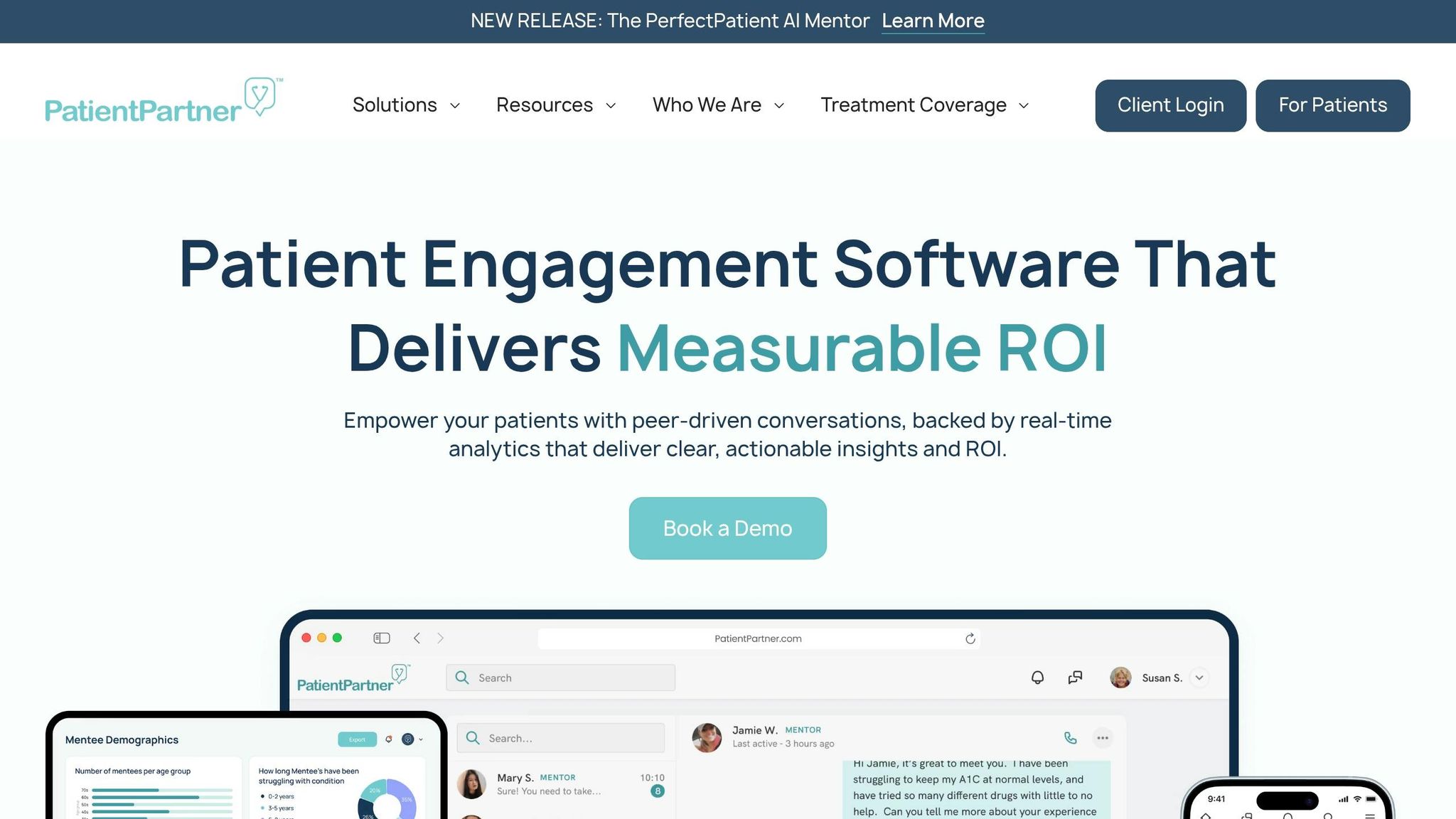
PatientPartner's Compliance-Ready API Infrastructure
PatientPartner takes healthcare data security seriously, applying top-tier encryption standards to its API infrastructure. The platform uses TLS 1.3 with ECDHE to ensure Perfect Forward Secrecy and employs mTLS (mutual TLS) for secure communication between services. These measures safeguard sensitive patient data during transmission.
When it comes to data storage, PatientPartner encrypts patient health information using AES-256 in Galois/Counter Mode (GCM). To enhance security further, it leverages envelope encryption managed by a Key Management Service (KMS). The data encryption keys themselves are encrypted by master keys stored in hardware security modules, adding an extra layer of protection. Additionally, high-risk identifiers like medical record numbers are secured with field-level encryption, reducing exposure even in the unlikely event of a breach.
A centralized API gateway serves as a critical checkpoint, handling TLS termination, validating JWTs (JSON Web Tokens), and enforcing schema controls before any backend processing occurs. This setup ensures that sensitive information, such as Protected Health Information (PHI), is never logged in plaintext. Role-Based Access Control (RBAC) is applied across all endpoints, ensuring that users only access the data they are authorized to see. Automated certificate management also plays a vital role by issuing and rotating TLS certificates, minimizing the risk of service disruptions caused by expired credentials. Together, these measures create a robust encryption framework that aligns with HIPAA standards.
Balancing Patient Engagement with Data Security
PatientPartner doesn’t just prioritize security - it also ensures that patients can engage with the platform easily and securely. By using OAuth 2.0 and OpenID Connect (OIDC), the platform provides secure, credential-free access that balances convenience with strong protection. The "Privacy by Design" approach ensures that API responses only include the minimum data necessary for specific interactions, adhering closely to HIPAA's "minimum necessary" rule.
Despite the multiple security layers, the platform maintains high performance. TLS 1.3 improves connection speeds with faster handshakes compared to older protocols. Meanwhile, the API gateway employs token bucket rate limiting to handle traffic spikes, ensuring uninterrupted access for legitimate users. This thoughtful design enables pharmaceutical and med-tech companies to deliver effective patient mentorship programs without compromising on stringent data protection requirements.
Conclusion
The encryption strategies and compliance measures discussed earlier are becoming even more critical as new regulations take shape. The January 2025 Notice of Proposed Rulemaking (NPRM) emphasizes this by mandating HIPAA-compliant encryption for all systems managing electronic protected health information (ePHI) by mid-2026. This shifts encryption from being an "addressable" option to a non-negotiable requirement.
Recent incidents, such as a significant ransomware attack in 2024, have underscored the dangers of insufficient security. Breaches tied to API vulnerabilities have become alarmingly costly, with average damages exceeding $10 million. Enforcement actions in 2025 levied penalties ranging from $25,000 to $3 million, reflecting the seriousness of these vulnerabilities.
"Encryption of ePHI at rest and in transit would become explicitly required, as would multi-factor authentication (MFA) for all systems containing ePHI." - HHS OCR (via January 2025 NPRM)
One key benefit of proper encryption is that, in the event of a breach, organizations may avoid the need to notify individuals or the media under the Breach Notification Rule. This not only safeguards patient privacy but also helps maintain the organization’s reputation. However, encryption alone isn’t enough. It must be part of a broader security framework that includes effective key management, strict access controls, immutable audit logs, and continuous system monitoring.
For healthcare organizations, compliance is not a one-and-done task - it’s an ongoing commitment. Implementing technologies like TLS 1.3, AES-256 with envelope encryption, multi-factor authentication, and detailed audit logs is essential. These measures not only ensure regulatory compliance but also build trust with patients. By combining encryption with robust key management and stringent access controls, healthcare platforms can create a secure API environment capable of supporting long-term growth and reliability.
FAQs
Do I need both encryption in transit and at rest for HIPAA?
Yes, under HIPAA regulations, encryption is required for both data in transit and data at rest to protect Protected Health Information (PHI). This helps ensure sensitive information stays secure whether it's being transmitted or stored, minimizing the chances of unauthorized access or data breaches.
When should a healthcare API use mTLS instead of regular TLS?
Mutual TLS (mTLS) is a better choice than regular TLS when both the client and server need to verify each other's identity. This is especially important in healthcare, where sensitive protected health information (PHI) is transmitted. By requiring both parties to authenticate, mTLS provides an added layer of trust and security.
What’s the safest way to store and rotate encryption keys for ePHI?
The best way to handle encryption keys securely for ePHI is by relying on HIPAA-compliant secret management solutions. Combine this with role-based access control (RBAC) to ensure only authorized individuals have access. Maintaining detailed audit logs of key access is another critical step, as it provides a clear trail of who accessed what and when. Additionally, enabling regular, automated key rotation reduces the risk of exposure, keeping encryption keys safe and compliant.