


How Multilingual Tools Boost Patient Engagement
Key Takeaways
Author


If patients can’t read the message, they often don’t take the next step. In U.S. healthcare, more than 25.7 million people have limited English proficiency, and that shows up in lower reply rates, more missed visits, weaker follow-up, and lower involvement in care decisions.
I see the pattern as simple: language gaps cause drop-off at every step. English-only reminders get ignored, forms go unfinished, discharge instructions get missed, and portals stay unused. The fix is also simple in concept: use the right mix of multilingual texting, live interpreters, translated digital tools, and human guidance where patients need help most.
Here’s the article in plain terms:
- Why patients drop off: reminders, intake, scheduling, visits, discharge, and portals often default to English
- What the data shows: LEP patients can have about 2x higher no-show rates
- What tools help: two-way texting, video or phone interpreters, multilingual forms and portals, and mentorship
- Where each tool fits: texting for routine outreach, interpreters for high-risk conversations, digital tools for self-service, mentorship for treatment starts and follow-through
- What to measure: response rate, booking rate, no-show rate, screening completion, and adherence
- What teams need to set up: privacy rules, human review for high-risk content, and clear rules on when staff must use an interpreter
A few numbers make the case fast: multilingual outreach can lift SMS response rates from 5%–12% to 25%–40%, and booking conversion from 15%–20% to 35%–50%. For me, that’s the clearest takeaway: better language access doesn’t just help patients feel more informed - it helps them show up and stay on track.
The rest of the article explains where these gaps happen, which tools to use, and how to track whether they work.
How Language Barriers Cause Drop-Off Across the Patient Journey

Multilingual vs. English-Only Healthcare Outreach: Key Performance Metrics
Where engagement breaks down
Engagement often slips at the very start of the patient journey.
When IVRs, SMS reminders, and self-scheduling links default to English, many patients miss the message, ignore it, or decide it’s not meant for them. That early drop-off has a ripple effect all the way through care.
The same pattern shows up at intake. 34% of LEP adults say they have trouble filling out medical forms, 33% struggle to communicate with medical office staff, and 25% have trouble scheduling an appointment.
During the visit, the problem doesn’t go away. Patients may feel less at ease asking questions, and they may have a hard time understanding what the provider is telling them. After the visit, English-only discharge instructions can lead to medication mistakes and a higher risk of readmission. And when patients try to manage care online, access is still limited: only 11% of U.S. hospital patient portals are multilingual.
Why language access is a compliance requirement
This isn’t just a patient experience issue. It’s also a legal one.
Title VI of the Civil Rights Act and Section 1557 of the Affordable Care Act (ACA) require healthcare providers that receive federal funds, including Medicare and Medicaid, to give meaningful access to patients with limited English proficiency (LEP). The 2024 final rule on Section 1557 tightened those expectations, with more focus on the quality of language services and notice requirements.
As of January 2026, The Joint Commission reclassified language access as a formal patient safety requirement, putting it in the same category as infection prevention.
Which metrics are most affected
The impact shows up in the numbers teams already watch every day.
| Metric | English-only Messages | Multilingual Automated Outreach |
|---|---|---|
| SMS response rate | 5–12% | 25–40% |
| Booking conversion | 15–20% | 35–50% |
| No-show rate | 25–40% | 12–18% |
| Screening completion | 35–45% | 55–70% |
The gap goes beyond outreach performance. Only 63% of LEP adults said they felt involved in care decisions, compared with 82% of English-proficient patients. That difference matters. When patients don’t feel included, trust slips. And when trust slips, follow-through often does too.
These are the pressure points where real-time translation tools can have the biggest effect.
sbb-itb-8f61039
Real-Time Multilingual Tools That Improve Engagement and Adherence
Use multilingual tools across the whole care journey: reminders and follow-up, live visits, and post-visit self-service. Each one removes friction at a different moment. Put them together, and they help protect engagement and adherence from start to finish.
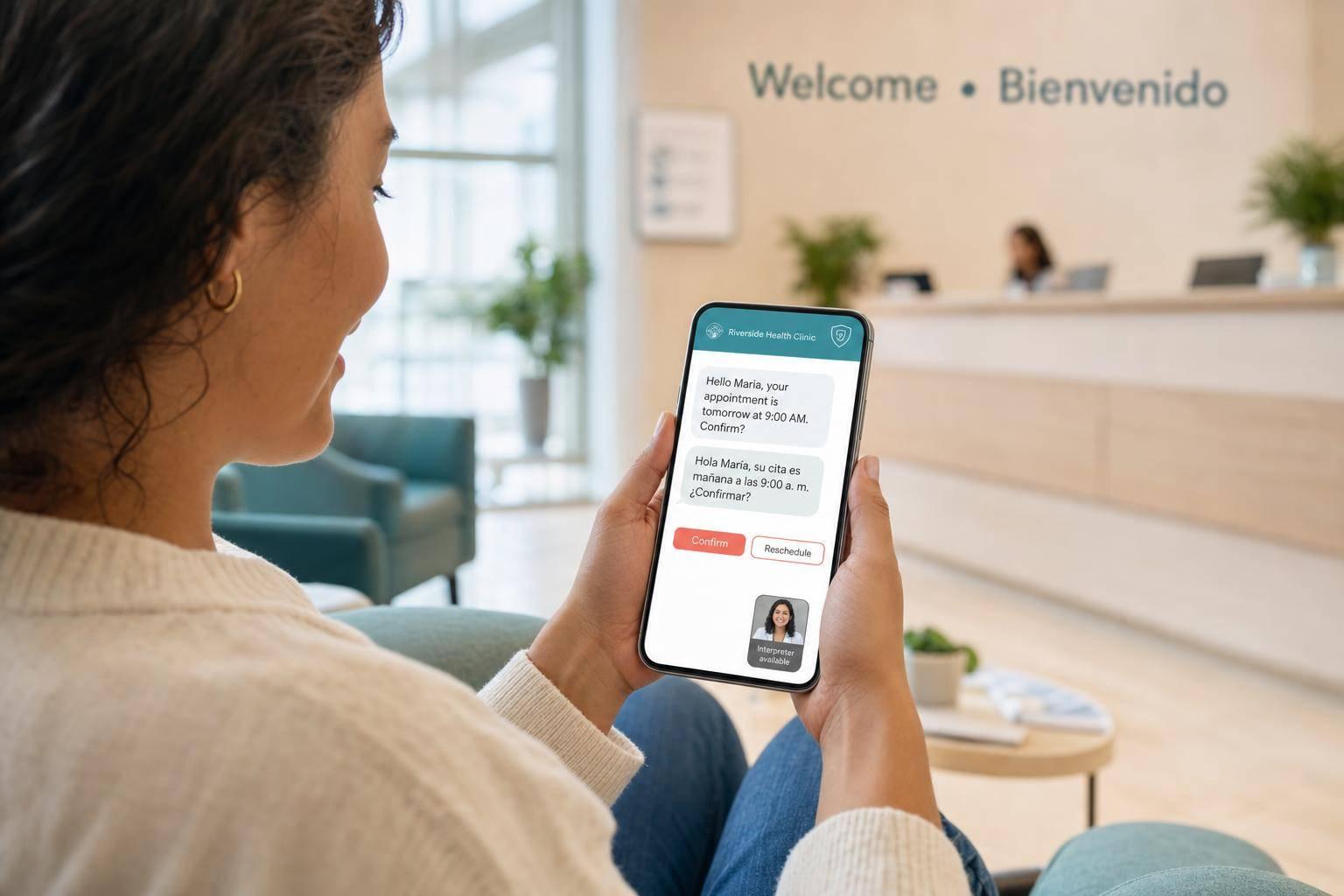
Bidirectional multilingual texting for reminders and follow-up
Bidirectional multilingual texting lets staff write messages in English while patients get them - and reply - in their preferred language. That makes routine touchpoints like reminders and follow-ups much easier to handle. Healthcare groups using this setup have reported a 380% increase in response rates and a 66% reduction in same-day cancellations.
There’s also a simple but important workflow win here. Staff who rely on manual translation tools often run into trouble keeping Spanish messages inside standard SMS limits of 160–320 characters. Automated platforms fix that by formatting messages for mobile delivery.
When the exchange gets more complicated, text alone isn’t enough. That’s the point to move from automation to live interpretation.
Interpreter and video language support during care encounters
Some care conversations should never be squeezed into a text. Surgical consent, end-of-life discussions, and other shared decisions call for qualified human interpreters because nuance and context affect both safety and compliance. Use live interpretation for high-stakes moments where every word matters.
In January 2026, Houston Methodist deployed 102 VRI devices in high-traffic areas, including the ED and specialty clinics, through a partnership with AMN Healthcare. The system also added over-the-phone interpretation (OPI) to wearable, hands-free devices for nurses, giving clinical staff direct access to interpreters in 200+ languages.
After the visit ends, that same language support needs to keep going in portals, forms, and discharge materials.
Multilingual portals, forms, and education content
Language access can’t stop at the visit. It has to carry into follow-up too. A multilingual reminder loses its value fast if the next step is English-only. The whole digital path needs to stay in the patient’s language, from intake forms and consent guidance to post-visit instructions and education content.
A Federally Qualified Health Center serving 12,000 patients tackled this head-on. After it put in place a GenAI platform covering six languages - Spanish, Mandarin, Vietnamese, Arabic, Somali, and Hmong - the clinic saw a 92% improvement in non-English speaker engagement and an 85% reduction in translation service costs.
Localized trackable links add one more practical layer. Tools like Dialog Health's "DH Links" let staff send language-matched URLs for intake forms or education content, with built-in tracking so care teams can see which patients opened and reviewed their materials.
The next step is governance: define where each tool fits, who can use it, and how results are measured.
Adding Human Support: How PatientPartner Extends Multilingual Engagement
Translation tools close the language gap. But understanding a message and feeling ready to act on it are two different things. That’s where human-guided mentorship comes in.
Real-time mentorship for new patient starts and early adherence
For patients dealing with language barriers, understanding the words is only one part of the problem. PatientPartner connects prospective patients with AI-powered peer mentors who help them through complex treatment journeys. The platform supports real-time conversations in the patient’s preferred language and adjusts based on treatment stage and goals.
This matters most during new patient starts, when translated information by itself may not be enough to get someone moving. PatientPartner reports that patients using the mentor reached dose titration targets 35% faster and completed care plans 45% faster than patients without mentor guidance. For someone starting a new therapy, that extra support can help turn understanding into action.
Why mentorship matters alongside translation tools
Mentorship adds confidence and context when translation alone doesn’t clear up hesitation, fear, or uncertainty. When a patient is starting treatment, knowing what to do is not always enough. PatientPartner’s mentorship layer is built to offer reassurance and practical context that helps patients stay engaged through early decision points.
Sentiment and engagement insights for enterprise teams
PatientPartner also gives enterprise teams real-time reporting and sentiment analytics that flag friction before patients drop off. The platform points to key moments and objections, such as side-effect or recovery concerns, so teams can respond before a patient disengages. Those insights help teams spot multilingual patients who may need extra support before drop-off begins.
How to Put Multilingual Engagement Tools in Place and Measure Results
Once you’ve spotted the language gaps, the next move is practical: pick the right tools, decide who owns what, and track whether those tools are helping.
Set governance for safety, privacy, and appropriate use
Before rollout, give clear ownership to compliance, clinical operations, patient experience, and IT.
Every vendor should have a BAA in place. For high-risk materials like consent forms, discharge instructions, and medication guides, use qualified human review. That extra check matters.
You’ll also want a do-not-translate list for drug names, brand names, and ICD codes. For PHI, use zero-data-retention or private-cloud deployment. And make sure staff know when a qualified interpreter is required.
Compare tool types by use case and implementation effort
Use the lightest tool that fits the job. Then track the result that matters most.
| Tool Type | Primary Use Case | Compliance Considerations | Implementation Complexity |
|---|---|---|---|
| Multilingual Texting | Reminders, follow-ups, quick Q&A (380% response increase; 66% fewer cancellations) | HIPAA/BAA required; TCPA/CTIA standards | Low (EMR integration) |
| Interpreter Services | High-stakes clinical encounters, consent (trust and safety) | Title VI & Section 1557 mandates | High (Scheduling/Cost) |
| Multilingual Portals | Forms, medical history, education (reduces access barriers) | PHI separation; ADA/Section 508 | Medium (Technical i18n) |
| Mentorship Support | New patient starts, long-term adherence (peer-led behavioral change) | HIPAA-compliant peer platforms | Medium (Staffing/Coordination) |
Review your EMR data every quarter to see which language groups are growing in your patient population. That helps you decide where to roll out tools first.
Here’s a simple example: if a patient group almost never logs into the portal, secure texting will usually reach them faster. It’s not about using the biggest system. It’s about using the one people will actually respond to.
Conclusion: Multilingual access improves understanding, trust, and follow-through
Language barriers are not a small edge case. More than 25.6 million people in the U.S. live with limited English proficiency, and the gap between hearing information and understanding it can lead to missed appointments, delayed treatment starts, and preventable readmissions.
Multilingual access improves understanding, trust, and follow-through. Mentorship, like the real-time support PatientPartner provides, adds the human layer that turns translation into adherence.
FAQs
Which patients should get multilingual outreach first?
Start with patients who have limited English proficiency, especially those who have too often been overlooked or who depend on federally funded safety-net systems.
This also matters a lot for patients managing complex chronic conditions or facing a higher risk of adverse events. When providers collect language preferences during intake, they can communicate more consistently, support better adherence, and help cut readmissions.
When should staff use a live interpreter instead of texting?
Staff should use live, qualified interpreters for sensitive, complex, or high-stakes clinical conversations, where accuracy and nuance matter most. That includes diagnosis and treatment planning, informed consent, mental health visits, and clinical exams.
In-person interpretation is often the best fit for psychiatric care and American Sign Language. Texting can work for routine administrative messages, but when patient safety and regulatory compliance are on the line, human interpreters matter.
How can teams measure ROI from multilingual tools?
Teams can measure ROI from multilingual tools by looking at three areas: financial results, day-to-day work, and clinical outcomes.
That means tracking things like:
- Lower admin costs, including shorter call times and less use of outside interpretation services
- Revenue growth from more patient enrollment and more appointment bookings
- Better quality metrics, such as preventive screenings, medication adherence, and fewer readmissions or emergency department visits
- Higher patient satisfaction across languages, along with better staff efficiency