


Real-Time Support with Cloud-Native Patient Platforms
Key Takeaways
Author


Patients often decide fast, but many support programs respond too late. In this piece, I show the main point right away: cloud-native patient platforms help teams respond in minutes, not days, which can cut drop-off, support more treatment starts, and give teams a clearer view of what patients do next.
Here’s the short version:
- Timing is a big deal: 20% to 30% of new prescriptions are never filled at the start, and 50% or fewer patients stay on therapy after one year in several disease areas.
- Older support models slow everything down: manual intake, delayed benefits checks, limited personalization, and slow reporting all create gaps.
- Cloud-native platforms change the flow: they use event-triggered workflows, APIs, microservices, and elastic infrastructure to respond when a patient acts.
- Compliance is built into the setup: HIPAA controls, audit logs, encryption, and role-based access can be part of the platform from day one.
- Business teams get better visibility: they can track starts, refill gaps, follow-up completion, and where patients stall.
- Human support still matters: automation can move fast, but mentorship and navigator outreach still help when a patient is unsure or stuck.
If I reduce the article to five decision points, they are these:
- Responsiveness - can the platform react right after a form fill, refill gap, or shipment event?
- Scalability - can it handle volume spikes after a campaign, launch, or new indication?
- Data flow - can it connect with CRM, EHR, pharmacy, and analytics systems through FHIR/HL7 and APIs?
- Compliance - can teams add channels like SMS or portal alerts without a long rebuild?
- Business impact - can teams link support activity to starts, adherence, and drop-off?
Quick Comparison
| Criteria | Older support systems | Cloud-native patient platforms |
|---|---|---|
| Response time | Often hours or days | Often minutes |
| Workflow trigger | Manual review, fixed schedules | Live patient events |
| Scale during volume spikes | Queues grow fast | Infrastructure expands as needed |
| Personalization | Broad patient groups | Trigger-based next steps by behavior |
| Data visibility | Delayed reports | Near-live dashboards and signals |
| Compliance changes | Heavy review for each update | Controls built into the platform |
| Human support routing | Often delayed | Faster routing to mentors or navigators |
So if you want the plain answer, it’s this: the gap between patient interest and patient action is where many programs lose people. A cloud-native setup helps close that gap while keeping data controls in place and giving teams clearer performance data.
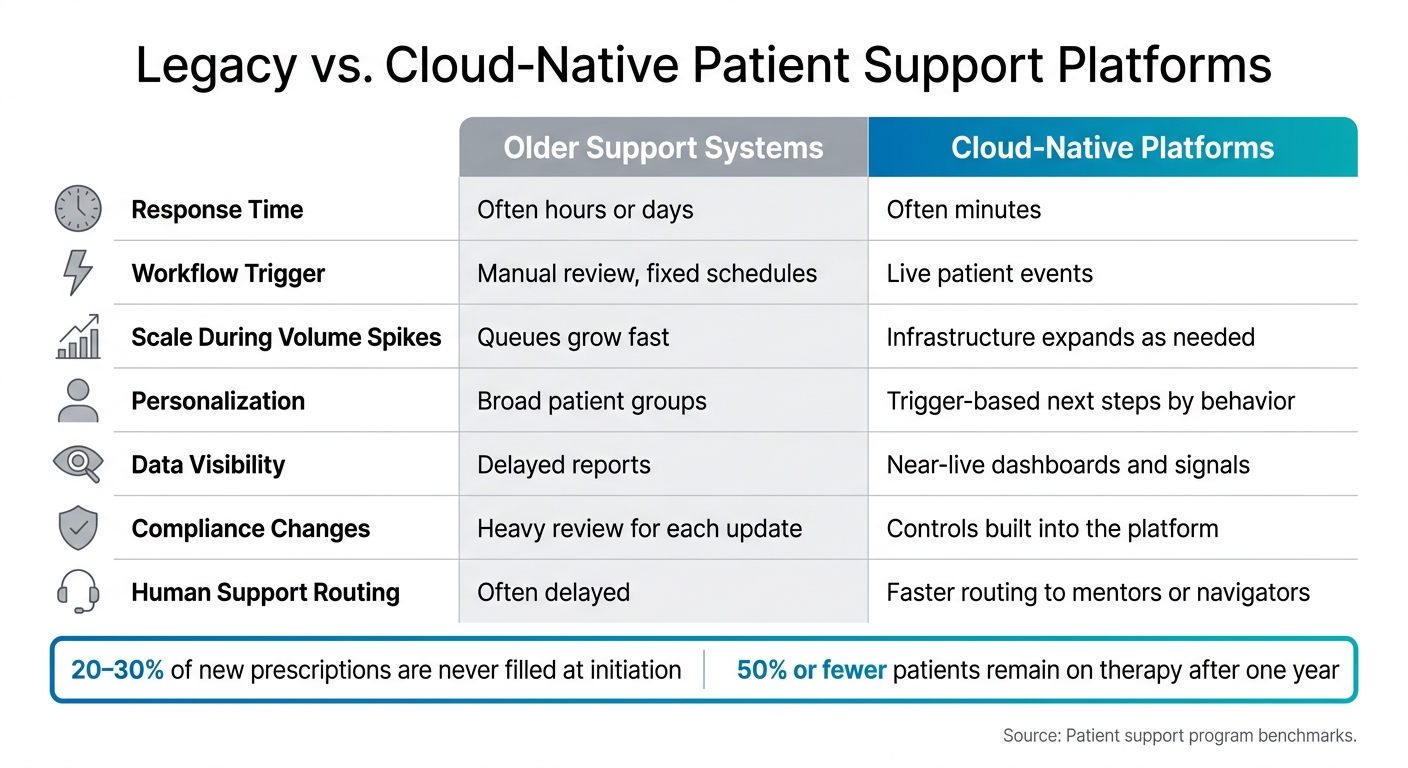
Legacy vs. Cloud-Native Patient Support Platforms: Key Differences
AWS re:Invent 2025 - UC San Diego Health modernizes patient engagement with Amazon Connect (BIZ218)
sbb-itb-8f61039
The Problem: Where Traditional Patient Support Systems Fall Short
Traditional support workflows slow things down at almost every handoff. A prescriber's office sends enrollment paperwork to a hub. The hub then manually enters that data into a separate system. Only after that does benefits investigation begin - sometimes days later. In the meantime, the patient is left waiting, stressed, and searching for answers that never seem to arrive.
Delayed Outreach and Broken Patient Journeys
This is where patients often slip through the cracks. A prescriber's office sends enrollment paperwork to a hub. The hub manually enters that data into a separate system. Benefits investigation starts later - sometimes days later. For the patient, that gap can feel endless.
And those delays have a measurable cost: 20% to 30% of new prescriptions are never filled at initiation, and 50% or fewer patients remain on therapy after one year across several disease categories. Timing plays a big role in both.
The issue gets worse after hours. If a patient finds out on a Friday afternoon that they need a new biologic therapy, they may not hear from a support program until Monday or Tuesday. That delay gives cost worries, fear of side effects, or advice from patient mentors time to chip away at their confidence.
When demand jumps, the cracks get even bigger.
Limited Scale, Personalization, and Visibility
Traditional systems are built for steady volume, not sudden surges. If a U.S. brand launches a new indication or runs a direct-to-consumer campaign, inbound volume can spike overnight. Legacy infrastructure usually can't stretch to meet that demand. The result is pretty predictable: longer queues, missed calls, and slower follow-up right when patients are most ready to act.
Personalization has the same problem. Older platforms tend to group patients into broad buckets like "newly diagnosed" or "on therapy" and send the same outreach path to everyone. But those patients are not dealing with the same thing.
- A caregiver helping a family member manage treatment
- A patient facing financial strain
- A patient feeling nervous about surgery
They can all end up getting the exact same message. That's not support. It's just volume. At the same time, stakeholders often have to rely on delayed reports, with little line of sight into where patients are dropping off.
And making changes isn't simple either. Every update tends to run straight into compliance review.
Compliance Pressure Without Flexibility
The issue isn't just scale. It's also how hard it is to change anything.
In the U.S., regulated patient engagement must meet HIPAA rules, support audit trails, use role-based access controls, and line up with state privacy laws such as California's CCPA/CPRA. Legacy systems often hardwire these requirements into the application itself, which makes change slow and difficult.
So when a new privacy rule appears - or when a team wants to add a new engagement channel like SMS check-ins, a mentorship program, or telehealth integration - each update turns into a custom compliance effort. Every workflow needs its own access controls, audit logs, and security review.
That slows teams down in a very practical way. Many organizations avoid trying new ideas at all, not because the ideas lack merit, but because their infrastructure can't support them in a compliant way without months of development work. Compliance stops acting like support and starts acting like a roadblock.
The Solution: How Cloud-Native Platforms Support Real-Time Patient Engagement
Cloud-native platforms cut the delay between what a patient does and how the support team responds. At the core, this comes down to architecture that can react on its own, scale on demand, and keep guardrails in place.
Microservices, Containers, and Elastic Infrastructure
Microservices break the platform into separate services for messaging, identity, scheduling, analytics, and workflows. Each one can scale on its own. So if enrollment jumps after a launch or during a surge, the messaging layer can handle the extra load without forcing changes across the rest of the system.
Containers help make that work in practice. They package each service the same way every time, which makes deployments more predictable and releases faster. If a team needs to adjust outreach logic for a new therapy or add an adherence workflow, they can do that without tearing apart the full system.
Once a platform can scale like that, the next step is simple: respond to patient signals the moment they happen.
Event-Driven Communication and Live Patient Signals
Older systems run on fixed schedules. Cloud-native platforms respond to what patients are doing right now. If a patient completes an intake form, misses a refill, or hits a care milestone, that action can trigger an immediate next step. That might be an alert to a support team member, a personalized message, or the next part of an onboarding workflow.
Useful signals include:
- Portal logins
- Refill gaps
- Appointment confirmations
- Symptom check-ins
- Unanswered outreach
Taken together, these signals show where each patient stands and what should happen next. In mentorship programs, for example, they can route patients to the right mentor right when support is needed.
Real-time support sounds fast - and it is - but speed alone isn't enough. Every action also needs to stay controlled, traceable, and auditable.
Security and Compliance Built Into the Platform
In a well-designed cloud-native platform, compliance is built into the system from the start. Encryption protects data in transit and at rest. Role-based access controls limit who can view specific information. Audit logs record every system action automatically. Secure API integrations with EHR and CRM systems keep data flows controlled and auditable.
Because those controls are already part of the platform, teams can add SMS, portal alerts, or other channels without kicking off a separate compliance project.
That same setup also gives teams a cleaner view of engagement, drop-off, and outcomes.
What Enterprise Teams Gain from Cloud-Native Patient Platforms
When real-time workflows are in place, the payoff shows up fast: more patient starts, better insight, and stronger mentor support.
More Patient Starts and Less Drop-Off
A lot of programs lose patients in the gap between interest and treatment start.
A prospective patient fills out an eligibility form, then waits. Hours go by. Follow-up comes late. That delay can cost starts. Shrinking that gap helps more patients begin treatment and cuts drop-off.
Real-time triggers, tailored content, and guided next steps help patients work through cost concerns, logistics, and treatment uncertainty before they disengage.
Just as important, those same signals show teams where patients stall.
Better Engagement Data for Innovation and Commercial Teams
Cloud-native platforms turn each interaction into real-time engagement data: what patients read, where they pause, and how they respond. Marketing teams can see which messages lead to scheduling. Commercial teams can track patient starts by campaign. Innovation teams can spot repeat hesitation points and redesign those moments.
Sentiment analysis adds another layer. When NLP processing flags that patients often express confusion about copay requirements or anxiety around injection technique, teams can act on it right away. They can update content, adjust outreach timing, or add targeted educational resources before those concerns become drop-off triggers. That feedback helps teams change content, timing, and escalation earlier.
And that insight matters most when it leads patients to a person, not just another message.
A Stronger Model for Mentorship-Driven Support
Architecture drives speed. But for many patients - especially those facing surgery, a new biologic, or a complex chronic therapy - what helps them move forward is a conversation with someone who has been there.
The same event-driven platform that picks up patient signals can route a prospective patient to a mentor at the moment of hesitation. PatientPartner's mentorship model is linked to higher treatment starts, stronger confidence, and longer persistence.
For mentorship programs, real-time matching, structured follow-up, and escalation can turn patient intent into higher starts and stronger adherence.
For enterprise teams, this is more than a patient experience upgrade. It's a commercial asset that produces richer program data, supports new patient starts, and helps build the long-term adherence that matters for both clinical and business outcomes.
Conclusion: What to Prioritize in a Real-Time Patient Support Strategy
Legacy patient support is often too slow and too fragmented for the way patients engage today. Cloud-native platforms help fix that by reacting to patient signals in real time, scaling when demand spikes, and making results easier to track.
That need shows up clearly in current engagement benchmarks. Recent data points to weak digital engagement, while tighter workflows have already been tied to stronger first-fill conversion and longer therapy duration.
For enterprise teams, five priorities stand out:
- Responsiveness: Trigger outreach from patient events in near real time instead of waiting for manual review
- Interoperability: Connect with CRM, EHR, specialty pharmacy, and analytics systems through FHIR/HL7
- Compliance by design: Build in encryption, audit logs, and access controls from day one rather than bolting them on later
- Patient insight capture: Gather structured behavioral signals so teams can improve content, timing, and engagement strategy
- Measurable engagement outcomes: Track starts, drop-off rates, follow-up completion, and adherence instead of looking only at activity volume
Real-time support should still send patients to people when human guidance matters most. Mentorship needs to stay in the mix. Automation adds speed, but real-time routing to an experienced mentor can stop hesitation from turning into drop-off. PatientPartner's model - connecting prospective patients with experienced mentors through a real-time, compliance-ready platform - shows how human support and cloud-native infrastructure can work side by side.
The aim is simple: build a support model that is fast enough to meet patients where they are, flexible enough to scale across programs, and measurable enough to show what it's doing. Organizations that get those three parts right will be in a stronger position to improve patient starts, cut drop-off, and build adherence that supports clinical and commercial outcomes.
FAQs
How do cloud-native platforms reduce patient drop-off?
Cloud-native platforms cut patient drop-off by replacing slow, one-size-fits-all communication with real-time, personalized support. Instead of waiting for a problem to show up, they use predictive analytics and continuous monitoring to flag high-risk moments, like treatment hesitation, missed doses, or anxiety about side effects, and then prompt help right away.
PatientPartner adds a human layer to that process. It connects patients with experienced mentors who can offer empathetic, lived-experience guidance at the moment it matters most.
What systems should a patient platform integrate with?
Patient platforms should connect with the clinical and back-office systems teams already use. That means linking up with EHR, CRM, and HUB systems so mentorship data moves into clinical workflows and the rest of the patient support setup without friction.
They should also work with medical devices and IoT tools, including continuous glucose monitors and insulin pumps. In plain terms, the platform shouldn’t sit off to the side. It should pass data where care teams can actually use it.
Using HL7 FHIR APIs helps with interoperability and supports secure, HIPAA-compliant data exchange.
How is HIPAA compliance handled in real time?
PatientPartner handles HIPAA compliance in real time by building privacy and security into the platform from the start. It uses end-to-end encryption for data in transit and at rest, role-based access controls, and automated monitoring to help maintain standards without getting in the way of communication.
The platform also includes identity verification, detailed audit trails, and strict confidentiality agreements to protect sensitive health information during real-time mentorship.