


EHR Interoperability Trends: What Pharma Needs to Know

Key Takeaways
Author


EHR data is becoming more usable for pharma, but the main issue is no longer just access. It’s control. In 2026, pharma teams need to work with FHIR APIs, TEFCA, USCDI, faster exchange, and tighter AI rules, all at once.
Here’s the short version:
- FHIR APIs let teams pull specific health data instead of sorting through files and PDFs.
- TEFCA helps data move across networks under shared rules, but access still depends on permissions, workflow, and source support.
- USCDI gives teams a common set of data fields, including orders, medication details, and patient communication fields.
- Faster exchange can support treatment-start outreach, benefits work, and follow-up timing, but data delays and gaps still happen.
- AI use needs limits, review, and logging. Structured data helps, but poor inputs still lead to bad outputs.
A few numbers show where things stand:
- By 2024, about 90% of U.S. hospitals offered API-based patient access.
- About 70% used standards-based APIs such as HL7 FHIR.
- 80% were taking part in or planning for TEFCA by 2025.
If I had to boil the article down to one point, it would be this: use interoperable EHR data to spot patient engagement trends, but keep people in the loop before action is taken.
| Trend | What it changes for pharma | Main watchout |
|---|---|---|
| FHIR APIs | Pulls targeted data for support workflows | Data quality and uneven implementation |
| TEFCA | Expands cross-network exchange | Rules, contracts, and patient authorization |
| USCDI | Makes more fields usable across systems | Not every field is present or current |
| Faster exchange | Supports better timing for outreach | “Fast” does not mean instant or complete |
| AI-ready governance | Helps with triage and workflow support | Outputs need review, logging, and limits |
Bottom line: I’d treat interoperability as a workflow issue, not just a data issue. Start with one use case, verify source and timing, confirm consent, and send unclear cases to a trained person.
Trends 1 and 2: FHIR APIs and TEFCA Are Expanding Interoperable Data Access
FHIR APIs Are Becoming the Main Integration Layer
FHIR APIs are moving data exchange beyond static documents and toward queryable health data. Instead of passing around one large file, FHIR organizes clinical information into small, structured fields that software can pull and use directly.
For pharma patient-support teams, some of the most useful FHIR resources are MedicationRequest, Condition, Observation, Coverage, and CarePlan. A support workflow can request only the data it needs, such as prescription status, patient identity, or selected coverage details, and then kick off support actions automatically. In practice, that can mean faster status checks, cleaner eligibility routing, and fewer manual handoffs.
Still, FHIR isn't a magic pass. Results can vary a lot across EHR vendors and health systems. Resource availability, terminology mapping, authentication rules, rate limits, implementation quality, and plain old data quality can all differ. So while FHIR is strong for targeted data access, documents still matter in some cases.
| Dimension | FHIR API exchange | Document-based exchange |
|---|---|---|
| Data structure | Modular, standardized resources that applications can retrieve and use | Packaged clinical documents |
| Update frequency | Supports on-demand queries and event-driven workflows | Depends on document creation and ingestion workflows |
| Integration effort | Requires API authentication, profiles, terminology mapping, and monitoring | Requires document routing, parsing, and often human review |
| Scalability | Supports reusable integrations across multiple organizations | Can scale for established exchange networks |
| Pharma use cases | Medication-status checks, consent-aware support enrollment, care-gap alerts, and patient-navigation and mentorship workflows | Referral packets, transition-of-care summaries, and longitudinal case documentation |
Use FHIR when you need targeted, computable data. Keep documents in the mix when you need broader clinical context.
But access at scale isn't just a technical issue. It also depends on trust, shared rules, and network participation. That's where TEFCA comes in.
TEFCA Expands Nationwide Exchange, With Limits
TEFCA - the Trusted Exchange Framework and Common Agreement - is a nationwide governance framework for exchange under shared trust rules. Qualified Health Information Networks (QHINs) link participants across those networks. As of July 2025, ONC confirmed that participants can use both document-based query and FHIR-based query through TEFCA-trusted arrangements.
For pharma teams, TEFCA can help reduce fragmentation across health systems and cut down on manual record retrieval. That said, it doesn't erase every hurdle. Teams still need to plan for policy, workflow, and data-handling constraints.
| TEFCA opportunity | Implementation constraint |
|---|---|
| Reach across multiple networks and care settings | Governance complexity: permitted purposes, contracts, and patient authorization must be established before exchange begins |
| More consistent trust relationships | Variable technical implementation: confirm whether a participant supports document query, FHIR query, or both |
| Better access to distributed records | Missing data means unknown, not absent |
| Clearer data provenance | Preserve source organization, timestamps, and transformation history |
| Reduced manual record retrieval | Patient matching risk: use multiple identifiers and manual review for uncertain matches |
For every data element used in a patient-support decision, log the source, timestamp, query context, and transformation history.
The next issue is making that exchange standardized and fast enough to support live patient workflows.
sbb-itb-8f61039
Trends 3 and 4: Standardized Data and Faster Exchange Are Changing Patient Support
USCDI Expands the Standardized Data Pharma Can Use
If FHIR and TEFCA open the door to data access, USCDI decides which data can travel in a usable format. It works as a shared baseline. When systems agree on what a medication order or care plan should look like, data can move with less cleanup and back-and-forth.
USCDI v5, published on July 16, 2024, added 16 data elements plus the Orders and Observations classes, which gives pharma patient support more structured context. That includes medication orders, laboratory orders, medication administration details, route of administration, and clinical notes. It also added demographic and communication fields such as name to use, pronouns, and interpreter-needed status. Those fields can help teams handle outreach with more respect.
In plain terms, this means a support program may know more than the fact that a prescription exists. It may also see what was ordered, how the therapy is given, what the care plan includes, and how the patient wants to be contacted.
USCDI fields can support common pharma workflows like these:
| Program need | Relevant USCDI data categories | Likely source systems | Key validation checks |
|---|---|---|---|
| Confirm therapy initiation | Medications, orders, encounter information, problems, allergies and intolerances | EHR, e-prescribing system, specialty pharmacy, dispensing system | Confirm medication code, dose, route, order status, effective date, and whether the record represents an order, dispense, or administration |
| Identify adherence or treatment barriers | Medications, laboratory results, vital signs, health-status assessments, social history observations | EHR, laboratory system, patient-reported platform, care-management system | Check observation date, units, reference ranges, missingness, and whether information is clinician-recorded or self-reported |
| Personalize communication | Preferred language, phone number, address, accessibility-related information, communication preferences where available | EHR, patient portal, enrollment form, CRM | Verify the field's recency, permitted use, opt-in status, and whether the channel is accessible to the patient |
| Coordinate clinical and nonclinical support | Care plan, goals, interventions, conditions, social history, health-status assessments | EHR, care-management platform, social-care referral system | Confirm provenance, responsible organization, current status, and whether the data may be shared with the intended party |
There’s one catch: USCDI sets a floor, not a promise. Not every organization collects, shares, or updates every field. Before outreach starts, teams should check the source, timestamp, and status.
Interoperability Is Moving Closer to Real-Time Patient Journeys
Standardized fields only matter if they show up soon enough to be useful.
As FHIR-based access becomes more common, support teams can respond to patient events faster. That opens the door to quicker help at key moments. After a treatment is ordered or a patient is referred to support, a permitted workflow can confirm the event, review consent and preferred language, and then offer help.
But “faster” does not mean instant or error-free. Exchange may still be slowed by batching, interface outages, missing pharmacy data, or uneven implementation. “Minutes to same day” should be treated as an operating target, not a promise. A safer setup includes retry handling, duplicate suppression, data freshness thresholds, and a human review path when an event looks unclear.
Consent also has to be built into the workflow from the start. Before any message goes out, the program should confirm that the patient opted into the specific program, that the chosen channel is allowed, and that the message is available in the patient’s preferred language and in an accessible format. Accessibility is bigger than language alone. Programs should support screen-reader-friendly content, plain-language materials, and other contact options for patients with hearing, vision, cognitive, or health-literacy needs.
The table below shows how faster exchange can support key moments in the patient journey:
| Journey moment | Interoperable signal | Support opportunity | Boundary to preserve |
|---|---|---|---|
| Therapy initiation | New order, referral, prior authorization status, dispense, or administration | Enrollment offer, benefits navigation, education, or scheduling help | Don't infer that an order means the patient has taken the medication |
| Therapy switch | New medication, discontinued medication, new order, or documented intolerance | Explain support for the new therapy; suppress outdated program messages | Confirm the switch before changing outreach |
| Temporary pause | Held or discontinued order, missed administration | Offer a neutral check-in; route concerns to the care team | Don't assume nonadherence or advise restarting |
| Discontinuation | Discontinued medication, treatment-completion record, or explicit patient report | Update preferences, close outreach, provide approved follow-up resources | Respect the reason for stopping; avoid pressure to resume |
| Follow-up and monitoring | Encounter, care-plan update, lab result, or patient-reported outcome | Time reminders around the patient's chosen care plan | Use only the data necessary for the support purpose |
Before any outreach fires, teams should require the source, timestamp, status, and confirmation. The operating rules should also spell out timing, consent, and when human review is needed.
How to Implement FHIR with Epic, Cerner, and Other EHR/EMR Platforms.
Trend 5: AI-Ready Interoperability Raises Governance Demands
Structured EHR data makes AI more usable for pharma patient support. But that does not make it safe to automate actions on its own.
That’s the tension here.
The same interoperability gains that make data easier to share also make it more important to control how that data gets used, who can use it, and what guardrails are in place. The day-to-day question is pretty simple: where can AI help, and where does it drift into unsupervised decision-making?
Where AI Can Help Pharma Operations and Patient Engagement
When EHR data is normalized, coded in a consistent way, and timestamped in a reliable way, AI can handle useful operational tasks.
For example, patient-support teams can use AI to:
- Segment patients by language preference or reported access barrier
- Prioritize adherence outreach based on refill patterns
- Summarize support interactions
- Flag patients who may need help with benefits navigation
- Spot patients who started a therapy but show signs of delayed refill activity, then send those cases to a support representative for human review rather than automatic action
Still, interoperable data does not make AI better on its own.
If the data includes duplicate patient records, old medication lists, missing dates, or coding that varies from one source to another, AI can produce misleading segmentation or bad outreach suggestions. And that can happen even when the data technically meets interoperability standards.
ONC's HTI-1 rule makes this point clear by stressing access, exchange, transparency, and the ability to assess predictive tools for fairness, appropriateness, validity, effectiveness, and safety - the FAVES framework.
Governance Controls That Should Come Before Automation
Before building automation, document the intended use in plain language. Also, keep outreach triage separate from clinical inference. The second one calls for much tighter validation, oversight, and documentation.
Before any AI-assisted workflow goes live, test for data and model issues such as incomplete records, duplicate patients, inconsistent identifiers, old medication lists, missing timestamps, unclear terminology, and population mismatch. A model trained mostly on patients with frequent clinical contact may do a poor job with low-engagement patients, which can lead to uneven outreach results.
The table below shows how the same interoperable data can carry very different risk levels depending on the use case:
| Use case | Data sensitivity | Automation level | Human-review requirement | Primary governance risk |
|---|---|---|---|---|
| Segmenting patients for educational outreach | Moderate to high; may include diagnoses, medications, and contact preferences | Automated recommendation for segment assignment | Human review before individualized outreach | Incorrect classification, inequitable access, or inappropriate messaging |
| Prioritizing adherence-support outreach | High; may involve refill history, treatment status, and social factors | Automated flagging only | Required review by support staff | False positives, false negatives, stale data, and unsupported adherence inferences |
| Sentiment analysis of patient messages or calls | High; free text may contain sensitive health information | Automated classification and summarization | Human review for sensitive or ambiguous content | Misinterpretation, language bias, privacy exposure, and missed safety signals |
| Benefits-navigation prioritization | High; may include insurance and financial information | Moderate | Review eligibility and hardship-related flags | Bias against underdocumented or underserved patients |
| Operational forecasting for patient-support volume | Moderate | High, with periodic review | Validate forecasts and monitor drift | Poor planning caused by data lag or source-system changes |
| Clinical-risk prediction or treatment recommendation | Very high | Potentially automated decision support | Qualified clinical review and documented oversight | Patient harm, bias, invalidity, regulatory noncompliance, and unclear accountability |
Before anyone acts on an AI output, check the purpose, inputs, fairness process, validation status, maintenance history, and any out-of-scope uses that users should avoid. Outputs should be labeled as predictions, not facts. Users should also be able to see the data attributes behind any alert.
That line between support operations and clinical decision-making is where governance starts to matter a lot. These controls help turn interoperable data into workflows with clear accountability.
What Pharma Teams Should Do Next
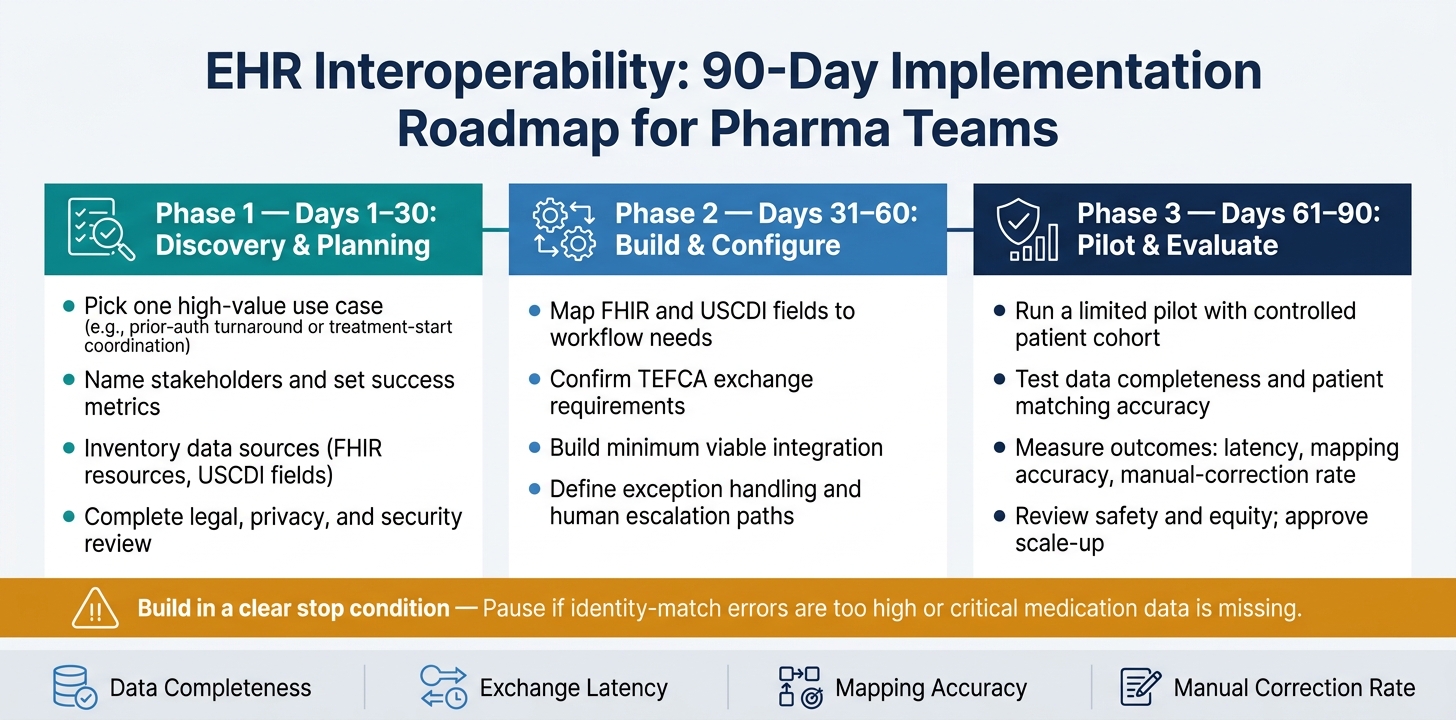
EHR Interoperability 90-Day Implementation Roadmap for Pharma Teams
The five trends in this roundup - FHIR APIs, TEFCA, USCDI standardization, near-real-time exchange, and AI governance - aren't separate workstreams. They stack on top of each other.
A smart move is to start with one or two high-value use cases, like prior-authorization turnaround or treatment-start coordination, then build outward. Don’t try to roll out a full enterprise integration all at once. The next step is much simpler: turn those signals into one controlled workflow at a time.
A practical 90-day sequence helps keep the work in bounds.
- Days 1–30: Pick one use case, name stakeholders, set success metrics, inventory data sources, and complete legal, privacy, and security review.
- Days 31–60: Map FHIR and USCDI fields, confirm exchange requirements, build the minimum viable integration, and define exception handling and human escalation.
- Days 61–90: Run a limited pilot, test completeness and patient matching, measure outcomes, review safety and equity, and approve scale-up.
Build in a clear stop condition. For example, pause if identity-match errors are too high or if critical medication data is missing.
Once the pilot begins, watch completeness, latency, mapping accuracy, and manual-correction rate before scaling. Faster exchange only helps if the incoming data is accurate enough to use.
Interoperability can show what happened. It can’t explain why it happened.
EHR data may show that a prescription was written or that a patient missed a refill. But it won’t tell you if that patient is worried about side effects, unsure how to take a medication, or stuck because of cost. That gap matters. And the evidence points in the same direction: data signals work better when paired with human support.
A meta-analysis of 23 studies involving 9,735 patients found that provider-led interventions increased the odds of medication adherence by 54% compared with control groups. In another example, a case-manager intervention increased treatment initiation after fracture from 33% to 53%. Where appropriate, PatientPartner can add near-real-time patient mentorship that helps patients navigate treatment decisions and day-to-day care.
Use interoperable data to flag when support is needed, then route the patient to a trained person or qualified mentor through a compliant, documented workflow.
FAQs
How is TEFCA different from FHIR?
The search results don’t mention TEFCA.
They focus only on FHIR, an HL7 standard used to structure and exchange patient data through REST APIs. They also cover FHIR’s role in U.S. regulatory compliance and clinical interoperability.
What should pharma pilot first?
Start with the workflow that carries the most weight and needs the deepest system connections. In many cases, that’s specialty pharmacy. Run that pilot for about 8 weeks.
The point of the pilot is simple: prove identity matching works and show end-to-end interoperability in a live setting before you branch into areas like nurse services or financial assistance. If that first workflow holds up, you’ll have a much clearer path for the next phase.
Put extra care into data mapping. And don’t rely only on synthetic data for testing. Use real member records so you can catch the kinds of issues that tend to show up only in production-like conditions.
Shift to limited production only after the FHIR model and security layer are in place, and after conformance testing passes.
Where does human review matter most?
Human review matters most when patients feel unsure or stuck. That’s where automated systems hit a wall. They can process inputs and flag patterns, but they can’t offer empathy or the kind of lived-experience guidance that helps a person feel seen. That human layer can also reduce hesitation and treatment drop-off.
Human oversight also plays a key role in ethical governance. That includes IRB review of clinical decision support recommendations, along with careful review of complex quality deviations that automated systems may miss.