


Real-Time Patient Support and GDPR Compliance
Key Takeaways
Author


If you support EU patients in real time, GDPR applies to more than forms and sign-up data. It also reaches chats, notes, usage logs, and access requests.
Here’s the short version: if a patient support program handles EU health data, you need both an Article 6 legal basis and an Article 9 condition. You also need to limit what you collect, control who can see it, verify identity before sharing records, and reply to Article 15 access requests within one month. For Article 20 portability, only some data counts, such as patient-entered details, self-reported history, patient-written messages, consent records, and in some cases observed usage data.
Just as important, privacy affects participation. The article points to data showing that nearly 70% of patients hesitate to use health apps because of privacy concerns, while only 17% are willing to share health data with drug companies. Another cited finding says 67% of consumers link trust to being able to control their personal data.
If I had to boil the article down, I’d put it this way:
- Real-time support creates GDPR risk fast because health conversations often include special-category data
- U.S. companies are not out of scope if they support EU residents, clinics, or campaigns
- Data minimization matters: collect what the program needs, not what might be nice to have
- Access and portability are different: Article 15 is broader; Article 20 is narrower
- Portable data is limited to data the patient provided, plus some observed data, when consent or contract and automated processing apply
- Mentor notes, scores, and derived outputs are usually not portable
- Core controls matter: RBAC, MFA, encryption, audit logs, retention rules, and clear processor contracts
- Trust affects enrollment and adherence, so privacy design is part of patient support, not a side task
A simple way to think about it: good patient support needs context, but GDPR limits how much context you can keep and share. The article shows how to handle that tension without slowing patient help to a stop.
Patient Data Privacy And Security HIPAA, GDPR
sbb-itb-8f61039
The GDPR challenge for real-time patient support
Patient messages about diagnosis, side effects, or hesitation count as health data under GDPR Article 9. That means real-time support has to handle them with tighter controls. The hard part isn’t just collecting this data. It’s handling it in the moment without chipping away at patient rights. And once that support data is moving through the system, the next pressure point is clear: can patients access it or move it without hassle?
What real-time support platforms process
A mentorship platform handles far more than basic contact details. In a typical session, several data types can be processed at the same time:
- identification details such as name, phone number, and account ID
- background information, including condition type, treatment stage, and prior therapies
- scheduling records linked to time zones and appointment reminders
- session notes and communication logs
- language and topic preferences
- engagement signals
Each category brings its own compliance burden. Health-related fields, free-text messages about symptoms or treatments, and session notes all fall under special-category data. So they need both a lawful basis under Article 6 and a valid condition under Article 9(2).
Where compliance pressure shows up in daily operations
The challenge is putting these rules into practice without slowing support to a crawl. In day-to-day work, the pressure tends to show up in a few clear areas.
Identity verification is one of them. Patients should be verified with email, phone, or multi-factor authentication. Storing copies of IDs should be avoided unless the law or the risk level calls for it.
Internal access control is another big one. Role-based access helps keep mentors limited to the data they need for assigned sessions. Internal teams and enterprise clients should get only pseudonymized or aggregated data, unless there’s a recorded purpose for sharing more.
Then there’s the paperwork side of it. Every processing activity, from session notes to scheduling data to engagement signals, needs a mapped purpose, a legal basis, a retention period, and a record of who can access it. In plain terms, documentation becomes daily work, not a one-and-done legal task.
Processor and controller roles also need to be spelled out in contracts. When a mentorship platform works with a pharma or med-tech company, the platform will usually act as a data processor and follow the enterprise customer’s documented instructions. The customer, acting as controller, sets the lawful basis and the purposes for processing. The platform is then responsible for carrying out those instructions in a secure and transparent way. Clear contracts help avoid role confusion when patients send requests or when regulators look at the program.
How platforms such as PatientPartner can support compliant engagement
For a platform like PatientPartner, compliant design means keeping real-time mentorship fast while cutting down on unnecessary data exposure. Clear notices, narrow access controls, auditable workflows, and clear role boundaries help teams respond to patients without putting privacy or trust at risk.
Those same controls also help teams verify and fulfill Article 15 access requests and Article 20 portability requests with less friction. Built this way, real-time mentorship can stay compliant while still moving fast when patients want to access or move their data.
How patient access and data portability requests work in practice
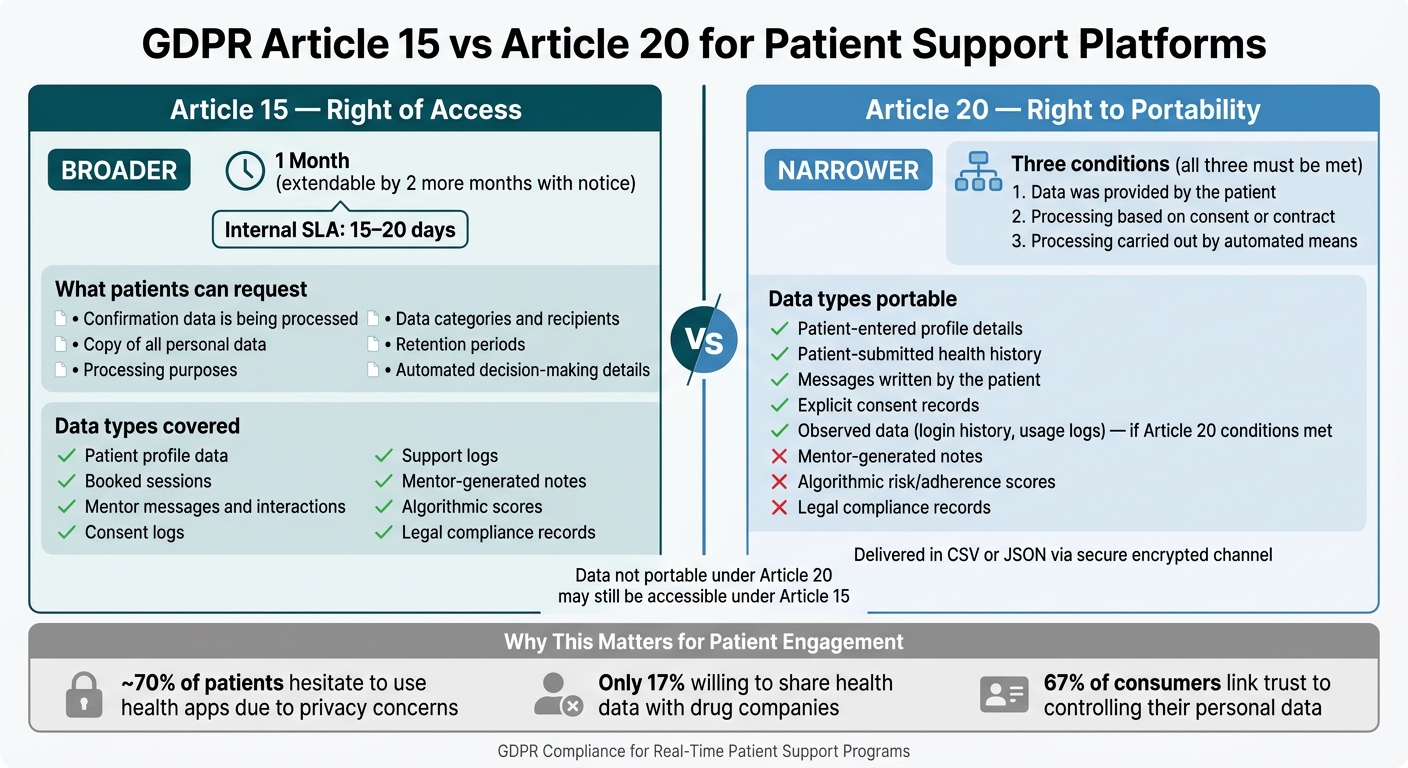
GDPR Article 15 vs Article 20: What Patient Data Is Accessible vs Portable
Once access rights are live, the workflow needs to split full access requests from the narrower portability requests.
Patient access requests under Article 15
Under Article 15, a patient can ask for confirmation that their data is being processed, a copy of that data, and details about purposes, categories, recipients, retention, and automated decision-making. On a mentorship platform, that usually means gathering profile data, booked sessions, mentor messages and interactions, consent logs, and related support logs. The aim is simple: get patients an answer fast without clogging up day-to-day mentorship work.
The process starts at intake. Requests may come in through a web form, email, or an in-app channel, and they should be logged in one central case management system under DSAR – Access. The clock starts when the request is received, and the response is due within one month. If the request is complex or there are many requests at once, that period can be extended by up to two more months. But there’s a catch: the patient has to be told within the first month, and the reason for the delay has to be clear.
A good way to keep this moving is to set an internal 15–20 day SLA. If data collection stalls, escalate by day 7. If the draft is still missing pieces, escalate again by day 20. By day 25, decide whether an extension review is needed.
Identity checks belong right at the front. For logged-in users, an authenticated session plus a one-time code is enough. If there’s doubt about identity, use a narrow follow-up check, such as date of birth, last login date, or part of a phone number.
The final response should include:
- A human-readable summary grouped by data type and purpose
- A CSV or JSON export for structured data
If anything is redacted, flag it clearly and explain why.
What is portable and what is not under Article 20
Portability is narrower than access. So the next job is sorting data by source and legal basis.
Article 20 portability applies only when three conditions are met: the data was provided by the patient, the processing is based on consent or contract, and it is carried out by automated means. That includes patient-submitted profile fields, self-reported health history, messages written by the patient, and timestamped consent records. It does not include mentor-written notes, algorithmic scores, or records kept only for legal compliance.
The European Data Protection Board adds an important point here: observed data, like usage logs or login history, can fall within portability. But inferred or derived outputs, such as adherence predictions or engagement classifications, do not.
For portability, sort the data into four buckets: patient-provided, observed, mentor-generated, and derived.
| Data type | Portable? | Example | Reason |
|---|---|---|---|
| Patient-entered profile details | Yes | Name, email, condition selected at sign-up | Provided by the patient and processed automatically under consent or contract. |
| Patient-submitted health history | Yes | Self-reported symptoms, prior treatments entered in forms | Directly provided data used for support. |
| Messages written by the patient | Yes | In-app questions to mentors, feedback submissions | Content authored by the data subject in an automated system. |
| Explicit consent records | Yes | Timestamped consent to share data with a pharma partner | Reflects the patient's own choices and agreements. |
| Mentor-generated notes | No | Internal comments, guidance notes | Created by the controller or mentor, not provided by the patient. |
| Algorithmic risk or adherence scores | No | Engagement risk score, likelihood-of-adherence classification | Inferred or derived data, not subject-provided. |
| Legal compliance records | No | Logs maintained solely for regulatory reporting | Processed under legal obligation, not consent or contract. |
| Observed data | Yes, if Article 20 conditions are met | Login history, device identifiers, usage logs | Observed data can be portable when the processing is automated and based on consent or contract. |
For a portability request, verify identity, pull out the data tied to consent or contract, and send it in CSV or JSON through a secure, encrypted channel. And one point matters here: data that is not portable may still be available under Article 15 access rights, even if it falls outside Article 20.
Those lines on paper only hold up if the platform can back them with traceable controls.
Controls that make compliance workable
The next step is operational: put controls in place so access and portability requests are traceable, secure, and fast.
Core controls for secure and traceable data handling
Article 15 and Article 20 requests only work in day-to-day use when the platform enforces clear data boundaries at the technical level. That means using controls tied to specific risks, not vague policy language.
Data mapping is the starting point. You need a current inventory of the patient data you collect - profile fields, session logs, chat transcripts, consent records - plus why you collect it, where it goes, and how long you keep it. That gives compliance and operations teams one clear reference point.
Role-based access control (RBAC) limits sensitive health data to people who actually need it. On a mentorship platform, that means mentors should only see assigned patients, while admin access should be limited by role. Least-privilege access helps protect live mentoring conversations without getting in the way of rights-request handling. If someone needs temporary elevated access for an investigation, that access should be logged and auto-revoked.
Multi-factor authentication for mentors and staff helps cut account-compromise risk. AES-256 encryption at rest and TLS in transit help protect health data if a breach happens. Immutable audit trails should show who accessed or changed each record, when they did it, where they did it from, and why.
Retention and deletion need the same level of discipline. Conversation logs, session notes, and analytics data do not carry the same level of risk, so each should have a documented retention period with automated enforcement. Automated deletion also makes erasure requests faster and less prone to mistakes.
| Risk area | Control measure |
|---|---|
| Unauthorized access to health data | Role-based access control; least-privilege defaults; MFA for all staff and mentors |
| Data breach or interception | AES-256 encryption at rest; TLS encryption in transit; key rotation and separation |
| Inability to investigate incidents | Immutable, timestamped audit logs covering access, edits, exports, and admin actions |
| Excessive or unclear data collection | Documented data map |
| Stale or over-retained patient data | Automated retention schedules with deletion or anonymization workflows |
| Inconsistent rights-request handling | Documented DSAR workflows with SLAs, assigned owners, and audit evidence |
Technical controls only go so far if contracts and governance say something else.
Processor contracts, role definitions, and DPIA readiness
The DPA should match the controller/processor split already in place and pin down each party’s duties. It should define the scope and purpose of processing, list the required security controls, name any subprocessors such as cloud hosting or communications infrastructure, require subprocessor obligations, and set firm timelines for breach notification. It should also require the processor to help the controller respond to patient rights requests and carry out Data Protection Impact Assessments (DPIAs) when needed.
DPIAs are mandatory or strongly recommended for large-scale health data, real-time communication, or adherence profiling. A reusable DPIA template should cover the processing description, the necessity and proportionality assessment, the risks found, and the mitigation measures. That makes it much easier to respond when a client or regulator takes a close look. Bringing in privacy, security, product, and legal teams helps make sure the assessment matches how the platform works in practice. That way, compliance doesn’t turn into a bottleneck as patient support programs grow.
Review cloud and communications subprocessors before onboarding and then again on a set schedule. Focus on incident response, data residency, encryption, and audit rights. PatientPartner can standardize DPA and DPIA templates for enterprise clients, which helps reduce launch friction for new patient support programs.
With those controls in place, compliant design can support patient confidence instead of getting in the way of engagement.
Why compliant design improves patient support
Transparent data practices and stronger patient confidence
When access, portability, and security controls are already built in, compliance starts to do more than check a legal box. It becomes a trust signal. And in real-time mentorship programs, trust matters a lot. Patients are more likely to take part openly when they understand how their data is handled.
The research backs that up. One study on mHealth app adoption found that people were much more likely to use health apps as worries about data privacy, confidentiality, and security went down. Among those factors, security concerns had the strongest correlation (β = .36; P = .01). Deloitte found something similar: 67% of consumers say that being able to easily control their personal data affects how much they trust an organization.
That has a pretty direct takeaway. A plain-language privacy notice can reduce hesitation during enrollment and help keep patients involved over time.
Regulators make the same point from another angle. Transparency details should be shared as early as possible, in accessible formats and plain language matched to health literacy levels. It also helps to co-design consent flows with patient advocates and test comprehension before launch, so you can confirm patients understand the disclosure.
How platforms such as PatientPartner can support compliant engagement
This is where platform design starts to matter in a very practical way. PatientPartner supports access, portability, security, and workflow design in real-time mentorship programs.
Those controls help teams respond to Article 15 access and Article 20 portability requests. Well-structured workflows cut operational friction, and integration with existing CRM and HUB systems helps keep compliance built into the support program itself. In plain terms, support can stay fast without cutting corners on patient rights.
When patients trust the platform handling their data, they tend to stay engaged longer.
FAQs
Does GDPR apply to U.S. patient support teams serving EU patients?
Yes. GDPR applies to U.S.-based patient support teams that process the personal data of people in the European Union.
The key point is territorial scope. GDPR is not tied to where a company sits. It depends on whose data is being processed and what the company is doing.
So if a platform:
- offers services to EU residents, or
- monitors their behavior
it must follow GDPR rules for data processing, security, and international data transfers.
That still applies even if the company has no physical presence in the EU.
What health data is portable under Article 20?
Under GDPR Article 20, data portability applies to personal data a patient has provided to a platform. That covers two buckets of data:
- Data the patient actively and knowingly submitted
- Data observed through their use of the platform, such as app usage patterns or health-related metrics
The platform must make this data available in a structured, commonly used, and machine-readable format. In practice, that usually means formats like JSON, CSV, or HL7 FHIR.
How should platforms verify identity for data access requests?
Platforms should use a proportionate verification process before releasing or deleting any health data. That process should sit inside a clear workflow that covers intake, verification, internal review, and final fulfillment.
Each step, including the verification method used, should be recorded in a secure audit log. This creates a clear record of what happened, supports transparency and compliance, and helps protect sensitive information.