


Patient Communication: FDA Guidelines Explained
Key Takeaways
Author


If a patient-facing message names a prescription drug, biologic, or device and says what it does, FDA rules likely apply. That means I need to keep every claim tied to the current approved label, give risks clear space next to benefits, and treat websites, handouts, ads, apps, and social posts with the same care.
Here’s the short version:
- Patient communication is regulated when it includes product claims, dosing, indications, benefits, or risks.
- Patient engagement is different. Listening, support, and mentor programs are often nonpromotional unless they drift into product claims or off-label discussion.
- FDA expects content to be truthful, non-misleading, and aligned with the approved label.
- For consumer promotion, risk information must be easy to notice and easy to read.
- Drug labeling, device labeling, ads, and social posts do not all follow the same review path.
- Digital posts with tight space still need risk language. A link alone does not fix an unbalanced message.
- Support and mentorship programs need scripts, training, monitoring, and records.
- Review does not stop at approval. Teams should recheck materials when labeling changes, safety issues appear, or FDA action occurs.
A few facts help frame the issue. The article notes that most U.S. adults have limited health literacy, and a 2018 review of direct-to-consumer TV ads found benefits were stated with numbers more often than risks. That gap is exactly where FDA review tends to focus.
If I had to reduce the whole article to one test, it would be this: Can each patient-facing asset be traced to approved language, current labeling, and a named owner? If the answer is no, the material needs more work.
Quick comparison
| Area | What it covers | Main risk |
|---|---|---|
| Patient communication | Claims about benefits, risks, use, dosing | Misbranding, imbalance, off-label statements |
| Patient engagement | Listening, support, patient input, mentor activity | Turning support into promotion |
| Drug patient labeling | Medication Guides, PPIs, IFUs | Conflict with Prescribing Information |
| Device patient labeling | Setup, safe use, cleaning, troubleshooting | Missing safety or usability details |
| Digital/social | Websites, posts, SMS, apps | Too little risk detail, reused claims drifting out of bounds |
So the article’s main point is simple: FDA compliance in patient communication is not just about legal review. It is also about making sure patients can see, read, and use the information without being misled.
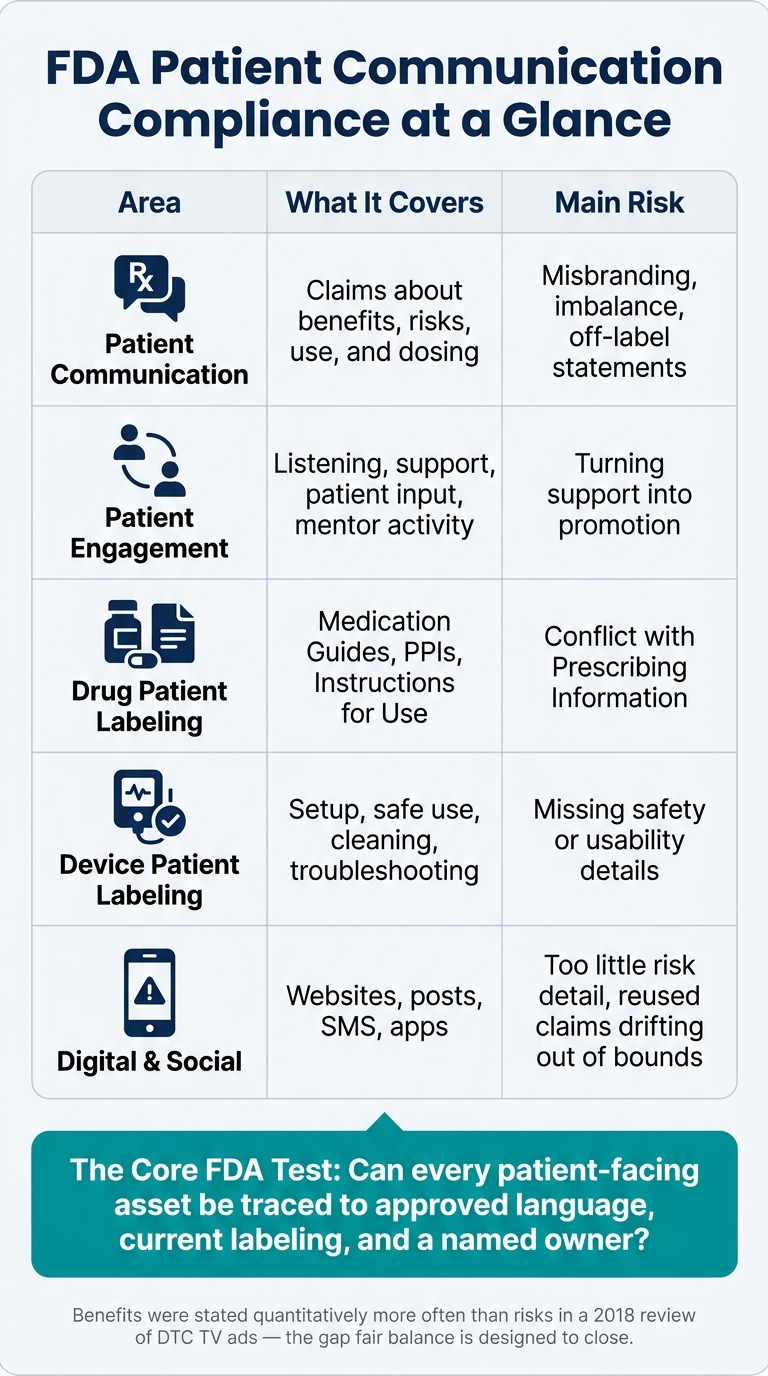
FDA Patient Communication Compliance: Key Areas, Coverage & Risks
Communicating Benefit and Risk Information
sbb-itb-8f61039
Core FDA Rules for Patient-Facing Information
Before anything goes out, patient-facing material has to be truthful, present benefits and risks fairly, and stay inside the FDA-approved label. The practical job is making those rules part of a simple review process for claims, risk language, and labeling format.
Truthful, Non-Misleading, and Consistent with Approved Labeling
Truthful and non-misleading means each claim needs support from scientifically sound data, shown with proper context, and without leaving out material risks or limits.
In practice, that means checking every piece against the current U.S. label before release:
| What to Check | What FDA Requires |
|---|---|
| Indication | Claims only cover FDA-approved uses |
| Population covered | No claims for unapproved populations |
| Dosing and administration | No conflict with approved dosage, route, or regimen |
| Limitations and contraindications | Key limits and contraindications are disclosed |
It also means avoiding two common mistakes: cherry-picking favorable data and hinting at a cure when the evidence only shows symptom relief. FDA calls out both as misleading. A simple label-comparison review before release can catch them.
Fair Balance and Risk Presentation in Consumer Promotion
For consumer-directed prescription drug promotion, FDA requires fair balance. Risk information has to be as prominent and as easy to read as benefit information, so patients can weigh both clearly. This goes beyond word count. It covers font size, placement, tone, and the way the whole piece is built.
A 2018 analysis of DTC TV ads found that benefits were described in quantitative terms more often than risks. That's the kind of gap fair balance is meant to stop.
For broadcast ads, FDA requires a major statement of the most important risks in the audio, or in the audio and visual, parts of the ad. That statement needs to be clear, delivered at a pace people can follow, and written in neutral language that doesn't soften the seriousness of the risks. It helps to script the major statement early, then test whether people can understand it.
Medical Device Patient Labeling Requirements
Devices follow the same truthfulness standard, but patient labeling has its own safety-first format.
For devices, patient labeling includes any material aimed at patients, not just the package insert. FDA guidance says this labeling should use plain language and explain what the device is used for, how to use it safely, warnings, precautions, contraindications, expected outcomes, and any follow-up steps.
FDA discourages promotional language in patient instructions because it can pull attention away from safety details. It's better to treat patient labeling as a safety document and test drafts with lay users before final approval.
These rules shape the content itself; the next section shows how they play out across labeling, ads, and digital channels.
How FDA Guidance Applies to Labeling, Advertising, and Patient Education
FDA rules don't hit every format the same way. A drug package insert, a device instruction booklet, a TV ad, and a social post may all talk about the same product, but they sit under different review standards. If teams sort that out early, the review path gets a lot cleaner.
Drug Labeling vs. Device Patient Labeling
Start with the right label type. Everything that follows depends on that call.
For prescription drugs, FDA-approved patient labeling, such as Medication Guides, Patient Package Inserts, and Instructions for Use, is tied to the product's Prescribing Information. Device patient labeling works differently. It centers on safe setup, use, cleaning, storage, and troubleshooting.
| Dimension | Drug Patient Labeling | Device Patient Labeling |
|---|---|---|
| Primary audience | Patients, caregivers, clinicians | End users, lay caregivers |
| Core content | Approved indication, dosing, risks, warnings, adherence | Setup, operation, cleaning, storage, maintenance, safety precautions |
| Where it appears | Prescription fill, onboarding, refill counseling | First use, training, troubleshooting, follow-up |
| Review focus | Label fidelity, risk disclosure, medical-legal-regulatory review | Usability review, readability, lay-user comprehension |
That split matters. Unacceptable drug patient labeling can block approval. So this isn't just a paperwork issue. Labeling quality can decide whether a product gets to market at all.
That same line between label types also shapes how teams handle risk disclosure in ads and patient education.
Risk-Benefit Communication in Ads and Educational Materials
FDA reviewers pay attention to imbalance. Tiny font, dense legal copy, and visuals that push benefits harder than risks can all draw scrutiny.
Numbers matter too. Use absolute numbers, such as 57 out of 100 patients, instead of relying only on relative phrasing like 50% reduction. Patients usually grasp tradeoffs better when the math is stated in plain terms.
Brand-specific educational materials can also count as promotion. When that happens, the material needs to stay in line with approved labeling and show fair balance. Education can help patients use the label in day-to-day life with things like:
- reminders
- storage tips
- side-effect reporting
What it can't do is add claims or tone down warnings.
Online formats make this harder because space is tight and layouts don't give you much room to work with.
Digital Channels, Websites, and Social Media Controls
Digital channels follow the same FDA rules, but the margin for error is smaller. Content gets reused fast, space is limited, and wording can drift. A product website counts as promotional labeling and must follow FDA submission rules before launch.
Space-limited formats, like social posts, bring a clear challenge. FDA guidance for character-limited channels says the post still needs concise but meaningful risk information, including at least the most serious risks, plus a prominent, dedicated link to full risk details. That linked page should include dosage form and strength information.
The link doesn't fix an unbalanced post. The first message people see still has to frame the product honestly.
One useful way to manage this is a channel-specific claim matrix. It's a controlled document that maps:
- which claims are cleared for which formats
- what risk disclosure each one needs
- which destination page meets that need
That gives teams one reference point for review and helps keep digital content from drifting as it's reused across channels.
Patient-Centered Communication Within FDA-Compliant Engagement Programs
Once the core promotion rules are in place, the next move is building support programs that gather patient input without changing approved claims.
That separation matters. Patient-centered support only works when approved claims stay apart from service, education, and mentorship workflows.
Patient Engagement, Patient Preference Information, and Listening Mechanisms
Patient preference information (PPI) includes qualitative or quantitative data on how patients weigh the benefits, risks, and attributes of interventions. PFDD applies across the product life cycle. The role of PPI here is simple: use it to improve clarity, relevance, and sequencing. It should not be used to stretch or add to claims.
In practice, that means keeping a clear record of:
- the methodology
- participant criteria
- key findings
- how the input shaped the final materials
That paper trail matters if FDA or internal auditors review how patient perspectives were used. The goal is to show that patient input improved the support experience, not the product message.
Those insights should shape support design, not expand what the product is said to do.
Using Mentorship and Support Models Without Altering Regulated Messaging
Support programs tend to work best when mentors stay within approved, nonclinical guidance. Their role should be experiential and practical: how to use the product, what to ask a clinician, and when to report issues. They can help patients understand labeled use and what usually happens next.
Where's the line? Mentors cannot add benefit claims, downplay labeled risks, or comment on off-label uses.
PatientPartner supports this model by connecting prospective patients with experienced mentors within a compliance-reviewed framework.
Channel-by-Channel Compliance Planning
The same guardrails should apply at every touchpoint, but the review process should fit the channel. A brand site doesn't create the same risk as a peer-support exchange, even if both mention the same product.
| Channel | Key Risk | Control Action |
|---|---|---|
| Web (brand sites, microsites, patient portals) | Mentor scripts, FAQs, and linked pages may introduce unapproved claims | Approve mentor scripts and moderation rules before launch; lock FAQs to approved language; log updates and monitored user questions |
| In-clinic materials (posters, handouts, device IFUs) | Treat as labeling or advertising when they contain product claims | Differentiate support materials from promotional ones; document distribution; review when labeling updates occur |
| Mentorship-enabled support (peer programs, platforms) | Product-specific mentor messages may be treated as promotion | Define program guardrails; use approved talking points; monitor interactions; maintain training and policy records |
Implementation Checklist and Conclusion
Internal Governance for Review, Approval, and Monitoring
The last step is putting FDA rules into a review and monitoring process your team can use again and again.
At the center of that process is a formal medical, legal, and regulatory review committee. For FDA-compliant patient communication, that group should include Regulatory Affairs, Medical Affairs, Legal, Marketing, and Patient Engagement. Put it under a written charter that spells out decision rights, quorum, and timelines.
Every patient-facing asset should go through this process before it goes live. That includes brochures, websites, emails, social posts, support scripts, and device instructions.
Each team has a clear job:
- Regulatory Affairs checks that content matches the label
- Medical Affairs checks scientific accuracy
- Legal reviews risk
- Marketing makes sure the message stays clear and patient-friendly
After approval, store each item in a central repository with its version, effective date, and current label reference. If labeling changes, send affected materials back through review before they are used again.
It also helps to define escalation triggers upfront. Boxed warnings, safety signals, or FDA actions should prompt immediate review and, when needed, temporary removal.
Approval is only half the job. Monitoring is what keeps materials aligned as labels shift and channels change. Audit websites, social channels, and mentor interactions on a routine basis so issues are caught early. Use pre-approved scripts, document spot-checks, and track remediation timelines. Track findings, remediation time, and recurrence rate.
Key Takeaways for U.S. Pharma and Med-Tech Teams
For teams, the practical test is simple: can every patient-facing asset be traced back to approved language, current labeling, and a clear owner?
Use the same label-fidelity standard for every patient-facing claim. In print, TV, and digital formats, benefit and risk information should have equal prominence.
Websites, apps, SMS, and social posts follow the same risk-presentation standard. Character limits may change the format, but they do not change the obligation.
Mentorship and support programs should stay tied to approved messaging and documented guardrails.
FAQs
When does patient communication become FDA-regulated?
Patient communication falls under FDA rules when it crosses into areas the FDA oversees. That includes drug promotion, labeling, and messages about an FDA-regulated product’s approved uses, risks, and contraindications.
It can also fall under FDA rules when it includes patient engagement tools that qualify as software as a medical device under an FDA risk pathway.
How can teams keep risk and benefit information balanced?
Teams can keep risk and benefit information in balance by following FDA fair balance requirements. That means stating both the upside and the possible downsides in clear terms, including side effects and contraindications, so claims don’t give a one-sided picture.
It also helps to use approved patient-facing scripts and templates instead of writing every message from scratch. Keep track of versions and the reason behind each change, and review communications on a regular basis with compliance involved.
On top of that, real-time monitoring, audit trails, and adverse-event detection can catch biased or unsafe messaging fast, so teams can fix problems before they spread.
What controls should support and mentor programs have?
Support and mentor programs need clear guardrails for compliance, data security, and patient trust.
That usually means putting a few core protections in place:
- Data protection: encryption, role-based access, data minimization, and de-identification where possible
- Oversight: audit trails, automated monitoring, incident response, and regular security reviews
- Patient safeguards: consent management, confidentiality agreements, staff training, and review of patient communications and educational content
Put simply, these programs work best when privacy isn't treated as an afterthought. It needs to be built into how data is handled, how teams are supervised, and how patients are supported day to day.