


Real-Time Patient Support in Pathway Design
Key Takeaways
Author


Most patient drop-off happens between visits, not during them. I’d sum up the research this way: if you want care pathways to work better, you need support in the gaps between appointments.
Here’s the short version:
- Real-time navigation helps people get care started, especially when they need help finding providers or dealing with coverage issues.
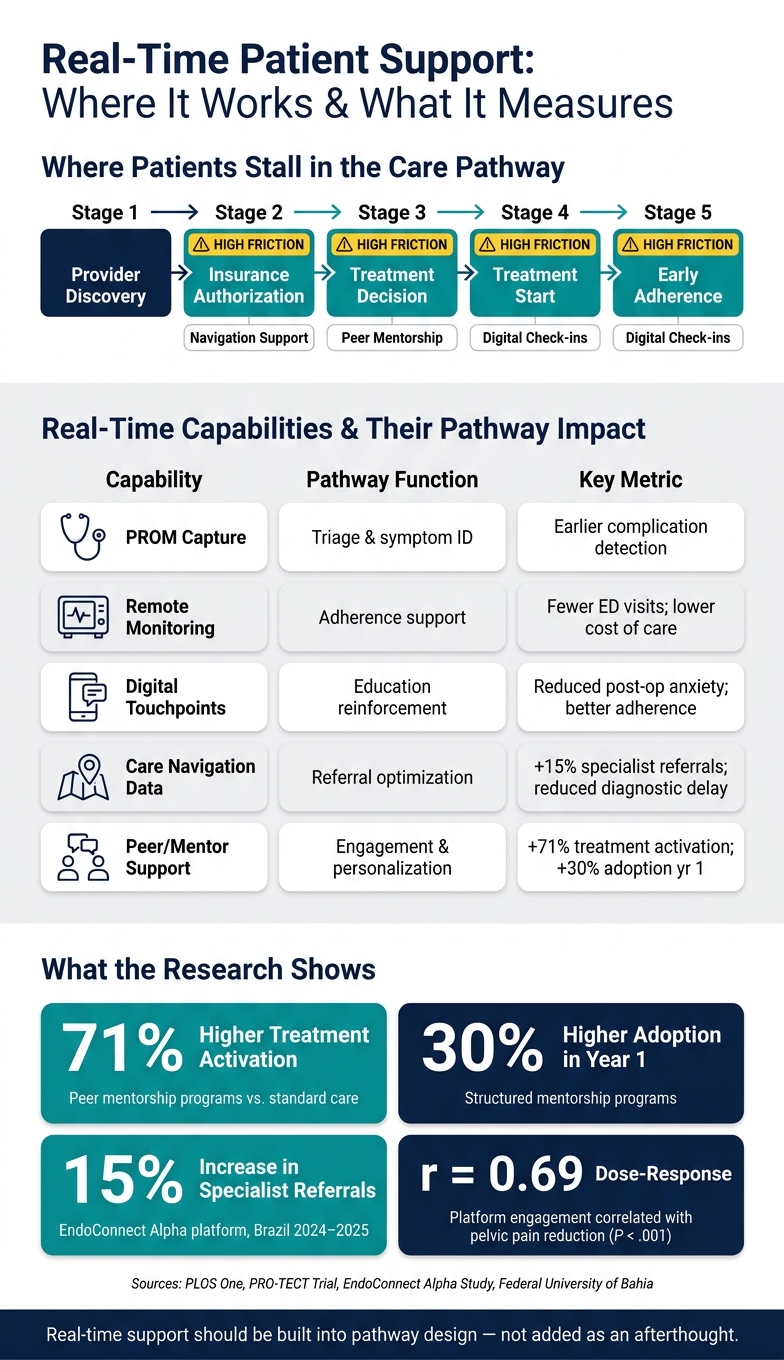
- Peer mentor programs can improve action early in the pathway, with one study reporting 71% higher treatment activation and 30% higher adoption in year one.
- Digital symptom check-ins can flag problems sooner, which can improve symptom control and physical function.
- Chat, remote follow-up, and benefits support help reduce drop-off at high-friction steps like referrals, authorizations, treatment starts, and early adherence.
- For U.S. teams, the main job is simple: track where patients stall, then place human and digital support at those exact points.
I also see a clear pattern in the data: the strongest results show up in pathway mechanics such as treatment starts, follow-up completion, referral flow, and adherence. Results are less clear for broader patient well-being measures, so teams should measure both clinical outcomes and pathway progress.
In plain English, this article says that real-time support is not just an extra service. It should be built into pathway design, measured against drop-off points, and tied to actions that help patients move to the next step.
What Recent Studies Show About Navigation and Mentorship
Effects on treatment initiation and pathway completion
Recent studies show that structured navigation and mentorship help people start care and make it through key transition points. A PLOS One analysis of 1,353 chat records found that real-time text navigation can spot access gaps and help close them. The study also found that navigation services help patients get past barriers at the individual, interpersonal, and structural level.
"Healthcare navigation services supported by trained [coordinators] substantively assist... patients overcome obstacles... at individual, interpersonal, and structural [levels]." - Sexton Topper P. et al., PLOS One
Peer mentorship also stands out, especially when someone is deciding whether to begin treatment. Structured mentorship programs increased treatment activation by 71% and adoption by 30% in the first year.
Where outcomes improve most and where findings are mixed
This matters most at the moments where patients are most likely to get stuck. The strongest evidence shows gains in access, treatment initiation, and pathway completion. Navigation and mentorship are especially helpful during high-friction steps like finding the right provider, getting insurance authorization, and moving through other drop-off points in care.
The picture is less clear for quality of life and distress. Those outcomes are harder to connect to a single program or support layer. So if a care team is building a pathway, it makes more sense to track concrete milestones, such as:
- treatment starts
- follow-up completion
- adherence
That gives teams a clearer read on whether the support is working where it counts.
How mentor-led support fits this evidence base
The studies point to a simple idea: trust reduces friction. When patients talk to someone who has been through something similar, the next step can feel less intimidating. Shared experience can lower avoidance and make action feel more doable. That same dynamic helps explain why peer mentorship works.
In practice, this kind of support fits best at high-friction moments, when a patient needs human guidance right away. PatientPartner connects prospective patients with vetted mentors who have gone through similar healthcare journeys. That lines up closely with the confidence-building and barrier-solving effects the research ties to mentorship. When support is timely, personal, and tied to a specific care step, mentor-led guidance can improve adherence.
sbb-itb-8f61039
Patient Navigator Services Help Participants Stay Focused On Care
How Digital Tools and Real-Time Data Improve Pathway Design
Digital tools turn patient input into pathway signals.
PROMs and PROs as real-time pathway signals
When teams collect PROMs and PROs through digital check-ins, they can spot symptom shifts, communication gaps, and support needs before those issues turn into disengagement.
The PRO-TECT Trial, conducted across community oncology practices in the United States in 2026, included nearly 1,200 patients with advanced solid tumors. It used weekly electronic symptom monitoring and found statistically significant improvements in symptom control and physical function compared with standard care. The gains were strongest among Black patients and patients with a high school education or less.
That matters for a simple reason: real-time symptom reporting helps care teams catch problems sooner. Instead of waiting until the next visit, teams can use symptom reports as a trigger for faster triage and reduce missed escalation.
"Routine symptom check-ins could be a game-changer in reducing healthcare disparities." - Allison Deal, Senior Biostatistician, UNC Lineberger Comprehensive Cancer Center
The same idea carries over once treatment begins. A patient’s needs don’t pause between appointments, and that’s often where things start to drift.
Remote monitoring, digital touchpoints, and adherence support
Technology-enabled follow-up helps close the space between visits, where many patients lose momentum. Well-timed digital touchpoints can reinforce education, ease anxiety, and keep patients tied to their care plan during high-risk periods.
One example comes from a prospective study at the Federal University of Bahia. In the study, 20 patients undergoing orthognathic surgery received structured support through a private WhatsApp group for 21 days after surgery. The digital support group showed a statistically significant reduction in anxiety (ΔBAI = -5.3, p = 0.013), while the standard care group saw a significant worsening in oral health-related quality of life (p = 0.021). The protocol gave patients guidance tied to specific post-op days while still allowing individualized responses. In practice, that means digital follow-up can be built into pathway design as a repeatable part of care, not just an extra layer when staff have time.
Digital tools can also help teams deal with structural barriers earlier in the pathway. In the EndoConnect Alpha implementation study in Brazil (2024–2025), a platform that combined symptom tracking and care navigation across 10 primary health care units led to a 15% increase in gynecological referrals. The study also found a strong dose-response relationship between platform engagement and reduction in pelvic pain (r = 0.69; P < .001).
Table: Real-time support capabilities mapped to pathway metrics
These tools only pay off when the data ties to a clear pathway action and a measurable outcome.
| Real-Time Capability | Pathway Function | Value-Based Metric / Quality Indicator |
|---|---|---|
| PROM Capture | Triage and symptom identification | Earlier complication detection; faster intervention |
| Remote Monitoring | Adherence support | Fewer ED visits; lower total cost of care |
| Digital Touchpoints | Education reinforcement | Improved therapy adherence; reduced post-op anxiety |
| Care Navigation Data | Triage and referral optimization | Increased specialist referral rates; reduced diagnostic delay |
| Peer/Mentor Support | Engagement and personalization | Higher activation; better satisfaction |
For rural and low-connectivity patients, offline-capable tools such as progressive web apps can help keep support in place even when internet access is spotty.
What the Evidence Means for U.S. Commercial, Innovation, and Compliance Teams
Real-Time Patient Support: Where It Works & What It Measures
For U.S. teams, the evidence points to two clear priorities: fix the drop-off points and use real-time data to step in at the right moment. In practice, that changes pathway design from passive tracking to active intervention.
Designing Pathways Around Drop-Off Points
The evidence shows that patients tend to stall at fairly predictable moments. Two stand out: the treatment decision phase, where peer guidance helps patients decide whether to start treatment, and early therapy, where real-time mentorship can reduce drop-off and support adherence at key checkpoints.
Commercial and innovation teams can use patient journey mapping to bring those friction points into plain view. As Laura Muttini of Clear Point Health puts it, "Understanding how patients move through this pathway (and what barriers arise) is essential to improving outcomes." In plain terms, that means looking closely at cost, stigma, and lifestyle barriers. Those issues shouldn't sit in the background. They should shape how the pathway is built.
Using Patient Sentiment and Engagement Data Responsibly
Aggregated sentiment and engagement data can help teams spot risk and time outreach more carefully. But there has to be discipline around how that data is used. Platforms should apply HIPAA-compliant controls. Used this way, the data can help teams build trust and reshape pathways around the moments that matter most.
Where PatientPartner Can Support Pathway Execution
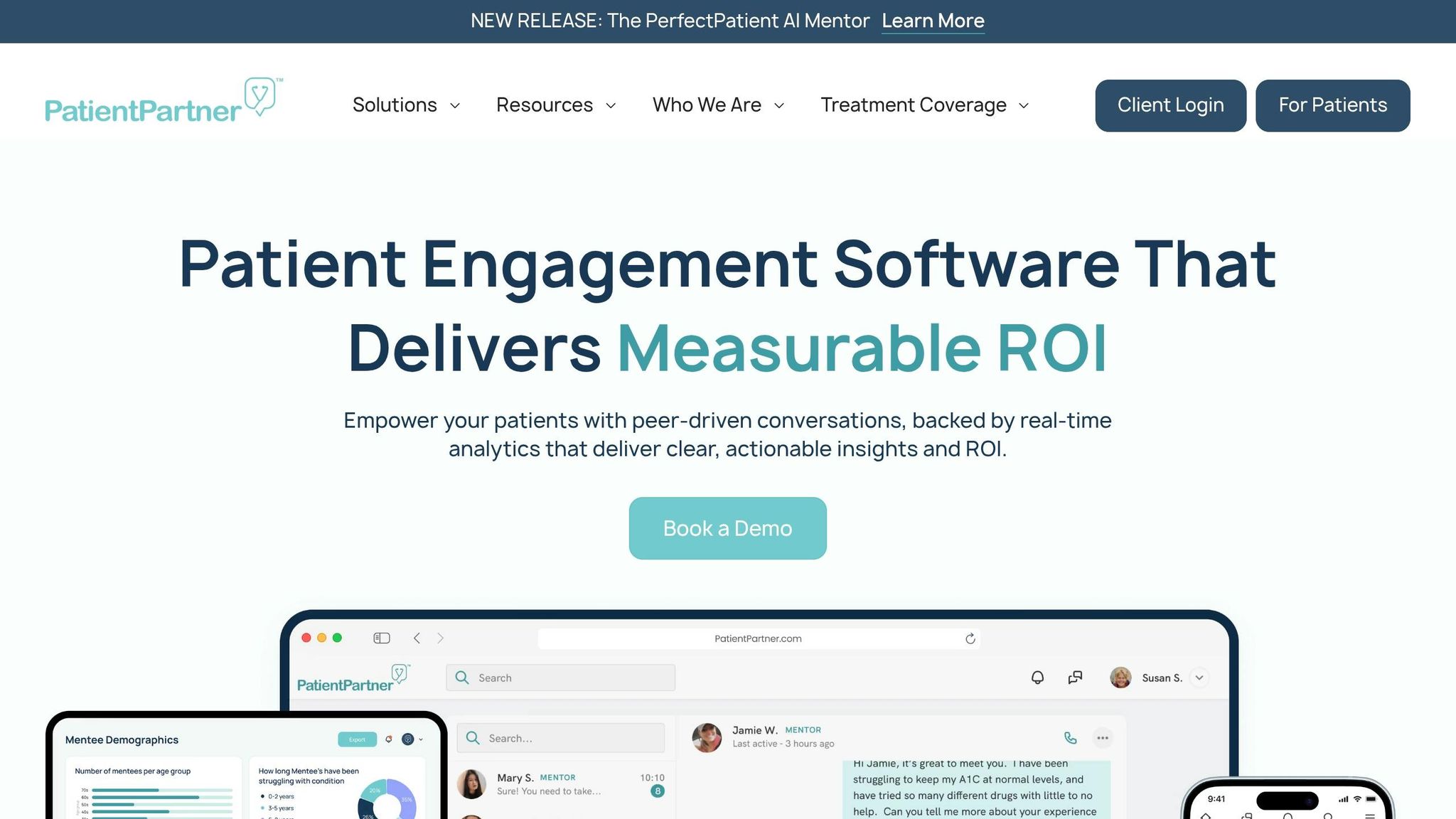
This is where execution often lives or dies. Real-time mentorship helps close the gap between pathway design and patient action. PatientPartner connects prospective patients with experienced mentors and provides real-time reporting and dashboards for program tracking.
Conclusion: Real-Time Support as a Research-Backed Pathway Tool
Taken together, these studies land on one clear point: real-time support helps close the gap between a patient visit and actual pathway progress. Recent reviews show that real-time support improves treatment initiation and adherence, which makes it a core tool in pathway design.
The biggest gains show up at the moments where patients often stall or fall off: initiation, access, milestone completion, and early adherence. Programs that place real-time human support at those drop-off points - instead of leaning only on clinician visits or passive self-management - show better pathway performance in measurable ways.
For U.S. teams, measurement needs to cover both outcomes and pathway mechanics. In plain English, that means tracking not only what changes clinically, but also what changes inside the pathway itself. Clinical markers, quality of life, and symptom burden all matter. But so do time-to-initiation, refill rates, visit adherence, and completion of required care steps. Looking at only one side leaves gaps in the picture.
PatientPartner can support pathway execution by connecting mentorship interactions to milestones, treatment starts, and adherence. That makes mentorship a measurable pathway lever, not just an added support layer.
Real-time support works best when it's built into the pathway and checked on continuously. Teams that set drop-off thresholds, use time-bound initiation targets, and review engagement data on a regular basis are in the best position to scale what works and fix what doesn't.
FAQs
What are the biggest drop-off points in a care pathway?
One of the biggest drop-off points comes right after a prescription is written: 20% to 30% of new prescriptions are never filled.
And that’s just one place where people slip through the cracks. Other common drop-off points include missed refills, unfinished pre-op tasks, and plain confusion about side effects or dosing. When there’s no real-time support, it’s easy for patients to feel overwhelmed, unsure, or alone in the process. That’s often when they start to disengage from care.
How do teams measure whether real-time support is working?
Teams track quantitative metrics and qualitative feedback in centralized, role-based dashboards.
Key indicators include treatment adoption, therapy adherence, patient confidence, communication frequency, response times, and session completion. Teams can also watch behavioral signals, like missed doses or symptom spikes, to spot at-risk patients early and fine-tune support strategies.
When should human support be used instead of digital tools?
Human support matters most when patients hit problems that digital tools can’t fully handle, like severe side effects, treatment burnout, or deep emotional distress.
AI and digital tools are useful for routine tasks. They can send reminders, answer common questions, and help people track what’s happening day to day. But they can’t replace empathy or lived experience. And when someone is struggling in a serious way, those human qualities often make the difference between dropping off and staying engaged in care.