


Care Coordination Models for New Patient Starts

Key Takeaways
Author


I’d choose a care coordination model based on what’s holding up treatment - not how many services it offers. First, define “start” as the first dose, first administration, or completed procedure. Then assign one owner to keep each patient’s next step moving.
We compare 5 approaches by referral ownership, time to treatment, patient questions, after-hours support, and fit across sites. Here’s the quick comparison:
| Model | Referral ownership | What may prevent delays | Patient questions | After-hours support | Fit across sites |
|---|---|---|---|---|---|
| Referral-based | Practice until receiving team accepts | Complete records and clear handoffs | Staff handle logistics; clinicians handle medical questions | Depends on office backup | Needs shared intake and status tracking |
| Centralized hub | Hub case owner | Coordinated coverage, cost, and pharmacy work | Access staff, plus licensed staff when included | Depends on contracted coverage | Needs partner updates and shared case records |
| Nurse-led and multidisciplinary | Named clinical coordinator | Early clinical review and barrier removal | Nurses, pharmacists, and other care-team members | Needs licensed backup | Needs shared care plans and staffing |
| Digital self-service | Program team - not the software | Online forms, reminders, and status updates | Secure messages with staff follow-up | Forms may stay open; staff hours vary | Needs connected systems and phone alternatives |
| Patient mentorship | Existing coordinator retains ownership | Peer support for questions and follow-through | Mentors share experience, not medical advice | Depends on mentor and staff availability | Needs training, privacy rules, and escalation tracking |
My bottom line: measure treatment starts, not just completed paperwork or patient conversations. Track median and 90th-percentile referral-to-start times, unanswered questions, and resolved escalations. Keep engagement separate from <u>confirmed treatment initiation</u> - and combine models when patients need more than one type of support.
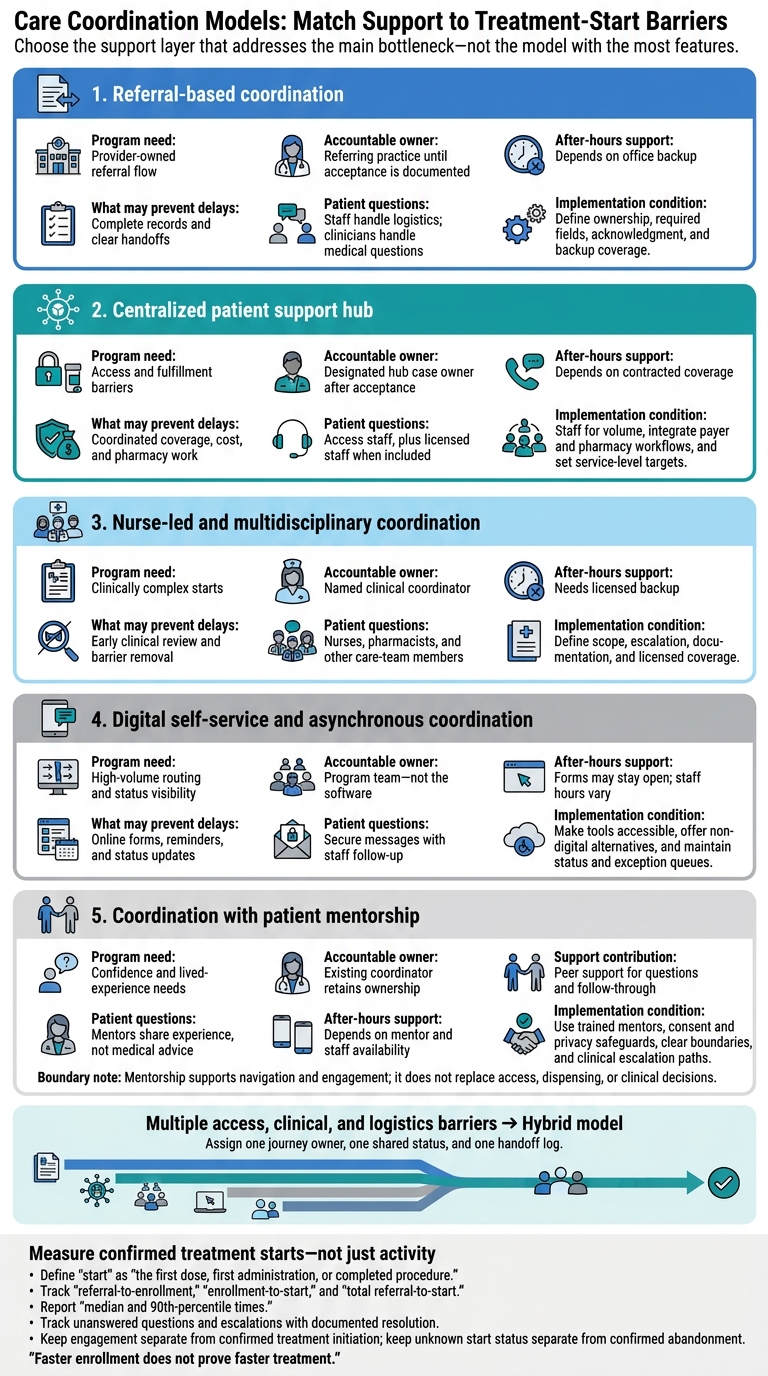
Care Coordination Models: Match Support to Treatment-Start Barriers
Unit 1 Lecture A: What is Care Coordination
sbb-itb-8f61039
1. Referral-Based Care Coordination
Referral-based coordination is the baseline model: the referrer starts the process, and the receiving team takes over after intake.
Referral Ownership and Intake
A clinician identifies an eligible patient, gets consent, and submits a referral through the EHR, portal, fax, phone, or enrollment form. The receiving team checks the patient’s identity, indication, prescriber details, documentation, insurance, and contact preferences. It then assesses urgency and eligibility.
Assign one named coordinator and a backup to manage handoffs for benefits review, prior authorization, patient support programs, and scheduling.
Time to Treatment Start
Set deadlines for each handoff to shorten the time from referral to treatment:
- Acknowledge the referral within 1 business day.
- Request missing information within 1 business day.
- Complete benefits verification within 2 business days.
- Submit prior authorization within 1 business day after documentation is complete.
Track median and 90th-percentile referral-to-start times, plus time spent waiting for records, payer decisions, and patient responses. Send urgent referrals to clinical review instead of leaving them in the routine queue.
Clear intake ownership is only part of the work. Patients also need answers before treatment can begin.
Patient Questions and Support Coverage
Give patients one contact channel, clear support hours, and a response-time standard. Coordinators can explain benefits status, paperwork, and scheduling. Questions about symptoms, dosing, or whether treatment is appropriate should go to a nurse, pharmacist, or prescriber.
Set after-hours instructions and backup escalation paths for urgent concerns, denied authorizations, missed appointments, failed deliveries, and patients who cannot be reached. Business-hours-only coverage is not enough for high-touch programs. Route clinical questions promptly so unanswered questions don’t delay treatment.
As programs grow, teams need the same workflow to work consistently across sites.
Enterprise Integration and Scale
Use shared intake fields, consent rules, referral statuses, role-based access, and audit trails across sites. These shared standards matter most when several sites use the same referral workflow, but triage rules should remain therapy-specific.
Connect EHR, CRM, benefits, and scheduling workflows so every open referral has an owner and a next action. This model suits enterprise programs that need consistent intake and tracking, but unclear ownership leaves gaps.
Close each referral with a documented outcome - started, declined, transferred, ineligible, or unreachable - and send that outcome to the referring clinician. Track confirmed treatment starts separately from completed specialist visits.
As referral volume grows, teams often organize this workflow into a centralized support hub.
2. Centralized Patient Support Hubs
Referral Ownership and Intake
A centralized hub owns each case from receipt to confirmed treatment start. It coordinates the same referral steps across external partners without changing what counts as a start. The case owner tracks receipt, consent, benefits, approvals, education, scheduling, and confirmed start.
Sending a case to a pharmacy doesn’t close it. The hub still needs to reconcile partner updates and fix failed handoffs. It remains the control point for handoffs, approvals, and exceptions.
Time to Treatment Start
Run benefits review, documentation collection, and affordability screening in parallel when possible. Check eligibility for commercial copay support, manufacturer assistance, or bridge supply early, including restrictions for public programs. Never promise assistance before approval.
Track missing documentation, payer decisions, and assistance determinations separately. This helps teams see exactly what’s delaying treatment.
Patient Questions and Support Coverage
Use tiered support. Service representatives handle enrollment and delivery, reimbursement specialists address coverage and cost, and nurses or pharmacists provide clinical education.
Publish support hours, time zone, callback expectations, language access, and after-hours instructions. Set clear escalation routes for denied coverage, unavailable assistance, failed delivery, and clinical concerns. A general callback queue isn’t enough.
Enterprise Integration and Scale
Connect case management with pharmacy feeds, provider portals, and reporting systems through a shared case identifier. Require partner receipt acknowledgments, timestamped updates, and exception queues.
Keep approved, dispensed, and started as distinct statuses. A shipment alone doesn’t confirm that treatment began. Limit data access by role, and keep patient-support data separate from marketing activity.
Judge scale by maintained service levels and confirmed starts - not just call volume or cases opened. Track overdue cases, abandonment, and escalation rates by therapy, payer, and dispensing channel. Poor hub design creates bottlenecks and unnecessary transfers.
When intake includes clinical triage, coordination shifts toward nurse-led and multidisciplinary teams.
3. Nurse-Led and Multidisciplinary Coordination
Referral Ownership and Intake
When referrals need clinical triage and help removing barriers, coordination moves beyond administrative tracking into shared care management. Unlike referral-only and hub models, this approach brings triage, education, and barrier removal into one team.
Assign one accountable referral owner - usually an RN, nurse navigator, or program coordinator - from intake through the first treatment start or formal handoff. This person checks completeness, confirms eligibility and urgency, documents consent, and coordinates benefits and clinical review. Define when responsibility passes to a pharmacist, social worker, prescriber, specialty pharmacy, or infusion team. Record every cross-role transfer in the shared care plan.
At intake, record the referral source, diagnosis and indication, prescriber, preferred care site, contact and language preferences, insurance, medications, allergies, relevant test results, urgency, and known barriers. Explain the program, document permission to exchange information, and confirm caregiver involvement. The nurse then assesses clinical readiness, health literacy, transportation, affordability, caregiver support, and practical barriers. These findings shape a care plan with milestones, owners, and escalation points.
Time to Treatment Start
Assign tasks with due dates rather than relying on informal handoffs. Nurses triage and educate; pharmacists reconcile medications and resolve interaction concerns; navigators handle appointments and benefits; social workers address practical barriers; and clinicians make final treatment decisions. Record these responsibilities in the shared care plan to avoid duplicate work, gaps, and delays tied to missing records, authorization, or clinical review.
Track referral-to-contact, referral-to-clearance, clearance-to-appointment, and referral-to-first-dose times. Also track the percentage of starts delayed by missing records, authorization, laboratory results, scheduling, or access barriers. Prescriber review, medication availability, and specialty-pharmacy enrollment can also hold up treatment. Compare median and 90th-percentile start times by referral source, payer, treatment, and site - not just one overall average.
Patient Questions and Support Coverage
Patient questions may involve clinical care, logistics, or psychosocial needs. Give patients one contact line, then route each question to the right discipline: nurses for symptoms and care plans, pharmacists for medication questions, navigators for access and scheduling, and social workers for practical and psychosocial barriers.
Protocols should spell out each role’s scope and escalation threshold. Direct emergencies to 911 or urgent care, as appropriate - not through coordination staff. Provide cross-trained backup coverage, documented cross-role handoffs, and an after-hours pathway. CMS care-management guidance supports continuity through a designated team member who remains regularly available to the patient and caregiver.
Enterprise Integration and Scale
Use a shared record with role-based access, ideally integrated with the enterprise EHR or connected through secure interfaces. It should show referral status, consent, care-plan goals, medication reconciliation, allergies, labs, authorization, appointments, patient questions, outreach, and escalation decisions. Enable secure information exchange with referring practices, specialty pharmacies, infusion centers, community partners, and authorized caregivers. Standardized templates, structured fields, and closed-loop referral updates help prevent missed handoffs and treatment-start delays. They also support comparisons across programs.
Covering staff need access to pending tasks, patient preferences, and escalation status to maintain care across disciplines. Define which disciplines can act independently and when a supervisor or clinician must step in. Daily or shift-based huddles can review approaching treatment-start deadlines, unresolved clinical risks, and overdue tasks. Patient-facing messages should name the team, not just one person. Document all material activity in the shared record.
When routine coordination can move into patient-led workflows, digital self-service can take on part of this workload.
4. Digital Self-Service and Asynchronous Coordination
This model moves routine intake, reminders, and updates online while staff handle exceptions.
Referral Ownership and Intake
Accept electronic referrals through a mobile-friendly form, portal, prescriber invite, or assisted phone enrollment. Follow a clear workflow: referral received → eligibility checked → patient invited to self-enroll or get help → consent recorded → missing items requested → coordinator assigned.
Patients should be able to save and resume, upload documents, review consent, and see what’s incomplete. Verify identity, eligibility, insurance, contact preferences, consent, and required documents.
Define when staff step in for incomplete intake, unreadable files, or missing signatures. Digital intake should reduce work - not shift responsibility to patients. Record the consent version, date and time, method, scope, and withdrawal status.
Time to Treatment Start
Send reminders for unfinished tasks based on patient preferences, and stop them when the task is complete or the patient opts out. Show progress toward treatment start in plain language, with the next action clearly visible.
Measure median and 90th-percentile time to first outreach, completed enrollment, benefits verification, prior-authorization submission, approval, shipment or appointment, and treatment start.
Track referral completeness, document rework, abandonment, failed contacts, payer turnaround, and missed service targets by channel and patient segment. Completing a form alone doesn’t shorten time to treatment. Approval, scheduling, and patient readiness still matter.
Patient Questions and Support Coverage
Use secure messaging for nonurgent questions about documents, coverage, and progress. Keep diagnosis and medication details out of external notifications.
Before enrollment, publish response hours, expected turnaround, supported channels, and emergency instructions. Assign a named owner and backup queue, and include a visible “talk to a person” option.
Keep nonurgent issues in the queue, but route urgent or clinical issues to staff immediately. Send clinical questions to licensed staff and escalate safety concerns through defined pathways. An automated acknowledgment is not a resolved request.
Enterprise Integration and Scale
Use standard interfaces to exchange referral requests, task status, and messages. An alert does not mean a task is complete.
Require auditable records, shared status visibility, and documented steps for handling failures across enterprise systems. Before scaling, test consent withdrawal, duplicate submissions, portal outages, wrong contact information, document rejection, and stalled referrals.
When digital workflows can’t resolve barriers or questions, the next model adds human mentorship to help patients move forward. This approach often involves strategic care partners who provide peer-to-peer support and guidance.
5. Coordination With Patient Mentorship
This model fits when access is already moving forward, but patients need confidence, motivation, or practical guidance to complete the next steps.
Referral Ownership and Intake
Mentorship brings in lived experience, with one designated owner responsible for triggering the referral. Unlike the other models, it focuses on patient confidence and persistence - not just completing a workflow. Mentorship supports navigation and engagement; it does not replace access, dispensing, or clinical decisions.
Record matching criteria and patient preferences. Patients must be free to decline or withdraw without losing access to treatment or other services. Share only the data needed for matching, and use a HIPAA-compliant authorization when PHI moves outside permitted treatment, payment, or operations. For PatientPartner, confirm vendor-described matching features during implementation before using them.
Assess whether mentorship changes engagement without presenting it as a way to shorten time to treatment.
Time to Treatment Start
Mentorship may help patients prepare questions, understand next steps, and stay engaged. It does not guarantee a faster start. The platform describes first two-way conversations within 6–48 hours.
Track match time, time to first contact, and contact completion. Measure contact separately from treatment start; a first conversation is not a treatment-start metric.
Patient Questions and Support Coverage
Mentors offer emotional and practical support, from preparing for treatment and organizing appointments to communicating with care teams. Do not present personal experience as medical advice. Licensed staff handle clinical issues, while access staff handle benefits and logistics. Train mentors on boundaries, privacy, crisis recognition, and safety reporting. Set clear escalation paths for urgent concerns.
Coverage depends on mentor availability, language match, hours, response-time standards, geography, and escalation staffing. Publish support channels and after-hours arrangements; “real-time” matching does not mean continuous clinical coverage.
Clear mentor boundaries also give the program a basis for tracking quality, privacy, and escalation as it grows.
Enterprise Integration and Scale
Link mentorship activity to patient case records and safety-reporting workflows. Verify vendor-described privacy and monitoring capabilities before implementation. Validate access controls, retention, recording permissions, and withdrawal handling. Where possible, use aggregated or de-identified sentiment reporting, but do not treat it as a clinical assessment.
For enterprise programs, track match rate, escalation handling, privacy incidents, and safety-report timeliness alongside contact metrics. Scale only after medical, legal, privacy, regulatory, pharmacovigilance, and patient-services review.
How the 5 Models Compare
The tables below compare the five models using the same decision points.
Referral Ownership and Intake
Track each intake status separately: receipt, acceptance, missing information, consent, eligibility, enrollment, and closure. Use standard intake fields, duplicate checks, and closed-loop status updates.
| Model | Entry point | Accountable owner | Intake requirements | Handoff risk |
|---|---|---|---|---|
| Referral-based | Provider order or office referral | Referring practice until acceptance is documented | Patient identifiers, treatment intent, records, insurance, required consent | Follow-up stalls when office staff assume the receiving team has accepted |
| Centralized hub | Provider start form or program referral | Designated hub case owner after acceptance | Core referral data, eligibility documents, consent, benefits information | Missing records bounce between the hub and practice |
| Nurse-led and multidisciplinary | Clinical team referral | Named clinical coordinator | Core intake plus clinical-readiness information | Clinical review or unclear task ownership delays enrollment |
| Digital self-service | Portal, web form, text, or electronic referral | Program operator - not the software vendor | Verified identity, complete fields, consent, language and accessibility needs | Submitted forms remain unaccepted or incomplete |
| Coordination with mentorship | Consented introduction within the existing program | Existing coordinator retains referral ownership | Minimum matching information; primary intake stays with the program | A mentor introduction is mistaken for completed referral management |
Time to Treatment Start
Report three intervals: referral-to-enrollment, enrollment-to-start, and total referral-to-start. Choose one definition of start - dispensing, first dose, or administration - and track each stage separately.
| Model | Potential speed advantage | Likely bottleneck | Measurable risk of delayed or missed start |
|---|---|---|---|
| Referral-based | Complete records and established payer workflows can prevent rework | Follow-up spread across offices | Incomplete-referral rate; time awaiting acceptance; unreachable patients |
| Centralized hub | Standardized benefits work and reminders | Queues, payer decisions, missing records, pharmacy or site capacity | Stage-level waiting time; resubmissions; enrolled patients without confirmed starts |
| Nurse-led and multidisciplinary | Early resolution of clinical-readiness questions | Licensed staffing and caseload limits | Time awaiting clinical review; clinical deferrals; scheduling delays |
| Digital self-service | Faster form collection and routine updates | Incomplete inputs, identity checks, digital exclusion | Form abandonment; failed verification; cases awaiting human follow-up |
| Coordination with mentorship | Added support may help patients follow through | Access and clinical steps remain with other teams | Uncompleted next-step requests; confirmed starts measured separately from engagement |
Report median and 90th-percentile times for all three intervals, along with confirmed-start rates that use clear denominators. Faster enrollment does not prove faster treatment. In one 12-month observational study, 131 of 193 mentor-connected patients requested a next step. That measures engagement - not confirmed initiation or a causal treatment-start benefit.
Patient Questions and Support Coverage
| Model | Question coverage | Responsible responder | Availability dependencies | Escalation path |
|---|---|---|---|---|
| Referral-based | Referral status, appointments, basic logistics | Practice staff; clinician for medical questions | Office hours and backup staff | Receiving team or treating clinician |
| Centralized hub | Access, cost, financial assistance, scheduling | Access specialists; licensed staff where included | Contracted hours, payer and partner availability | Access supervisor or clinical team |
| Nurse-led and multidisciplinary | Preparation, administration, symptoms, clinical education | Licensed professionals within their scope | Caseload, licensure, interpreter and backup coverage | Treating clinician or emergency services |
| Digital self-service | Standard administrative answers, forms, reminders | Approved content plus staffed exception handling | Accessible design and human response commitments | Named support queue; urgent concerns routed outside routine messaging |
| Coordination with mentorship | Practical routines and lived-experience questions | Mentor for peer support; licensed staff for clinical issues | Mentor availability and program backup | Existing access or clinical team |
An open channel does not guarantee a response. Publish hours, response times, language access, accessibility support, and caregiver options separately. Track unanswered contacts by language and channel, and make sure urgent concerns bypass routine support queues.
Enterprise Integration and Scale
Use these labels only to describe workflow fit - not as validated scores: S - strong; M - moderate; L - limited; I - implementation-dependent. Mentorship ratings describe only its added contribution; “ - ” means responsibility stays with the primary program.
| Model | Referral ownership | Intake simplicity | Reduce start delays | Benefits/access | Clinical questions | Lived experience | After-hours availability | Escalation | Team coordination | Scale across products and markets | Enterprise integration | Adherence support | Data/reporting requirements |
|---|---|---|---|---|---|---|---|---|---|---|---|---|---|
| Referral-based | S | M | M | M | M | L | I | M | M | I | I | M | Cross-office status exchange; acceptance and closure logs |
| Centralized hub | S | M | M | S | I | L | I | S | S | I | I | M | Case records; payer, pharmacy, and provider feeds; queue reporting |
| Nurse-led and multidisciplinary | S | M | M | M | S | L | I | S | S | I | I | S | Clinical documentation; staffing, handoff, and escalation records |
| Digital self-service | I | I | I | M | L | L | I | I | I | I | I | M | Identity matching; consent logs; abandonment and exception tracking |
| Coordination with mentorship | - | - | I | - | - | S | I | M | M | I | I | M | Link engagement and escalation events to the primary case, keeping them separate from start outcomes |
When combining models, assign one record owner and one source of truth for referral status. Agree on event definitions, timestamps, reason codes, and reporting denominators before connecting systems.
The next section examines the strengths, limits, and implementation risks behind these differences.
Strengths, Limits, and Implementation Risks
The comparison above shows where each model fits. Here, the focus shifts to where it can fail in practice. Staffing, permissions, workflow design, and escalation rules determine whether a model works. Judge execution - not promises - across referral flow, speed to start, patient questions, support coverage, and enterprise fit.
| Model | Prerequisites | Strengths | Limitations | Measurable risks to treatment starts | Preventive controls |
|---|---|---|---|---|---|
| Referral-based | Complete referral packet, required signatures, consent, and office follow-up capacity | Builds on existing clinical relationships | Office bottlenecks and manual transfers can leave missing information unresolved | Stalled authorizations; referrals awaiting contact; missed scheduling | Check required fields before transfer; assign backup staff; require receiving-team acknowledgment |
| Centralized patient support hub | Validated consent, payer-specific workflows, current records, and secure information exchange | Brings access work and exceptions into one place | A central queue alone cannot resolve missing tests, signatures, or payer decisions | Repeated document requests; aging authorizations; abandonment before a confirmed start | Route exceptions to a named office contact; reconcile pharmacy and provider updates; audit unresolved cases |
| Nurse-led and multidisciplinary | Enough licensed staff, scope-of-practice rules, shared documentation, and backup coverage | Pairs clinical triage with help removing barriers | High caseloads and divided clinical responsibility can delay decisions | Unanswered questions; unresolved escalations; missed appointments | Set acuity-based caseload limits; use triage protocols and warm handoffs; review overdue clinical issues |
| Digital self-service and asynchronous | Accessible tools, identity checks, consent capture, staffed message review, and live-support alternatives | Lets patients handle routine tasks beyond office hours | Login, device, language, and broadband barriers can prevent completion | Incomplete tasks; unread messages; abandonment concentrated in particular channels | Offer phone support and interpreters; flag failed outreach; compare task completion and starts across patient groups |
| Coordination with mentorship | Mentor training, consent, limited record access, supervision, and defined referral routes | Brings practical concerns to light before treatment starts | Nonclinical support cannot resolve authorization, prescribing, or urgent medical issues | Unanswered medical questions; delayed escalation; engagement without a confirmed start | Set clear boundaries; route clinical and safety concerns to qualified teams; audit escalation closure separately from mentor engagement |
A forwarded escalation is not a resolved escalation. Record who accepted it, what action remains, and when resolution is due. Clinical and safety concerns that affect readiness to start need a named reviewer and documented reporting procedures. Automated flags can help staff review cases, but they cannot replace accountable staff.
Mentorship also needs its own governance rules. For programs using PatientPartner, define mentor boundaries, consent, privacy safeguards, approved channels, response expectations, supervision, and escalation rules. Limit mentor access to what peer support requires. Route clinical or urgent concerns to qualified staff on the primary care team so unanswered questions do not stall the start workflow.
Review abandoned starts by their recorded cause: missing consent, incomplete documentation, cost, unanswered questions, missed appointments, or failed handoffs. Keep patients with unresolved start status separate from confirmed abandonment. Otherwise, weak follow-up can look like patient choice, leaving the underlying failure hidden.
Conclusion: Choose a Model and Measure Results
Choose the support layer that addresses the main bottleneck, not the model with the most features. Match the need to the lightest model that can solve it.
| Program need | Suitable model or support layer | Implementation condition |
|---|---|---|
| Provider-owned referral flow | Referral-based coordination | Define ownership, required fields, acknowledgment, and backup coverage. |
| Access and fulfillment barriers | Centralized patient support hub | Staff for volume, integrate payer and pharmacy workflows, and set service-level targets. |
| Clinically complex starts | Nurse-led or multidisciplinary coordination | Define scope, escalation, documentation, and licensed coverage. |
| High-volume routing and status visibility | Digital and asynchronous coordination | Make tools accessible, offer non-digital alternatives, and maintain status and exception queues. |
| Confidence and lived-experience needs | Patient mentorship | Use trained mentors, consent and privacy safeguards, clear boundaries, and clinical escalation paths. |
| Multiple access, clinical, and logistics barriers | Hybrid model | Assign one journey owner, one shared status, and one handoff log. |
Before launch, agree on the definitions and measurement rules you'll use to assess whether the model improves starts.
Define referral-to-enrollment and enrollment-to-start, then report median and 90th-percentile times monthly. Use CRM timestamps for enrollment and pharmacy or clinical records to verify starts.
Each week, track overdue questions against the response standard. Also track escalations with documented resolution within the target timeframe. Calculate abandonment among eligible patients within a preset window, and keep unknown status separate. Measure patient confidence at enrollment and after support using the same survey, and report response rates.
Keep initiation separate from longer-term outcomes. Review persistence at 90 and 180 days using a defined allowable-gap rule. Measure adherence only where appropriate - for example, proportion of days covered for applicable medications or on-time scheduled administrations. Establish these outcomes through dispensing or clinical records, not engagement activity.
Standardize reporting to allow comparisons across sites, therapies, and patient segments. Document each metric’s numerator, denominator, timestamps, exclusions, source, and reporting period.
Compare similar populations by payer, disease severity, therapy complexity, site, language, and digital access. Report sample sizes and missingness. Without a valid comparison design, describe differences as associations - not proof that one coordination layer caused better results.
FAQs
How do we identify our biggest treatment-start bottleneck?
Review engagement data to see where potential patients drop off or get stuck. Look for slow responses, disconnected communication, and gaps in your view of patient concerns.
Use real-time dashboards to track the patient journey and spot recurring questions. Compare engagement with patient readiness to determine whether delays come from missing information, trouble navigating the clinical pathway, or too little peer guidance at key decision points.
When should we combine care coordination models?
Combine care coordination models when your goals call for both human empathy and digital efficiency. Digital tools can automate tasks and collect data. Peer mentorship adds personal support to help patients work through hesitation and stay with treatment over time.
Together, these models help enterprise programs respond in real time while giving patients personalized support to start treatment successfully and continue their care.
How can we test whether coordination improves treatment starts?
Track more than engagement. Connect clinical milestones to business goals by measuring monthly referral rates, treatment scheduling, and actual prescription fills. Use customizable dashboards to see new treatment starts in real time.
Set clear rules for data access and use a strict tracking method to separate patient-reported interest in a next step from a verified treatment start.