


Multilingual Patient Education: Best Practices for Pharma
Key Takeaways
Author


If patients can’t read or trust therapy instructions, care can break down fast. In the U.S., more than 1 in 5 households speaks a language other than English at home, so pharma teams need patient education that is plain, accurate, reviewed, and easy to deliver.
Here’s the short version: I’d start with simple English source copy at a 6th- to 7th-grade reading level, build in room for text expansion like Spanish growing by 20% to 25%, use a risk-based translation workflow such as TEP (translate, edit, proofread), and push approved content through digital channels patients already use. For high-risk materials like dosing, consent, and medication guides, I’d add back-translation, version control, and medical review in the target language.
What matters most:
- Write for clarity first so translation does not distort safety meaning
- Plan for language and community fit in words, visuals, and examples
- Set one content standard across medical, legal, regulatory, and marketing
- Match review depth to risk because 63% of medical translation errors may have clinical effects
- Use digital delivery to track completion, confusion points, and support needs
- Add live mentor support when content alone is not enough for treatment starts or high-stress decisions
A simple way to think about it: clear source copy + controlled translation + tracked delivery + human support when needed.
| Area | What I’d do |
|---|---|
| Source writing | Keep it plain, direct, and safety-focused |
| Translation | Use TEP, glossary, and version control |
| High-risk content | Add back-translation and medical review |
| Layout | Leave room for text growth and format changes |
| Delivery | Send through portals, apps, SMS, and email |
| Measurement | Track adherence, completion, confusion, and call volume |
Below is a concise take on the article’s main points, without repeating it section by section.
Capturing the Patient’s Voice in Translation | MultiLingual Summer Series 2021
sbb-itb-8f61039
Build content that is clear in English before translating it
Before translation starts, lock the English source. Start with source copy written for translation, not just for reading. Clear source copy cuts translation mistakes and helps keep clinical meaning intact.
Write source materials for health literacy and safety
The American Medical Association (AMA) and the National Institutes of Health (NIH) recommend writing public-facing health information at a 6th–7th grade reading level. That target should guide every writing choice.
Use active voice, short sentences, and common words.
Modal verbs matter more than they seem. Use "must" for obligations and "should" for recommendations. If teams mix them up, a required safety step can sound like optional advice.
Use teach-back before finalizing the source. If patients can’t restate the instructions correctly, the copy needs work.
Adapt content for culture, not just language
Once the source copy is clear, adapt examples and visuals for the audience. This work shouldn’t wait until after translation. It needs to shape the English draft from the start.
Idioms are a simple example. Replacing "watch your sugar" with "monitor your blood sugar levels" makes the instruction safer and easier to translate later.
Visuals and examples need that same level of care. Nutrition guides, for example, can mention corn tortillas instead of bread for Hispanic communities. Small changes in wording and imagery can cut confusion before translation even begins.
Bring in community health workers or patient advocates during drafting, not only at review.
Create a multilingual content standard for enterprise teams
Without a shared standard, medical, legal, regulatory, marketing, and compliance teams will all write source content in their own way. When that happens, translation quality shifts from one asset to the next. A documented enterprise style guide helps stop that drift.
The guide should define:
- reading-level targets
- approved terminology
- rules for "must" vs. "should"
- mandatory regulatory statements that need 100% fidelity
- layout rules, including space for language expansion
The table below sums up the core controls any pharma content standard should lock down before translation begins:
| Standard Element | Requirement | Why It Matters |
|---|---|---|
| Reading Level | 6th–7th grade | Ensures accessibility across literacy levels |
| Terminology | Approved word list; common words only | Reduces variation across teams and translation errors |
| Regulatory Terms | "Must" vs. "should" defined explicitly | Prevents safety and compliance failures |
| Mandatory Statements | Frozen list; 100% translation fidelity required | Maintains FDA and regulatory alignment |
| Layout Buffer | Expansion space built into templates | Accommodates text growth across target languages |
Use the style guide to control intake, translation, and approvals. Then connect that same standard to translation review and sign-off.
Set up a translation and quality control workflow that reduces risk
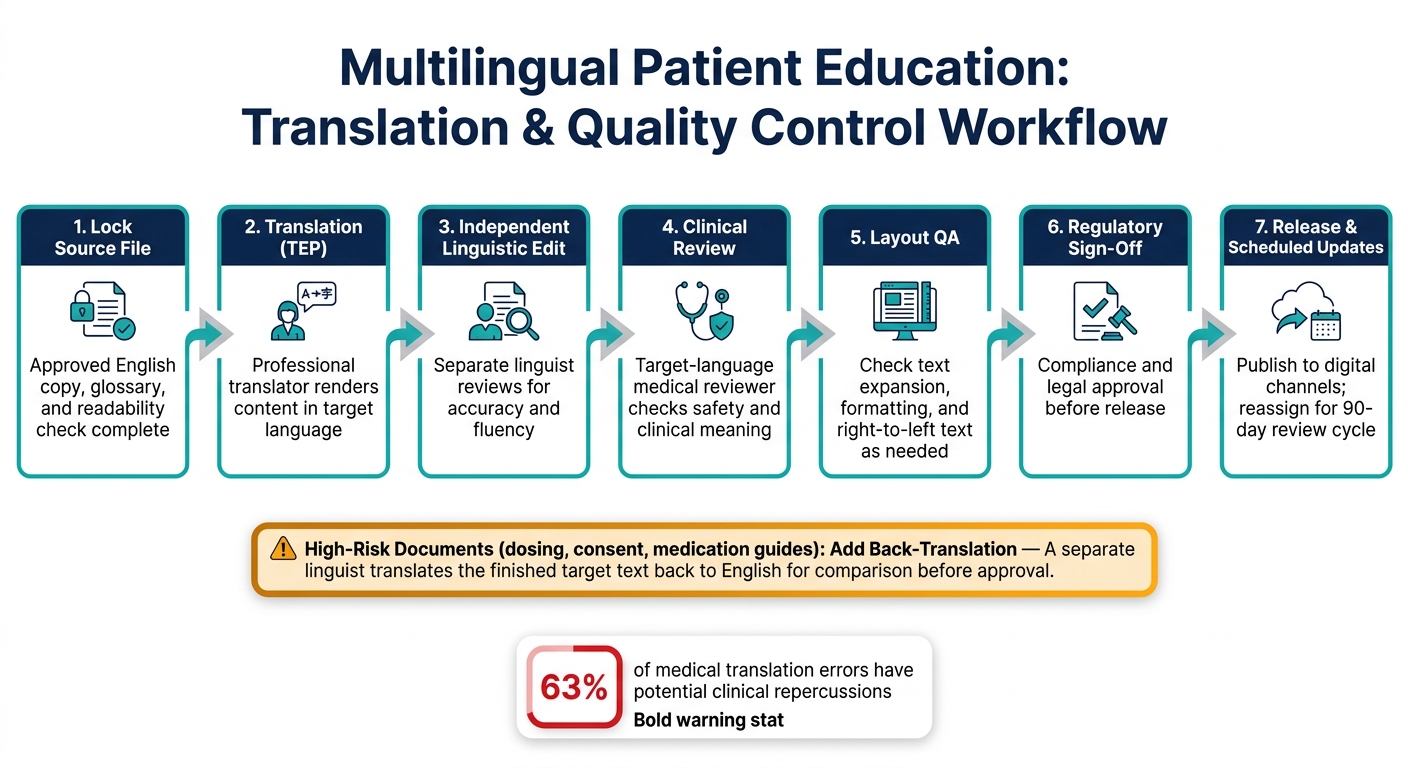
Multilingual Patient Education Workflow: From Source Copy to Patient Support
A controlled workflow helps multilingual education stay accurate, easy to review, and ready to publish. The safest path is TEP - translate, edit, proofread - instead of a one-pass translation.
Start with the approved source file, glossary, and a readability check. Then move through translation, an independent linguistic review, clinical review by a target-language medical reviewer, layout checks for text expansion and right-to-left text, regulatory sign-off, release, and scheduled updates. Once the source is locked, every handoff needs a check. That’s what helps keep instructions clear when patients use them in everyday life.
Assign one owner to review each translation every 90 days against the English source. If you skip that step, old translations can stay in use long after the source has changed.
For high-risk documents - dosing instructions, consent forms, and medication guides - back-translation adds another check. A separate linguist translates the finished target text back into English. Then that version is compared with the original. If the meaning drifts, the translation goes back for correction before approval.
Match translation method to document risk
The method should match the document’s risk level. One mistranslated word can alter dosing, warnings, or use instructions. Research shows why this matters: 63% of medical translation errors have potential clinical repercussions. That number is enough to support a tiered approach.
| Translation Method | Accuracy | Speed | Cost | Cultural Fit | Regulatory Risk |
|---|---|---|---|---|---|
| Professional Medical Translation | Highest | Moderate | High ($0.10–$0.40/word) | High | Lowest |
| Machine Translation + Expert Post-Editing | High | Fast | Moderate | Moderate | Low–Moderate |
| Internal bilingual review | Variable | Fast | Low | High | High |
| Community/Patient Review | Moderate | Slow | Low | Highest | Moderate |
Use professional translation for safety, dosing, and regulatory content. Machine translation with expert post-editing (MTPE) fits high-volume, lower-risk educational content. But there’s a catch: it should run on a trained custom engine, not a generic off-the-shelf tool.
Control terminology, versions, and approvals
Use the approved glossary and translation memory. Tie each asset to a source version. Then send changes to the right owner, whether that’s medical, legal, or regulatory. When the source changes, the change log should show which language versions are now out of sync. Without version control, patients can end up with conflicting instructions.
Any workflow that touches patient data should run under a BAA to maintain HIPAA compliance. In a regulated pharma setting, auditability isn’t optional. It’s the baseline.
After approval, route the translated content into the patient’s preferred digital channel.
Deliver multilingual education through digital patient support workflows
Once content gets approved, distribution becomes the make-or-break step. A PDF sitting in a shared drive doesn't help patients. The job is to place multilingual education inside the digital touchpoints people already use: patient portals, mobile apps, SMS, and email journeys.
Design digital delivery around patient language preference
Start at onboarding. Capture each patient's language, preferred channel, literacy level, and treatment stage, then send education based on those details. That's where digital delivery pulls ahead of paper. It lets teams deliver the same core information in different formats within one workflow.
Video, audio, interactive modules, and text-to-speech can all work together in a single path. That matters a lot for patients with low health literacy. It also helps teams apply literacy standards more evenly across languages, instead of treating plain-language support as an afterthought.
Compare static handouts with digital multilingual workflows
The gap comes down to day-to-day execution: how fast teams can update materials, how well they can tailor them, and what they can measure afterward.
| Feature | Static PDF/Paper Handouts | Multilingual Digital Platforms |
|---|---|---|
| Update Speed | Slow; requires re-printing and manual distribution | Fast; updates pushed instantly via CMS |
| Language Coverage | Limited by physical inventory and printing costs | Scales across dozens of languages on demand |
| Personalization | One-size-fits-all | Tailored to language, literacy, and treatment stage |
| Analytics | None; no visibility into whether the patient read it | Tracks completion, comprehension, and drop-offs |
| Accessibility | Limited to visual reading of printed text | Includes text-to-speech, video, and adjustable fonts |
| Workflow Integration | Manual; often handed out at the end of a visit | Built into portals, apps, and support programs |
One 2025 portal rollout across 10 languages increased engagement by 40% and reduced support calls by 25%.
Measure outcomes that matter to commercial and compliance leaders
Digital delivery gives teams something paper never could: usable data. For commercial teams, medication adherence rates and patient satisfaction surveys can point to whether education is landing. For compliance teams, drop-off points and misuse-related adverse events can show where content may need to change.
Just as important, digital analytics can show more than opens. Teams can see whether patients finish the content and whether they understand it, not just whether they clicked on it. If one language group keeps reporting confusion, that's a clear signal to revise the material and tighten the message.
For patients who still need reinforcement, digital education should hand off to live mentorship.
Combine multilingual education with real-time mentorship and an action plan
When digital education leaves patients with unanswered questions, live mentorship can step in and close that gap.
Where PatientPartner fits in a multilingual patient education strategy
Digital education matters. But it can't answer every question the moment a patient has it.
That’s where PatientPartner comes in. It works as an escalation layer after multilingual content, linking prospective patients with experienced mentors who offer real-time guidance across the healthcare journey. For high-stakes decisions like complex therapy starts, surgeries, or clinical trials, static materials often aren’t enough to close gaps in understanding.
Mentors can help with the parts that written or video content often misses: anxiety, stigma, and patient-specific confusion. They also capture patient feedback, which helps teams see how people are reacting to the education they receive.
The impact tends to show up in three places: comprehension, confidence, and follow-through.
Compare content-only education with mentor-supported education
| Dimension | Multilingual Content Only | Content + Real-Time Mentorship (PatientPartner) |
|---|---|---|
| Comprehension | Improves with plain language and visuals | Deepens through real-time clarification, especially for LEP and low-literacy patients |
| Confidence | May drop if side effects or technical details create uncertainty | Improves through emotional support and personalized reassurance |
| Activation | Passive - patients consume the content and act without live support | Active - mentors provide proactive guidance |
| Adherence | Can improve by 25% with culturally adapted translations | Can improve further by addressing emotional barriers and confusion during new patient starts |
| Feedback | Quantitative (clicks, views, downloads) | Qualitative (patient sentiment and confusion alerts) |
These differences help show where mentorship should fit in a rollout.
Conclusion: Key steps for scaling a compliant, effective program
Start with clear source content. Then put translation controls, digital delivery, and mentorship in place for high-risk patient journeys.
Write source copy at a 6th- to 7th-grade reading level before translating anything. Adjust for culture and literacy, not just language, so the material connects with the communities it serves. Build a controlled translation workflow with terminology management and compliance review built into the process.
Next, deliver content through measurable digital channels that show what patients do with the material, not just whether they received it. After that, add real-time mentorship in therapy areas where live guidance can make the biggest difference for new patient starts and long-term adherence.
A smart way to begin is to pilot the program in one therapy area first. Track sentiment, adherence, and support call volume before rolling it out more broadly.
FAQs
Which patient materials need the strictest translation review?
Materials tied to high-stakes clinical decisions or regulatory compliance need the strictest review. That applies in particular to:
- informed consent forms
- treatment plans
- eligibility decisions
- patient information leaflets
These documents shape patient safety and ethical decision-making, so they should be reviewed by qualified human medical translators or subject matter experts. For pharmaceutical submissions, rigorous quality assurance, often including back translation, helps keep the original intent intact and support regulatory requirements.
How can pharma teams measure whether multilingual education is working?
Pharma teams need to look past basic engagement metrics and focus on what happens after someone reads the content. The goal isn't just clicks or views. It's whether people understand the information, act on it, and whether the content makes day-to-day work easier.
A few metrics matter most here:
- Adherence and access: medication adherence, first-fill rates, time to fill
- Understanding: comprehension surveys, clinician and patient feedback
- Operational impact: fewer support calls, higher self-service resolution, and fewer misuse-related adverse event reports
- By language: segment results to see whether translated materials are closing health equity gaps
That last point matters a lot. If translated content gets read but doesn't improve understanding or access, something is off. Breaking results out by language helps teams see whether materials are doing their job - or whether some patient groups are still being left behind.
When should live patient mentorship be added to multilingual education?
Live patient mentorship should come in when automated multilingual outreach no longer meets what a patient needs. AI is great for routine interactions and 24/7 information. But there are moments when a person needs more than answers on a screen. They need reassurance, guidance from someone who has been through it, or a smooth handoff to a human.
Used after automated touchpoints, live mentorship helps close the gap between clinical appointments. It gives patients added confidence, supports adherence, and can improve overall outcomes.