


Real-Time Monitoring: Future of Patient Adherence
Key Takeaways
Author


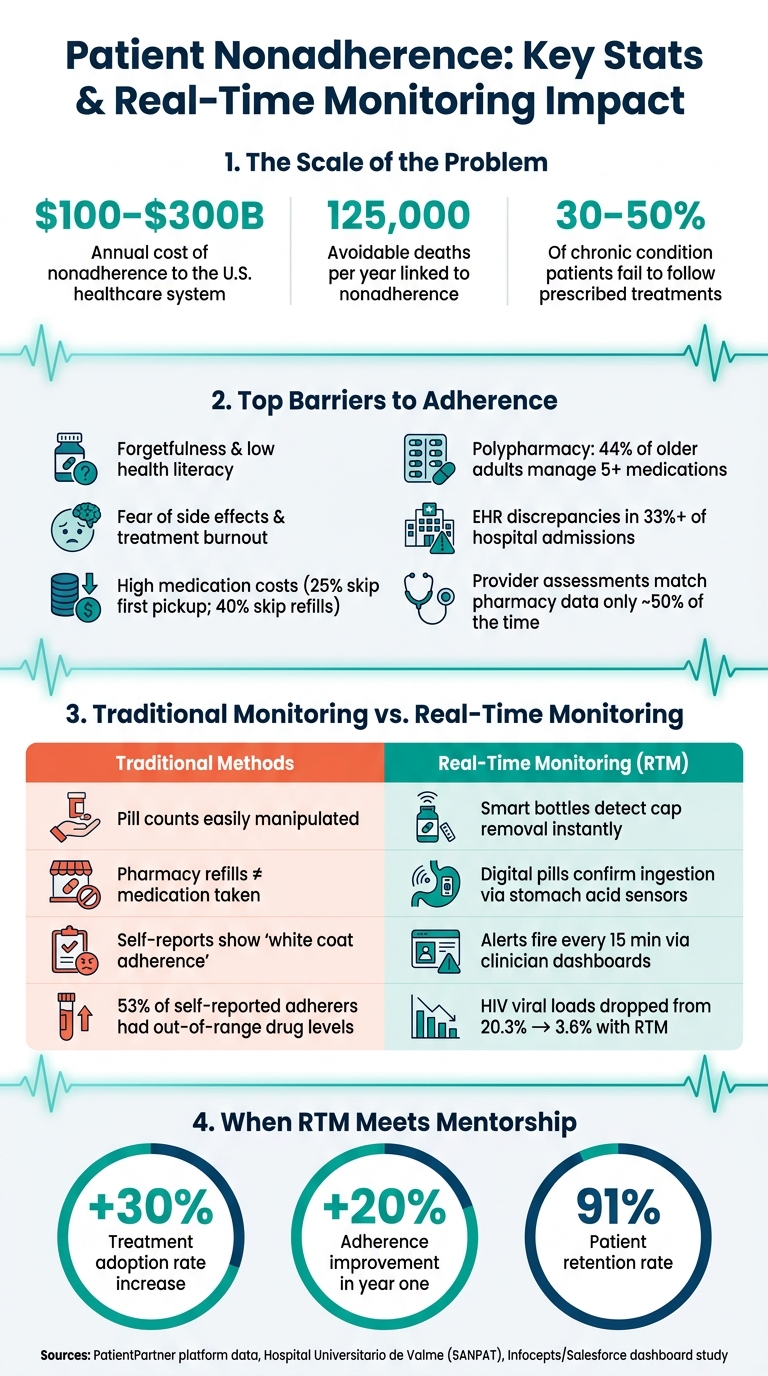
Nonadherence to medical treatments costs the U.S. healthcare system $100–$300 billion annually and contributes to 125,000 avoidable deaths each year. Real-time monitoring (RTM) is changing the game by providing immediate, precise data on medication use. Unlike older methods like pill counts or pharmacy records, RTM tools like smart pill bottles and digital pill systems track when - and if - patients take their medications. This shift allows healthcare providers to intervene early, reducing hospital readmissions and improving outcomes.
Key points:
- 30%–50% of patients with chronic conditions fail to follow prescribed treatments.
- RTM tools deliver direct, real-time data, enabling proactive interventions.
- Combining RTM with mentorship programs (e.g., PatientPartner) addresses personal barriers like fear of side effects or treatment burnout.
- AI-powered analytics can predict nonadherence risks weeks in advance, allowing tailored support.
RTM isn't just about tracking - it’s about connecting data with human support to keep patients on track and reduce healthcare costs.
Patient Nonadherence: Key Stats & Real-Time Monitoring Impact
How the Smart Pillbox is Transforming Medication Adherence
sbb-itb-8f61039
Key Barriers to Patient Adherence
Before implementing real-time monitoring solutions, it’s crucial to understand the complex, interconnected barriers that hinder patient adherence.
Systemic Barriers to Adherence
The healthcare system itself often creates conditions that make it harder for patients to stick to their prescribed treatments. One major issue is the lack of coordination between multiple specialists who rely on separate electronic health record (EHR) systems. This often results in incomplete or conflicting medication records, with discrepancies found in over 33% of patients at hospital admission. Additionally, limited consultation time prevents providers from thoroughly explaining dosing instructions, potential side effects, and the importance of regimen consistency. Financial obstacles further complicate adherence - high medication costs and inadequate insurance coverage lead 25% of patients to skip their initial prescription pickups, while 40% fail to refill their medications. These systemic gaps delay critical interventions and leave patients without the necessary support to follow their treatment plans. Real-time monitoring could help bridge these gaps by offering timely insights and interventions.
Patient-Specific Challenges
Adherence is also heavily influenced by individual factors, ranging from behavior to psychological and financial concerns. Forgetfulness, fear of side effects, depression, and low health literacy are common reasons patients abandon their treatment plans early. For older adults, the challenge is even greater - 44% of them manage five or more medications (a condition known as polypharmacy), making it harder to maintain consistent adherence. Studies reveal that nonadherence is driven by a combination of patient behavior, the complexity of the disease and therapy, healthcare system shortcomings, and socioeconomic factors. These individual challenges highlight the limitations of traditional tracking methods, emphasizing the need for real-time solutions that provide immediate and actionable data.
Shortcomings of Older Monitoring Methods
Traditional methods of tracking adherence often fail to provide a complete picture. For instance, pharmacy refill data only confirm that a medication was picked up - not whether it was taken. Pill counts can be easily manipulated, and self-reports often reflect "white coat adherence", where patients temporarily improve their behavior before a medical visit. Alarmingly, among patients who self-reported adherence, 53% had medication levels outside the recommended therapeutic range. Even primary care providers' assessments align with objective pharmacy refill data only about 50% of the time.
As Sadaf Faisal from the University of Waterloo explains:
"Currently, frequently used adherence measurements include counting pills, assessing pharmacy refill data, or patient self-reporting through interviews or questionnaires. However, these are surrogate markers of overall adherence and do not provide data related to the time of administration, dose taken or persistence."
Without accurate and timely adherence data, healthcare providers may misinterpret a patient’s condition, potentially escalating treatment unnecessarily while overlooking the root cause. These limitations underscore the gap that real-time monitoring seeks to address, offering a more precise and actionable approach to improving adherence.
Real-Time Monitoring Technologies and Their Effects on Adherence
Real-Time Monitoring Tools at a Glance
Traditional approaches often miss critical details about how patients actually take their medications. Real-time monitoring devices are stepping in to bridge this gap, capturing precise data on medication use. These tools come in various forms, each offering distinct advantages:
| Technology | How It Works | Key Benefit |
|---|---|---|
| Smart Pill Bottles | Equipped with sensors that detect cap removal | Easy to use; records access events |
| Connected Blister Packs | Conductive traces break when pills are removed | Ideal for managing complex multi-drug regimens |
| Digital Pill Systems | Ingestible sensors activated by stomach acid | Verifies ingestion with unmatched accuracy |
| Real-Time Alert Systems | Integrated with e-prescribing platforms | Notifies clinicians immediately about potential risks |
Smart pill bottles and blister packs track when patients access their medication, while digital pill systems go a step further by confirming ingestion. These devices transmit data via Bluetooth, LTE, Wi-Fi, or NFC to clinician dashboards or patient apps. This real-time data allows for better insights and quicker interventions to support adherence.
Data Analytics and Actionable Insights
Real-time tools are only part of the equation - analytics turn the captured data into meaningful action. Advanced systems use machine learning to analyze patterns like refill history, dosing habits, and engagement levels. Predictive risk scores highlight patients at risk of discontinuing treatment before it happens.
For example, in March 2026, a biotech company collaborated with Infocepts to create a prioritization dashboard within Salesforce. Updated every 15 minutes, the tool ranked patients based on factors like therapy complexity and missed doses. This targeted approach enabled 110 support specialists to focus on high-risk patients, leading to a 5% improvement in adherence across thousands of cases. Preeti Kulkarni from Infocepts summarized the strategy perfectly:
"The solution is not more patient education. It is better patient intelligence."
By embedding analytics into platforms clinicians already use, these tools ensure that actionable insights are readily available, reducing the risk of dashboard fatigue.
Benefits of Real-Time Monitoring
What sets real-time monitoring apart is its ability to shift care from reactive to proactive. A compelling example comes from Hospital Universitario de Valme in Andalusia, Spain. Between February 2024 and January 2025, the SANPAT alert system was integrated into the "Receta XXI" prescribing platform for 153 HIV patients. This led to pharmacist interventions skyrocketing from 84 to 877 and a significant drop in detectable viral loads - from 20.3% to just 3.6%.
Real-time monitoring also minimizes costly readmissions, especially for high-priced treatments like biologics, which can exceed $50,000 annually. This level of oversight ensures these expensive therapies are used effectively, improving adherence and supporting better long-term outcomes for patients. This proactive approach is further strengthened by mentorship’s impact on patient decision making, which helps patients navigate complex treatment journeys.
Combining Human Support with Real-Time Monitoring
Why Patient Mentorship Matters
Real-time monitoring can flag issues like missed doses or reduced app usage, but it doesn't uncover the deeper, personal challenges patients face - things like fear of side effects, treatment burnout, or difficulty understanding medical instructions.
That's where mentorship steps in. Pairing patients with mentors who have faced similar treatment journeys bridges this gap. Mentors help normalize fears, share practical tips from their own experiences, and connect daily treatment routines to meaningful goals, like returning to work, staying active, or avoiding hospitalization. Peer support programs for chronic conditions like diabetes, for example, have shown improvements in HbA1c levels by 0.4–0.6 percentage points. Much of this success comes down to better medication adherence and improved self-management.
PatientPartner: A Mentorship-Driven Approach
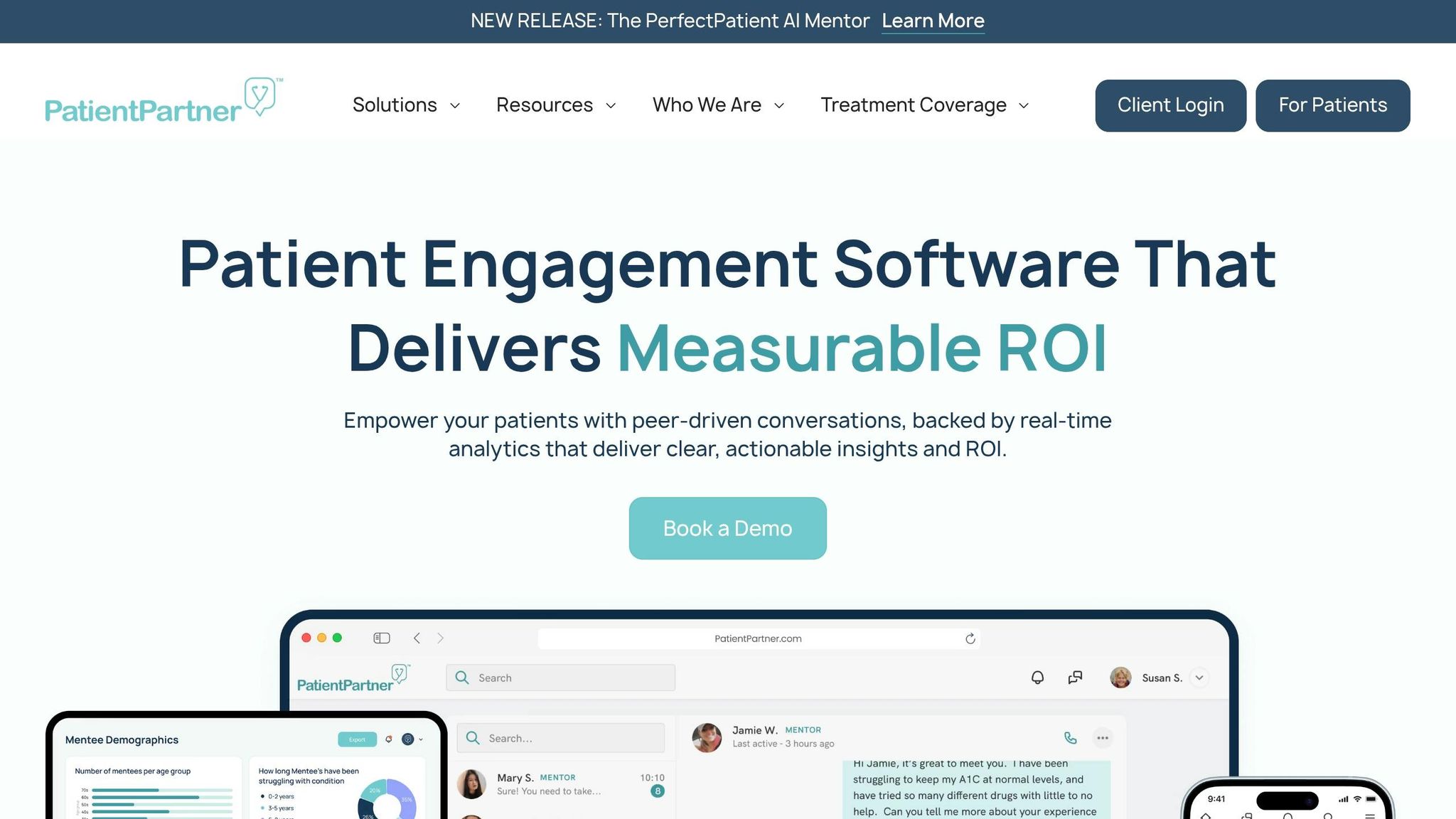
PatientPartner is a B2B SaaS platform designed to connect patients with mentors who have firsthand experience with similar treatments, medications, or surgeries. Pharmaceutical and med-tech companies use the platform to encourage treatment adoption and long-term adherence, especially during the critical early months when patients are most likely to stop treatment.
The platform delivers measurable results. Companies using PatientPartner have reported a 30% increase in treatment adoption rates and a 20% improvement in adherence within just the first year. PatientPartner is also fully compliant with HIPAA, SOC 2, and ISO 27001 standards, and it integrates seamlessly with existing CRM and HUB systems, making it an enterprise-friendly solution for patient support programs.
"Patient Partner is a unicorn in the industry. They are undoubtedly dedicated to the mission of positively impacting patients' lives." - Melissa B., Sobi Pharmaceuticals
Next, let’s explore how combining real-time data with mentorship enhances patient adherence.
Pairing Data with Human Support
Mentorship is powerful on its own, but when paired with real-time data, it becomes an even stronger tool for proactive patient engagement. While real-time monitoring can trigger alerts, human support adds the personal context needed to address barriers to adherence.
Take this example: a connected autoinjector logs multiple missed doses, or app usage starts to drop. PatientPartner can automatically prompt a mentor to reach out, uncovering issues like anxiety around injections or improper medication storage - problems that a dashboard alone wouldn’t catch. By using data as a starting point for empathetic conversations, mentors can provide targeted support. This integrated approach has led to a 91% patient retention rate and a 50% faster response to managing treatment side effects.
"Patient Partner has been influential in helping patients understand the benefits of our product." - Brad A., Mainstay Medical
Together, data and mentorship turn passive monitoring into an active tool for improving adherence.
What's Next for Patient Adherence and Real-Time Monitoring
Bringing Together Data from Multiple Sources
Combining data from different sources is the next big step in improving patient adherence. Right now, many monitoring tools work independently - think wearables tracking activity or pharmacy alerts for refills. The goal is to bring all these pieces together into one clear view of a patient's health. By merging data from wearables, electronic health records (EHRs), pharmacy refill histories, and even social determinants of health (SDOH), care teams can spot potential issues earlier and with greater accuracy.
For example, digital markers like sleep patterns, walking speed, or time spent outside can hint at how well a patient is managing their treatment. If someone suddenly stops going outdoors or their sleep changes dramatically, it could be an early sign of side effects or treatment fatigue - long before they miss a dose.
"Adherence to treatment is not only measurable through direct observation of medication intake but also through indirect behavioural markers that reflect the patient's capacity to sustain prescribed routines." - David Díaz-Jiménez et al., University of Jaén
When these diverse data streams are integrated into one actionable view, support teams can better prioritize outreach and intervene before small issues turn into bigger problems.
AI and Predictive Analytics in Adherence
AI is changing how we monitor adherence by focusing on prevention rather than reaction. Machine learning models can now predict the risk of nonadherence days - or even weeks - before it happens, with accuracy metrics (AUC) ranging from 0.70 to 0.95. AI can also pick up on subtle behavioral changes, like slightly delayed refills or reduced physical activity, which might indicate an early drift toward nonadherence. For example, using reinforcement learning to deliver adaptive nudges has led to a 10.3% improvement in medication adherence.
"AI-based predictive systems operate within anticipatory rather than reactive paradigms, potentially enabling health systems to identify patients progressing toward non-adherence before clinical deterioration occurs." - Sharmake Gaiye Bashir et al., Frontiers in Digital Health
One effective approach is a tiered escalation model. Here’s how it works: AI flags high-risk patients and assigns them to different levels of intervention. For instance, Level 1 might involve automated reminders, while Level 4 escalates to direct provider involvement. This ensures that human resources are focused on patients who need the most support.
The Growing Role of Personalized Patient Support
While AI and data can pinpoint which patients are at risk, they can’t fully explain why these risks exist - or provide the personal touch needed to drive behavior change. That’s where personalized patient support comes in. Combining clinical tools like motivational interviewing and pharmacist-led Medication Therapy Management (MTM) with digital monitoring and shared decision-making keeps patients engaged in their care.
This layered strategy - where real-time data identifies risks, AI prioritizes interventions, and human support delivers tailored solutions - creates a seamless blend of technology and personal care. It's a practical way to ensure patients stay on track with their treatment plans.
Conclusion: Connecting Technology and Human Support to Improve Adherence
Real-time monitoring works best when paired with human support. While monitoring tools can identify missed doses, behavioral changes, or even predict dropout risks weeks ahead, they can't uncover why a patient is struggling or offer the reassurance needed to stay on track. This is where human support fills the gap.
The potential for improving adherence is immense. Nonadherence takes a serious toll, with an estimated 125,000 deaths and up to $300 billion in avoidable costs annually in the U.S.. Yet, despite advancements, technology alone hasn't solved this challenge. The combination of continuous monitoring and personalized outreach is proving to be more effective.
For instance, if a patient misses doses early in their treatment, real-time monitoring can alert a mentor to step in and address concerns like unmanaged side effects, helping prevent treatment discontinuation. This blend of immediate data and compassionate mentorship creates a proactive care cycle. The key takeaway is clear: integrating real-time monitoring with human support strengthens long-term adherence. Speed matters only when it leads to timely, decisive action.
Platforms like PatientPartner demonstrate this approach in action. By connecting patients with experienced mentors, these platforms offer guidance throughout the care journey, enabling pharmaceutical and med-tech companies to support both new patient starts and sustained adherence.
"Improving adherence may have a greater impact on population health than any specific medical treatment advancement." - World Health Organization
The future of patient adherence isn't just about smarter technology - it's about connected technology. Real-time data, predictive analytics, and human support must work together in a unified system. Technology identifies risks, while human support ensures patients stay engaged and adherent.
FAQs
How is real-time monitoring different from refill data or pill counts?
Real-time monitoring offers a dynamic way to track medication use, providing immediate and objective data. In contrast, older methods - such as pharmacy refill records, pill counts, or self-reported information - are static and look backward, often missing critical details like timing, dosage, or consistency. By capturing interactions as they occur, real-time electronic monitoring enables timely, informed decisions. Tools like PatientPartner leverage this data to match patients with mentors, delivering tailored support to enhance adherence and improve health outcomes.
What should care teams do when real-time data shows missed doses?
When real-time data reveals a missed dose, care teams need to respond quickly with personalized actions rather than relying on delayed reports. Digital logs allow providers to analyze adherence trends, identify obstacles like misunderstanding or anxiety, and develop customized approaches. PatientPartner takes this further by delivering real-time alerts, empowering mentors to provide compassionate, patient-focused support that keeps individuals on track and improves their health outcomes.
How does PatientPartner use real-time signals to trigger mentor outreach?
PatientPartner uses AI-driven predictive analytics and sentiment analysis to spot crucial moments when a mentor's support might be needed. By keeping track of real-time interactions, it can detect signs of potential non-adherence - like missed medication refills, decreased engagement, or even hesitation expressed by the patient. When these signals appear, the system sends automated alerts to mentors and care teams so they can provide timely, personalized assistance. This combination of AI accuracy with a human touch helps tackle issues early, promoting better patient adherence.