


Patient Surveys vs. Real-Time Feedback Tools
Key Takeaways
Author


If I need to pick fast: surveys are for scorekeeping, and real-time tools are for fixing problems while care is still happening.
Here’s the short version:
- Patient experience asks what happened during care.
- Patient satisfaction asks whether care matched expectations.
- HCAHPS is still the main hospital survey in the U.S.
- HCAHPS can affect up to 2% of Medicare inpatient payment under VBP.
- Standard surveys often arrive 48 hours to 6 weeks after discharge.
- About 80% of mailed HCAHPS replies come back around 40 days after discharge.
- Response rates often sit around 25%–30%.
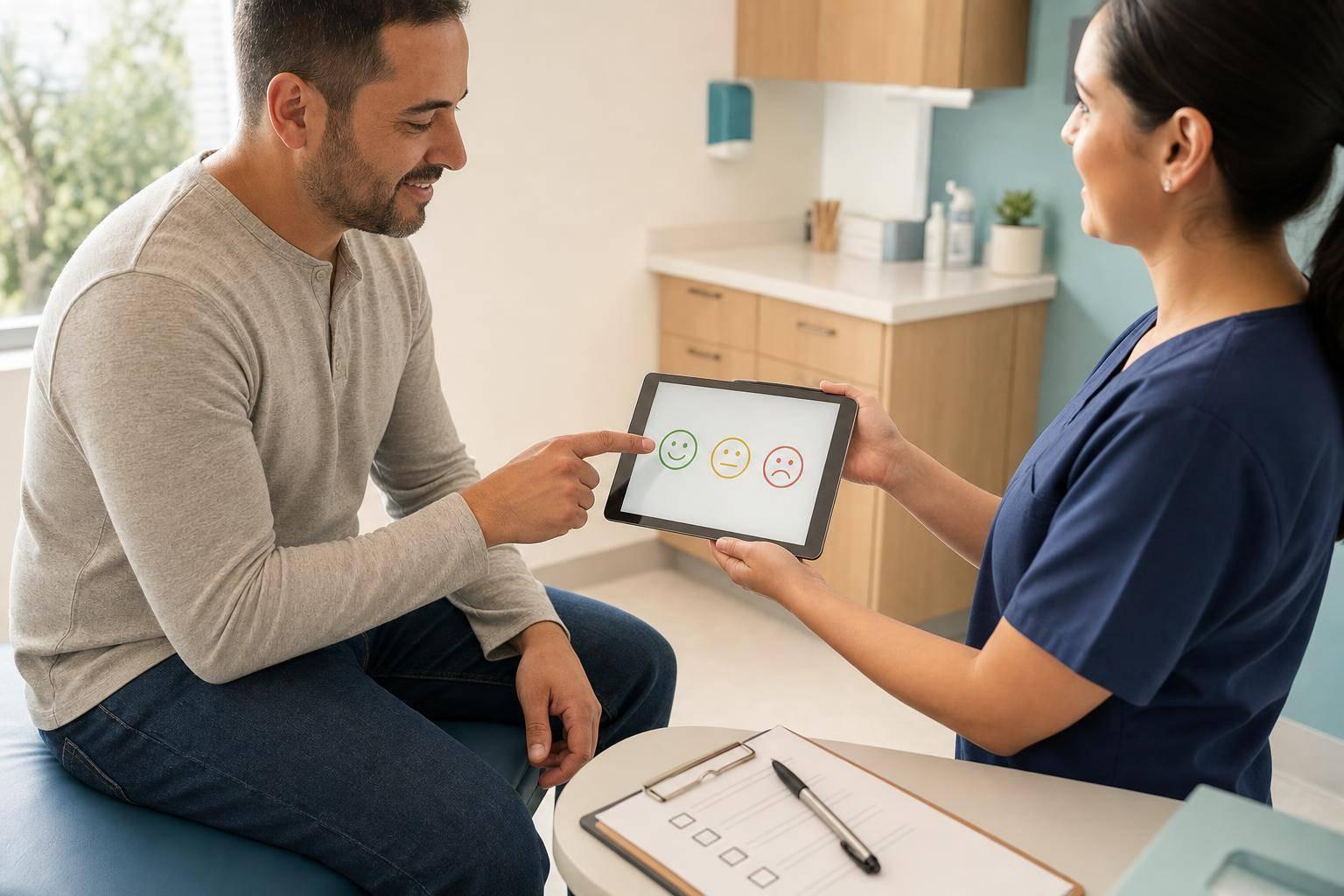
- Real-time tools use SMS, QR codes, kiosks, tablets, and portals to get input during care or right after.
- Short check-ins work best at the point of care: 1–3 questions, usually under 1 minute.
- If a patient reports a problem, teams should aim to follow up within 4 hours.
So if I want to benchmark hospitals, report to CMS, and track trends over time, surveys make sense. If I want to spot a bad handoff, a long wait, or poor communication before discharge, real-time tools fit better.
Most teams should not treat this as an either/or choice. The better setup is a mix: use real-time feedback to catch issues now, then use survey results to see if those fixes show up in long-term scores.
Quick Comparison
| Criteria | Surveys | Real-Time Tools |
|---|---|---|
| Best for | Reporting, benchmarking, payment programs | Same-visit issue fixing |
| Timing | 48 hours to 6 weeks after discharge | During care or right after |
| Scope | Full stay or full visit | One touchpoint |
| Response rate | Often 25%–30% | Often higher |
| Action | Usually after the fact | Can happen the same day |
| Main risk | Delay and recall gaps | Alerts without follow-up |
If I boil the article down to one point, it’s this: data only helps if someone can act on it. Surveys tell you how you did. Real-time tools tell you what needs attention now.
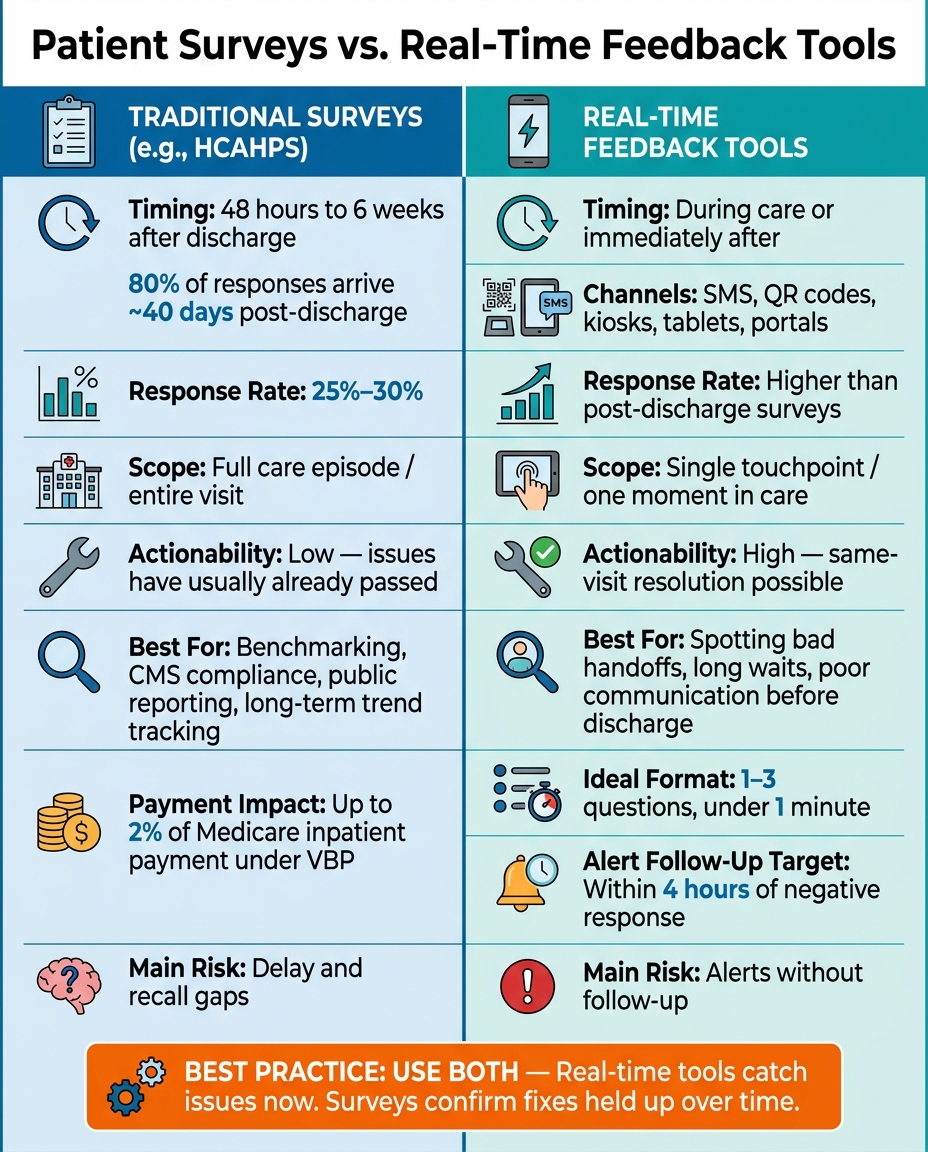
Patient Surveys vs. Real-Time Feedback Tools: Key Differences at a Glance
New CAHPS Tools for Patient Experience Measurement (Webcast)
sbb-itb-8f61039
Traditional Patient Surveys: Strengths, Limits, and Best Uses
Traditional patient surveys look backward. Hospitals send them by mail, email, or phone, and they usually show up 48 hours to six weeks after discharge. That means they reflect the full stay, not one specific moment. They work best as a tool for measuring care after the fact, not for fixing issues while the patient is still in the hospital. That lag is the main reason many organizations add faster feedback tools.
What Traditional Surveys Do Well
The biggest upside of standardized tools like HCAHPS is comparability. Since hospitals use the same questions and scoring method, quality teams can compare results across sites, regions, and time periods. That consistency also makes these surveys useful for CMS compliance and for public reporting on sites like Care Compare.
HCAHPS also has a direct link to Medicare payment through the Hospital Value-Based Purchasing (VBP) program. So the survey method matters for both quality reporting and reimbursement. In practice, validated surveys are best for:
- Benchmarking against other hospitals
- Tracking long-term trends
- Supporting compliance and public reporting
HCAHPS remains the national benchmark for standardized hospital experience measurement.
Those strengths matter most when the goal is standardization, not immediate action.
Where Traditional Surveys Fall Short
The main issue is time. In mail-based HCAHPS processes, about 80% of responses come back around 40 days after discharge. By then, recall is weaker, and the chance to act on a problem is often gone.
Response rates are another weak spot. HCAHPS response rates have stayed around 25% to 30% for more than a decade, and they have dropped since 2020. So the results often reflect a self-selecting minority. They show what happened, but not always why it happened.
Traditional surveys are a good fit for accountability, compliance, and long-term tracking. They are not built to spot problems early enough to fix them in time. That's where real-time feedback tools come in.
Real-Time Feedback Tools: Faster Signals Across the Patient Journey
Real-time patient journey tracking tools collect patient input during care or right after it through SMS, bedside tablets, kiosks, QR codes, or portal check-ins. Unlike retrospective surveys, these tools are built for immediate action. That speed matters most when the goal is to step in before the patient experience is over.
How Real-Time Feedback Works in Practice
In practice, these tools are usually tied to a specific care touchpoint, like registration, discharge, or a procedure. That means the feedback connects to one clear moment in care instead of getting lost in a broad post-discharge summary. Put simply, feedback becomes part of a live workflow, not just another report sitting in a queue.
On the back end, these systems often feed into a live dashboard so team leads can watch responses as they come in. If a patient submits a negative response, the system can send an automated alert right away. That gives staff a chance to step in while the patient is still in the building. And that timing can make all the difference when the issue is still fixable.
Benefits and Constraints of Real-Time Feedback Tools
The big draw is speed. The catch is whether the data leads to action. Kiosk-based tools can bring in higher response rates than post-discharge surveys, but more responses do not automatically lead to better experience scores.
That’s the heart of it: faster signals help, but they don’t solve the whole problem on their own. The questions still need to be well designed, and staff still need to respond in a timely way. If no one owns the process, alerts can pile up and turn into noise. If there’s no response workflow, the tool adds more data but not better care.
Those tradeoffs stand out even more when you compare real-time tools with standard surveys.
Patient Surveys vs. Real-Time Feedback Tools: A Direct Comparison
Both methods measure patient experience, but they do different jobs.
Traditional surveys ask, “How did it go overall?” Real-time tools ask, “What’s going on right now?” That timing gap changes everything: what kind of data you get, who can act on it, and how fast anything can be fixed.
| Criteria | Traditional Surveys (e.g., HCAHPS) | Real-Time Feedback Tools |
|---|---|---|
| Timing | Retrospective - typically 48 hours to six weeks after discharge | Immediate - during or right after care |
| Purpose | Standardization, benchmarking, and regulatory reporting | Immediate issue resolution |
| Scope | Whole visit - the full care episode | Single touchpoint - one moment in care |
| Response Volume | Lower; memory bias can blur results | Higher than post-discharge surveys |
| Actionability | Lower; issues have often already passed | High; same-visit resolution |
Where Each Method Performs Better
The better fit comes down to the goal. Are you trying to report performance, compare results over time, or fix a problem while the patient is still there?
Use surveys for compliance, benchmarking, and trend tracking. HCAHPS scores are directly tied to Medicare payments through the Hospital Value-Based Purchasing (VBP) program, and CMS uses them for public transparency. Because the questions are standardized, teams can compare results year over year and across patient groups without guessing whether they’re measuring the same thing.
Real-time tools are stronger when speed matters. If there’s friction at a single touchpoint, a long wait, a confusing handoff, a room issue, delayed communication, these tools help staff spot it and respond fast. The feedback is tied to one moment in care, not a memory pulled from weeks later.
Why a Hybrid Model Often Works Best
In practice, most organizations need both views.
Real-time feedback helps teams resolve issues in the moment. Surveys show whether those fixes held up over time. Put together, they form a simple loop: detect, respond, measure, repeat.
That’s why the main question often isn’t which method is better in the abstract. It’s who owns the feedback, what happens after it comes in, and whether the workflow makes action possible.
Implementation Priorities and the Role of PatientPartner
Governance, Workflow, and Measurement Design
A hybrid model works best when ownership is clear from the start. Patient experience, operations, and compliance teams each need a defined job: who collects feedback, who responds to it, and who reports on it. Without that setup, feedback often ends up sitting in a dashboard instead of leading to action.
Patient data also needs careful handling. That means BAAs, explicit consent, minimum-necessary PHI, and HIPAA-aligned security controls.
To cut down on survey fatigue, keep real-time pulse check-ins short: 1–3 questions that take less than a minute to finish. Longer, more structured surveys make more sense after discharge or at post-treatment milestones. For fast engagement, a 1–5 scale or one-tap response tends to work best.
A closed-loop alert system can pay off fast too. If a patient submits a negative real-time rating, that signal should flow into existing EHR or operations workflows so an automated alert goes to a manager or mentor for follow-up within 4 hours. That kind of quick response helps teams recover service issues before they snowball.
PatientPartner fits well here because it turns onboarding feedback into mentor outreach. If a patient flags medication confusion or trouble with access, mentors can step in before the issue affects adoption or adherence. That can help more patients start treatment and stay on track over time.
Key Takeaways for Continuous Patient Experience Monitoring
Both methods play different parts. Surveys help confirm performance over time. Real-time tools help teams act in the moment.
For pharma and med-tech teams, the goal is pretty simple: collect feedback at key touchpoints, send it to the right people fast, fix friction early, and use surveys to check whether those fixes hold up. That’s how patient experience monitoring starts turning into patient experience improvement.
FAQs
When should I use both surveys and real-time feedback tools?
Use both to get a more complete view of the patient experience.
Real-time feedback tools work best when you need to act fast. They help teams recover service issues in the moment, fix day-to-day problems, and spot small improvements while the visit is still fresh in the patient’s mind.
Traditional surveys give you a deeper read over time. They’re better for benchmarking, tracking trends, and planning at the organization level.
Put the two together, and you get the best of both: a way to handle urgent concerns right away and a broader view that helps guide bigger decisions.
How can hospitals act on real-time feedback without overwhelming staff?
Hospitals can focus on immediate service recovery by fixing problems before patients leave. Short, targeted pulse surveys through kiosks or digital touchpoints make that possible. They collect useful feedback without dumping long, broad reports on staff.
That gives leaders a chance to act fast on specific problems, like cleanliness or wait times, while there’s still time to fix them. When hospitals pair that feedback with staff coaching, frontline teams can improve how they perform day to day.
What should a good real-time patient check-in ask?
A good patient check-in, done in real time, should feel simple and focused on a few clear touchpoints while the visit is still fresh.
Skip the long form. Ask one or two short questions about the patient’s current experience or a specific interaction. The best questions feel conversational and open-ended, so you can learn why a patient feels the way they do - whether that’s about comfort, clarity of instructions, or wait times.