


Real-Time Mentorship's Role in Retention

Key Takeaways
Author


Half of adults who start a new chronic therapy stop within a year. My main takeaway is simple: if you want more patients to stay on treatment, support has to show up when doubt hits, not days later.
Here’s the article in plain English:
- Retention is more than enrollment. It includes staying on therapy, taking it as directed, and still using support over time.
- The first 30 days matter most. Missed onboarding, delayed starts, side-effect worries, cost issues, and prior authorization delays often lead to early drop-off.
- Static support falls short. Brochures, portals, and scheduled reminders can share information, but they can’t answer questions in the moment.
- Real-time mentorship helps keep patients engaged. Live support by phone, video, or secure message can help patients deal with fear, side effects, routine problems, and coverage confusion before they stop treatment.
- Human contact helps patients stay with care longer. Regular check-ins can build trust, spot risk early, and help patients recover after a lapse instead of quitting.
- Results should be tracked at set points. I’d look at retention, adherence, and program engagement at 30 days, 90 days, 6 months, and 1 year.
- A mentorship program needs clear rules. Fast matching, defined mentor roles, escalation paths, HIPAA-safe workflows, and feedback loops all matter.
Quick Comparison
| Area | Static Support | Real-Time Mentorship |
|---|---|---|
| Timing | Fixed schedule | Help when the patient needs it |
| Support type | General information | Person-to-person guidance |
| Response to side effects or fear | Limited | Direct conversation and next steps |
| Personal fit | Broad messages | Matched to the patient’s situation |
| Retention impact | Weak at high-risk moments | Better at reducing early drop-off |
Bottom line: if support is delayed, generic, or easy to ignore, retention slips. If support is live, personal, and tied to the moments patients struggle most, patients are more likely to stay on track.
sbb-itb-8f61039
The Retention Problem in Patient Support
Patient Retention Drop-Off: Why Real-Time Mentorship Outperforms Static Support
Patient dropout often shows up after onboarding, not before. That’s what makes it so frustrating. These patients signed up, got support, and still fell off before treatment had time to work.
Where Patients Disengage After Onboarding
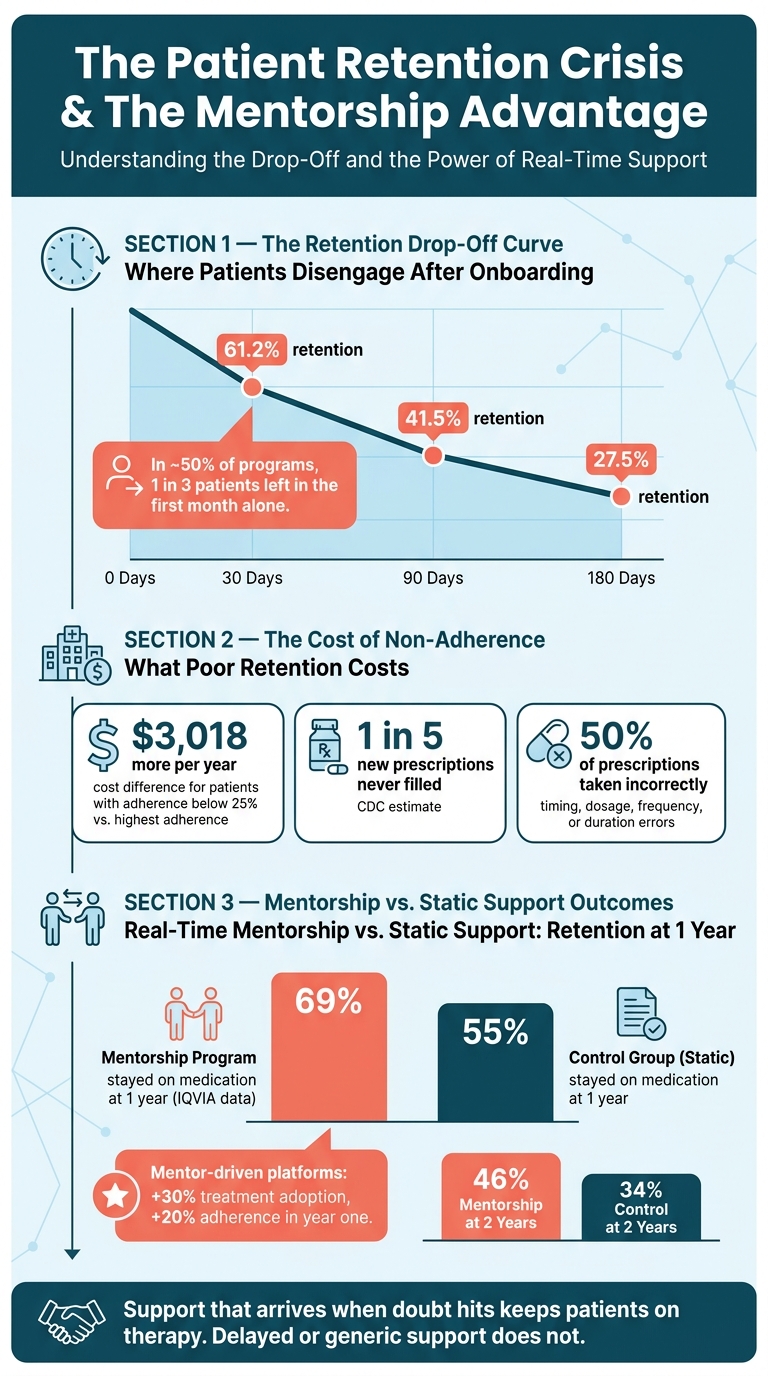
That early uncertainty turns into clear drop-off fast. Retention slips to 61.2% at 30 days, 41.5% at 90 days, and 27.5% at 180 days. In about half of those programs, roughly one-third of patients left in the first month alone.
Why does that happen? The same roadblocks keep showing up:
- Prior authorization delays
- Uncertainty about side effects
- Cost friction
Any one of these can stall therapy before it even gets going.
How Poor Retention Affects Commercial and Care Outcomes
Poor retention hits both patient care and the business side. Patients with adherence below 25% can cost about $3,018 more per year than patients with the highest adherence. Non-adherence is also tied again and again to higher rates of hospitalization and emergency department visits.
The business impact is just as direct. Every dropout turns enrollment, education, and activation spend into waste. When fewer patients stay on therapy, adoption drops, lifetime value shrinks, and future starts slow down. That’s the point where static support stops doing the job.
Why Static Support Fails to Keep Patients Engaged
The Limits of Brochures, Portals, and Scheduled Messaging
Most patient support materials fall short for a simple reason: they aren't there when help is needed most.
A brochure can't answer a late-night question. A portal can't tell a patient whether fatigue is expected or whether it's time to call a clinician. And when that gap shows up, adherence can fall apart fast.
The CDC estimates that about 1 in 5 new prescriptions are never filled. Even when prescriptions are filled, about 50% are taken incorrectly with respect to timing, dosage, frequency, or duration. That's more than an information problem. It's a problem of behavior, uncertainty, and confidence. Static tools weren't built to handle that, and simply handing patients a pamphlet or sending them to a website is not enough to promote understanding, behavior change, or retention.
Scheduled messaging runs into the same problem from a different angle. If reminders are tied to a calendar instead of what the patient is going through right then, they often miss the moment that matters. Generic prompts repeated over and over can lead to alert fatigue, and patients may mute them or stop paying attention. One review found that 45% of patients were not using a monitored device at 6 months despite automated reminders.
The core issue is straightforward: adherence is shaped by fear, discomfort, and perceived risk, not information alone. Static content can inform. It can't stay by the patient's side.
Static Support vs. Real-Time Mentorship: A Direct Comparison
The gap becomes clear at the exact point when a patient is deciding whether to keep going.
| Dimension | Static Support | Real-Time Mentorship |
|---|---|---|
| Responsiveness | Fixed timing; no on-demand support | Available when patients need it, including evenings and weekends |
| Personalization | Generalized content for broad populations | Guidance tailored to the patient's routine, barriers, and context |
| Emotional Trust | Informational only; institutional voice with limited ability to build rapport | Live validation, shared experience, and ongoing relationship built through honest conversation |
| Drop-off Prevention | Educates but weakly influences behavior at high-risk moments | Directly addresses disengagement triggers, supporting long-term persistence |
Real-time mentorship steps in at the moment of doubt, before hesitation turns into dropout.
How Real-Time Mentorship Improves Retention
Immediate Support at the Moments Patients Are Most Likely to Quit
A few moments tend to matter more than others: diagnosis, the first week on therapy, recovery after surgery, and any surprise around cost or coverage. Those are the points where adherence often slips and dropout starts.
Real-time mentorship helps by giving patients immediate human support right when they need it most. If a patient can reach a mentor by phone, video, or secure message, uncertainty can turn into practical next steps before disengagement turns into dropout. Instead of waiting for the next clinic visit, the patient can check whether a side effect is typical, get tips for easing discomfort, practice questions for their clinician, or sort through confusing instructions in plain English.
One digital peer support program reported 90% engagement at 60 days and 86% at 90 days, a strong sign that live connection helps people stay involved.
Personalized Guidance That Keeps Patients on Track
Generic outreach tells patients what they should do. Personalized mentorship helps them figure out how to do it in daily life, with all the messiness that comes with shift work, childcare, recovery, or travel.
When programs match patients and mentors by procedure, condition, age, or life situation, the guidance feels more relevant. And when support feels relevant, people are more likely to stick with it. That lowers friction, builds confidence, and keeps patients coming back. Companies using mentor-driven platforms have seen a 30% increase in treatment adoption rates and a 20% improvement in patient adherence within the first year.
How Human Rapport Supports Long-Term Persistence
One onboarding call usually isn't enough to build trust for a long, hard course of treatment. Trust tends to grow through steady contact. Patients notice when someone keeps showing up, checks in, and cares whether they're still on track.
That’s why strong mentorship programs rely on recurring touchpoints. Weekly or biweekly check-ins during the first month, followed by regular contact at 3-, 6-, and 12-week intervals, can help stop quiet disengagement when life gets hard or progress feels slow. Mentors can ask about adherence without judgment, point out small wins, and help patients recover from lapses instead of walking away from treatment. WHO reports that peer support can improve adherence while reducing clinician time across chronic and preventive care settings.
Recurring contact helps prevent silent drop-off and keeps patients engaged long enough for therapy to do its job. Programs track that through engagement, persistence, and refill behavior. Those gains only matter if they last, which leads straight to the next question: how to measure them.
Measuring Impact and Building a Scalable Mentorship Model
Metrics That Show Whether Mentorship Is Working
Data is what turns mentorship from a nice idea into something teams can defend, fund, and improve. The best measurement setups track three areas: retention, adherence, and program engagement. And they track them at the same checkpoints each time: 30 days, 90 days, 6 months, and 1 year.
Those checkpoints matter for a simple reason: most drop-off happens early. IQVIA’s analysis of a digital patient support program found that 69% of patients in the program vs. 55% in controls stayed on medication at 1 year, and 46% vs. 34% at 2 years.
| Category | Key Indicators | 30 Days | 90 Days | 6 Months | 1 Year |
|---|---|---|---|---|---|
| Retention | % still on therapy; time to discontinuation; active patients by cohort | Initial persistence | Early drop-off patterns | Mid-term persistence | Long-term persistence |
| Adherence | PDC/MPR; on-time refills; treatment interruptions | Early refill behavior | Interruption patterns | Cumulative gaps | Annual adherence rate |
| Program Engagement | Mentor touchpoints completed; response time; average session length; patient confidence and satisfaction scores | Onboarding completion | Check-in cadence | Ongoing contact rate | Sustained engagement |
For adherence, track PDC, MPR, on-time refills, and treatment interruptions. For engagement, confidence and satisfaction scores help fill in the human side of the story. Short surveys at 30 days, 90 days, and 6 months can show what claims data often can’t: whether patients feel supported, prepared, and able to stay on track.
Once those metrics are set, the next step is just as important. The program needs clear operating rules so teams can respond fast instead of spotting problems after the fact.
What an Implementation-Ready Mentorship Model Requires
To reduce the early drop-off described above, a scalable mentorship program needs seven operating controls.
Structured onboarding sets the ground rules from the start. It defines eligibility, captures consent, and makes expectations clear before the first mentor interaction. Mentor role definitions matter just as much. Mentors can share lived experience and reinforce physician instructions, but they do not give medical advice or change treatment plans.
Timely matching is one of the biggest make-or-break points. When a new patient is matched with the right mentor within 24–72 hours of onboarding, the program can address early uncertainty before dropout risk climbs. Matching can be based on diagnosis, treatment type, language, or demographic preference.
Escalation pathways keep the model safe and usable. Mentors need a clear way to flag clinical concerns or adherence warning signs to nurse educators, case managers, or physicians. Service-level agreements should spell out timing, such as urgent issues within 2 hours and non-urgent issues within 24 hours.
Communication standards should define approved channels, contact hours, documentation rules, and interaction frameworks for key moments. That includes initial onboarding, pre-treatment prep, early side-effect anxiety, and longer-term persistence support. HIPAA-compliant workflows also need to be built in, with encryption, BAAs, and restricted staff access.
Then there’s the learning loop. Patient surveys, mentor debriefs, and outcomes dashboards help program leaders spot what’s working and where the process needs adjustment. That may mean changing scripts, refining matching criteria, or adjusting touchpoint cadence over time.
PatientPartner supports this model with real-time matching, communication tools, standardized touchpoints, and dashboards tied to retention and adherence.
Conclusion: Real-Time Mentorship as a Retention Strategy
Measurement matters, but retention improves only when the program can respond in real time.
Patients usually don’t leave therapy because they suddenly stop caring. More often, they hit a moment of doubt, fear, friction, or fatigue and don’t get help when they need it. That’s where passive support tends to fall short. Portals, brochures, and scheduled messages have a role, but they can’t react in the moment when a patient feels unsure or overwhelmed. Real-time mentorship can.
The evidence points in the same direction: active support is associated with higher persistence at 90 days, 6 months, and 1 year. It works because it is personal, responsive, and built around the barriers patients face day to day. With clear metrics, compliant workflows, and steady feedback loops, it can scale.
FAQs
What makes real-time mentorship different from reminders?
Reminder tools are passive aids, like pill organizers or automated texts, that mostly deal with forgetfulness. Real-time mentorship is different. It gives patients active, human support.
A reminder can tell someone to take a medication. A mentor can help them work through what gets in the way, like fear, confusion, or side effects. That human connection, along with a sense of accountability, can do more to support long-term adherence.
Who should be matched with a mentor first?
Patients who are starting a new treatment or getting ready for surgery should move to the front of the line for mentorship matching. That early support can make a big difference. It helps patients feel less alone, eases anxiety, and gives them someone to turn to as they work through a new diagnosis or treatment plan.
Starting the match process early can also help patients feel more comfortable moving ahead with treatment. And when people get support from the start, they're often better prepared to stay on track over time.
How can retention be measured over time?
Measure retention over time by tracking therapy duration, engagement, and adherence rates. Many programs also look at progress at key points, such as 30 days, the midpoint, and completion.
It also helps to compare healthcare use before and after mentorship. On top of that, review self-management scores and real-time interaction data, like communication frequency and responsiveness.