


How GDPR Workshops Improve Patient Data Security
Key Takeaways
Author


If your team handles EU patient data, GDPR workshops can reduce mistakes that lead to data exposure, missed rights-request deadlines, and slow breach reporting.
I’d sum it up like this: these workshops help staff make better calls about access, sharing, storage, retention, and incident reporting. They also help U.S. healthcare teams deal with the gap between HIPAA and GDPR, especially since GDPR treats health data as special category data and can require action within 30 days for patient requests and 72 hours for some breach notices.
Here’s the short version:
- Staff confusion is a security problem. Teams often misuse consent, keep data too long, or send health data through tools that lack the right controls.
- Workshops turn rules into steps. Role-based sessions show clinicians, support staff, marketing teams, and IT what to do in daily work.
- Scenario drills help under pressure. Teams practice the first hour after a misdirected email, lost laptop, or improper chart access.
- Policy follow-through matters. Training works best when it leads to SOP updates, retention rules, incident logs, and clear ownership.
- The payoff is measurable. Many breaches involve people, and the article notes that around 80% involve a human element. Better training can lower error rates, improve audit prep, and help teams respond on time.
Bottom line: I see GDPR workshops as a security tool, not just a legal training session. They help people handle sensitive patient data with fewer mistakes and more consistency.
GDPR for ensuring health data privacy in research
sbb-itb-8f61039
Patient Data Security Problems That GDPR Workshops Address
GDPR gaps in healthcare usually don't begin with careless behavior. They begin when busy staff members aren't sure what the rules mean in daily work and have to make fast calls under pressure. That shows up in the same places again and again: uncertainty about what GDPR requires in practice, loose control over who can view or share patient data, and weak prep for rights requests and breach response. GDPR workshops are built to spot these issues before they turn into bigger problems.
Confusion Around GDPR Rules in Clinical and Patient Support Workflows
One of the most common mistakes is assuming consent is needed for every workflow. That's not how GDPR works. Health data can be processed when it's needed for medical diagnosis, treatment, or healthcare management, as long as the organization records the right lawful basis and the right Article 9 condition. When teams miss that point, two things tend to happen. They either collect too many consent forms and end up with messy, uneven records, or they hold back from using data they're allowed to use.
Data minimization and retention create the same kind of trouble. Patient intake forms often ask for more information than the workflow needs. Chat logs, outreach lists, and engagement records may sit around forever because nobody has set a retention schedule or checked what still needs to be kept. And that extra data isn't harmless. If a breach happens, the damage can be much worse.
Another common slip is sending health data through generic CRM or marketing tools without the safeguards it needs. Why does that happen? In many cases, staff simply don't realize that stricter rules apply to this kind of processing.
Weak Day-to-Day Controls Over Data Access, Sharing, and Storage
Even when people know the rules on paper, day-to-day security habits can still break down. Excessive user permissions are a repeat issue in healthcare. Staff members, temporary contractors, and outside vendors may get "view all" or export access to patient records even when their role doesn't call for it.
Unsecured messaging is another stubborn weak spot. Consumer messaging apps such as WhatsApp are often used to share lab results and coordinate follow-ups, even though they may not have proper data processing agreements or enough control over sensitive information. Audit trails are often missing too. That leaves organizations unable to show who accessed which patient record, when, or why. Under GDPR, that's a basic part of accountability.
Poor Readiness for Patient Rights Requests and Breach Response
Under GDPR, patients can ask to access their data, correct it, erase it, or receive a portable export, and organizations must respond within 30 days. In practice, many healthcare organizations still handle these requests by hand. Teams search across separate EHRs, CRM tools, messaging platforms, and analytics dashboards, trying to piece everything together. Often there's no clear owner, no set workflow, and no reliable way to confirm that a deletion was carried out across every system holding the patient's data.
Breach response often has the same weak spots. Staff may not know what qualifies as a reportable incident. And without a clear escalation playbook, it can take days before someone even realizes an incident needs formal action.
The result is missed deadlines, conflicting records, slower breach escalation, and weaker patient trust. The next section shows how workshops turn those gaps into daily practice.
How GDPR Workshops Improve Security in Practice
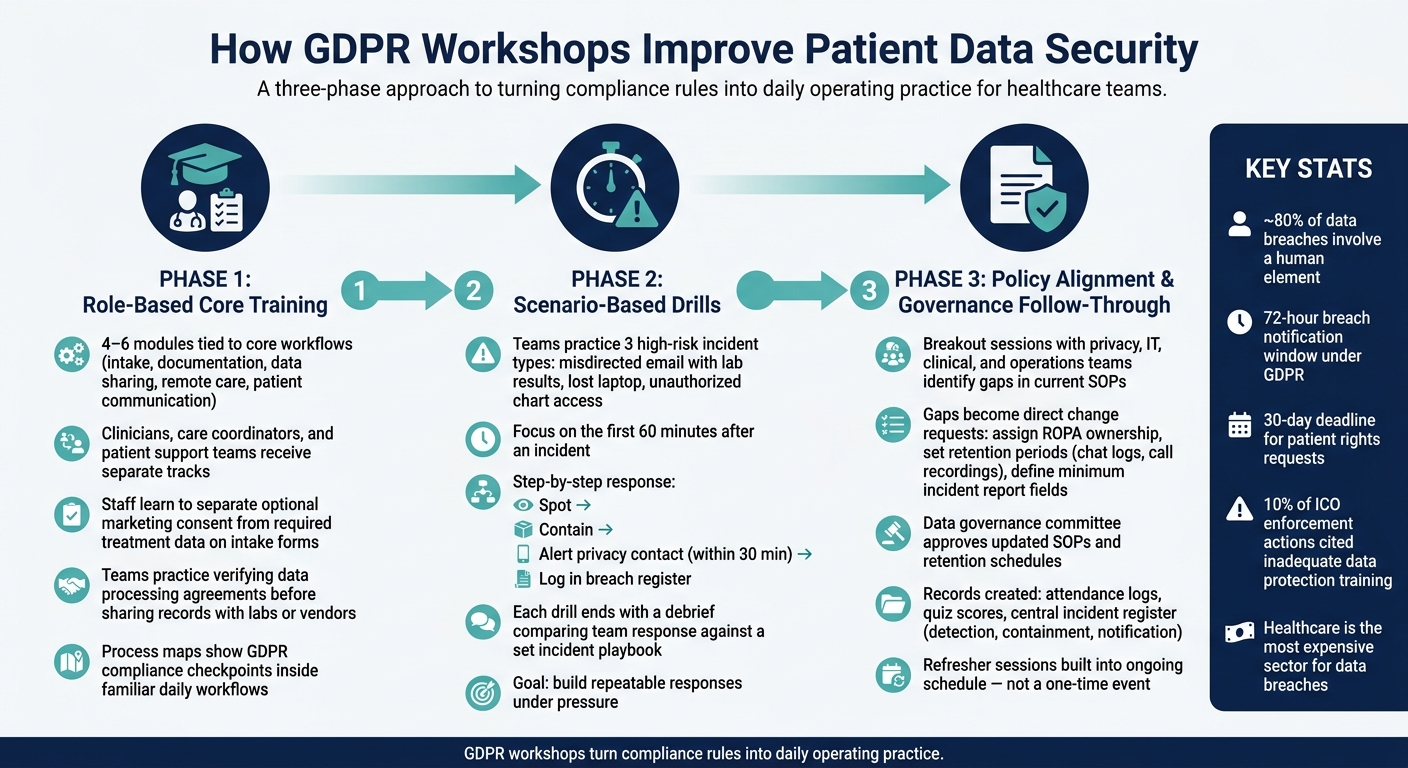
GDPR Workshop Framework for Patient Data Security
Finding the gaps is only half the work. The other half is fixing them with training people can use on a busy day. A solid GDPR workshop doesn’t just explain legal rules. It shows staff what to do when things move fast and stress kicks in.
The best workshops tie each part of the training to a repeat risk area: access, sharing, retention, and breach response. Three parts tend to matter most here: role-based training, scenario drills, and follow-through in policy and process.
Core Training That Connects GDPR Rules to Daily Tasks
The strongest workshops are built around job roles, not abstract legal lessons. Clinicians, care coordinators, and patient support teams don’t face the same risks, so they shouldn’t get the same training. A good workshop uses 4–6 modules linked to core workflows like intake, documentation, data sharing, remote care, and patient communication.
In the intake module, staff learn how to separate optional marketing consent from required treatment information on intake forms. They also learn how to record consent status the right way in the EHR or CRM. In the data sharing module, they practice checking that a data processing agreement is in place before records are sent to a lab, imaging center, or digital therapeutics vendor.
Workshops also lean on real-time patient journey tracking and workflow examples to show where GDPR duties fit inside work people already do. When staff can see a familiar workflow marked with clear compliance checkpoints, the rules stop feeling abstract and start feeling usable.
Scenario-Based Exercises for High-Risk Situations
Once people know the rules, they need to practice them under pressure. That’s where scenario drills come in. These exercises turn awareness into action. Participants work through incidents that could easily happen in daily operations: a staff member opening a patient’s chart without a clinical reason, a misdirected email with lab results, or a lost laptop.
Each drill focuses on the first 60 minutes after the incident. Staff practice how to spot the issue, contain it, alert the right internal contact, and begin the documentation trail. In a misdirected email exercise, for instance, participants learn not to contact the unintended recipient on their own before checking the playbook. Instead, they report the issue to the named privacy contact within 30 minutes and log the incident in the breach register. That kind of step-by-step guidance can cut down delays when the incident is no longer just a drill.
Each scenario wraps up with a debrief. The group compares its response against a set incident playbook, which makes weak spots easier to spot before they lead to actual harm.
Breach Response, Governance, and Policy Alignment
Training lowers risk only when it changes SOPs and clarifies who owns what. The strongest programs don’t stop at awareness. They turn workshop lessons into policy updates.
In breakout sessions, teams from privacy, IT, clinical, and operations review current SOPs and point out where duties are vague, split, or missing. Those gaps then become direct change requests. That might mean assigning ownership in the Record of Processing Activities (ROPA), setting fixed retention periods for chat logs and call recordings, or defining the minimum fields required in incident reports. A data governance committee then approves updated SOPs and retention schedules on a set timeline, so staff can see that workshop input leads to actual change.
Workshops also put in place the records regulators expect to see: attendance logs, quiz scores, and a central incident register that tracks detection, containment, and notification decisions. NHS Scotland audit guidance specifically calls for specialized data protection training for specialized roles, with regular refresher sessions built into the process - not treated as a one-time event. That same idea applies here: the workshop is the start, not the endpoint.
The Business and Compliance Impact for Healthcare Organizations
When workshop lessons start shaping day-to-day work, the payoff shows up in places teams can track: lower incident rates, faster response times, and smoother audit prep.
Fewer Human Errors and Stronger Technical Safeguards
A lot of patient data breaches come down to human error. Structured training helps cut near-miss disclosures and unauthorized access events before they turn into bigger problems.
It also helps teams use core safeguards the same way every time, including MFA, session timeouts, field-level encryption, and DLP rules. That kind of consistency matters. A control only works if people use it as intended.
Workshops also bring more discipline to vendor review and help reduce third-party data sharing. Instead of each team making its own calls, staff work from the same playbook.
Better Patient Trust, Audit Readiness, and Cross-Team Alignment
Organizations that handle GDPR patient rights requests through workshop-trained workflows often see faster response times and fewer complaints sent to regulators. Under GDPR, responses are due within one month, with an extension of up to two additional months for complex cases, as long as the patient is informed.
Cross-team alignment is another clear win. Compliance, marketing, patient experience, and digital operations teams often start from different assumptions about lawful bases, consent language, and retention rules. Shared workshop sessions bring those gaps into the open. From there, teams can build standardized approval processes and joint sign-off checklists for campaigns or digital programs that touch EU data.
Role-based training, vendor drills, rights-request simulations, and breach exercises strengthen security, compliance, and day-to-day operations.
These controls matter most where patient engagement meets sensitive data.
Where PatientPartner Fits In
PatientPartner is one example of how GDPR training applies to patient-mentorship workflows that handle sensitive data. Its mentorship workflows connect patients with mentors through scheduling, messaging, and follow-up. When EU data subjects take part, workshops help commercial and compliance teams set access rules, build consent flows, and define retention policies that keep the program secure, compliant, and efficient.
Conclusion: How GDPR Workshops Lead to Safer Patient Data Practices
These recurring gaps - unclear GDPR use in day-to-day work, loose access and sharing controls, weak readiness for rights requests, and limited breach-response maturity - show why workshops matter. Globally, around 80% of data breaches involve a human element, and healthcare is still the most expensive sector when something goes wrong.
The answer is to turn GDPR from a legal concept into role-based action. Workshops connect compliance to intake, EHR use, care coordination, and digital services, so staff can apply the rules in the moments that matter. Scenario-based exercises - handling a patient access request under time pressure, spotting a misdirected file as a possible breach, or working through a cross-border data transfer - help teams build responses they can repeat under stress.
That kind of training also makes ownership clearer and response times shorter. Teams can tighten access rules, put retention and deletion practices in place, and get legal, IT, clinical, and patient program leaders on the same page. That includes knowing who escalates what, when documentation begins, and how the 72-hour notification clock works when it applies.
Training also strengthens accountability. In one ICO review, 10% of enforcement actions in a single year cited inadequate or incomplete data protection training as a core issue. And the math is pretty simple: preventive training costs far less than breaches, investigations, remediation, and brand damage.
For U.S. organizations that handle EU patient data - through clinical trials, digital health programs, telehealth, or patient support services - GDPR workshops are a practical way to cut risk and build trust, not just a box to check. They turn dense rules into clear operating playbooks and help HIPAA-trained teams see where GDPR goes further on patient rights and governance. In patient mentorship programs like PatientPartner, that same discipline helps keep communication and records secure by giving mentors and support teams clear boundaries around sharing health details, recording sessions, and storing notes.
As digital patient engagement software becomes more data-heavy, recurring GDPR workshops shift from a one-time effort to a core capability. Organizations that treat them that way are in a stronger position to grow safely, keep patient trust, stay ready for audits, and meet new regulatory demands without scrambling.
FAQs
Who should attend a GDPR workshop?
Everyone in the organization should take part. Effective compliance works best when privacy is part of day-to-day service delivery, not a side task.
Training should match each person’s role. That means separate tracks for:
- all staff and contractors
- clinical and frontline teams
- developers and IT administrators
- management and legal teams
This kind of role-based training helps people handle sensitive data the right way, report incidents fast, and manage Data Subject Access Requests (DSARs) without confusion.
How often should healthcare teams repeat GDPR training?
Healthcare organizations need more than a once-a-year training box check to meet GDPR in practice.
All staff and contractors should get training at onboarding and then again every year. That sets a baseline for everyone who touches patient data, even in small ways.
For clinical and patient-facing teams, annual training isn’t enough. These groups should train quarterly so key habits stay fresh, especially around confidentiality, patient story handling, and data request processes. In healthcare, those situations come up all the time, so people need repetition, not just a slide deck they saw months ago.
Technical teams should train every year or whenever a new release goes out. If systems change, the rules around data handling can change with them.
Management and legal teams should also take part in annual breach-response tabletop exercises. Those sessions help teams walk through what they’d do if something goes wrong, before they’re dealing with the real thing under pressure.
What should training change after a GDPR workshop?
After a GDPR workshop, training should help shift company culture so privacy becomes part of day-to-day work.
That means moving beyond theory and into routine habits. People need to know how privacy shows up in their own jobs, not just in a slide deck. In practice, teams should build secure habits, follow role-specific workflows for sensitive data, log both training completion and understanding, handle Data Subject Access Requests within the one-month deadline, spot breaches or near misses early, and make sure consent withdrawals and data updates stay synced across connected systems.