


Customer Lifetime Value Calculator
Key Takeaways
Author


Understand Customer Value Before You Spend More
A Customer Lifetime Value Calculator helps you estimate how much revenue or profit a typical customer may generate across the full relationship with your business. That matters when you're setting marketing budgets, reviewing pricing, or deciding how much you can afford to spend on acquisition.
Simple or Advanced CLV Estimates
Some teams only need a quick answer based on average order value, purchase frequency, and customer lifespan. Others need a more refined view that includes gross margin, customer acquisition cost, retention rate, and discount rate. This tool supports both approaches, so you can start simple and add detail when it makes sense.
Why CLV Matters
A solid customer lifetime value calculator can reveal whether your growth is actually profitable. It gives context to CAC, helps compare acquisition channels, and makes long-term customer economics easier to understand. If you're focused on repeat purchases, subscription revenue, or retention strategy, a clear CLV estimate can be far more useful than looking at one sale in isolation.
Built for Real-World Decisions
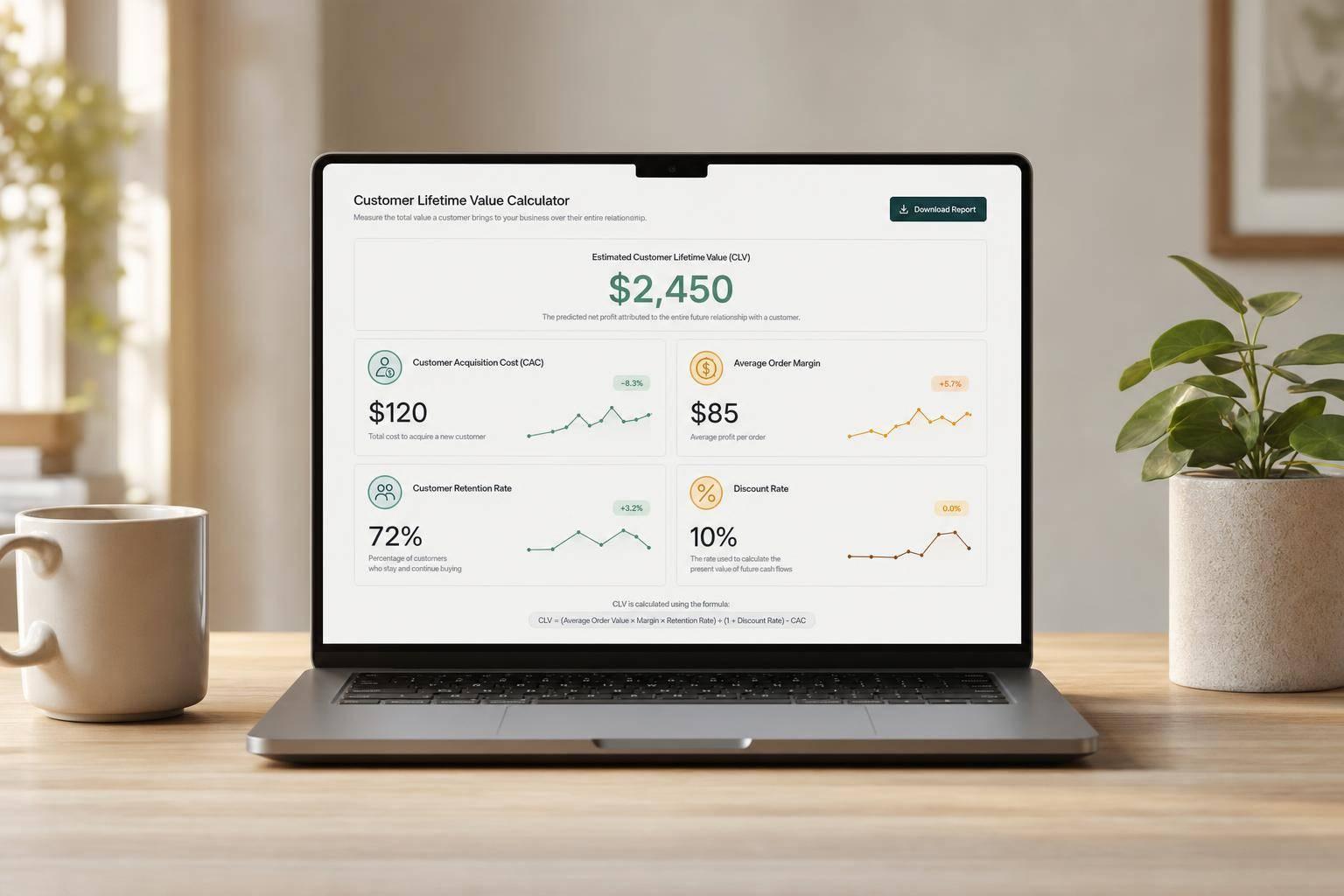
This CLV calculator keeps the math readable, formats results clearly, and highlights key assumptions so you can interpret the estimate with confidence.
FAQs
What’s the difference between revenue-based CLV and profit-based CLV?
Revenue-based CLV estimates the total sales a customer is expected to generate over the relationship. Profit-based CLV goes a step further by applying gross margin, so you’re looking at the value that may actually contribute to the business after direct costs. If you also enter customer acquisition cost, the tool can show a net view that’s often much more useful for budgeting and marketing decisions.
When should I use retention rate and discount rate?
Use retention and discount rate when you want a more finance-oriented estimate instead of a straight multiplication model. Retention rate helps reflect the chance that customers continue from one period to the next, while discount rate accounts for the time value of future earnings. Since this method is more sensitive to assumptions, the calculator labels it as an estimate and checks for invalid combinations that would make the formula unreliable.
What if my CAC is higher than my customer value?
That’s a warning sign worth paying attention to. If your customer acquisition cost is greater than your profit-based CLV, you may be spending too much to win customers relative to what they return over time. That doesn’t always mean the business is broken, but it usually means you should review pricing, retention, margins, or acquisition channels to improve profitability.