


Checklist for GDPR Compliance in Healthcare SaaS

Key Takeaways
Author


If you handle EU patient data, GDPR can apply even if your company is based in the U.S. For healthcare SaaS, that usually means you need to sort out four things fast: your role, your legal basis for health data, your security and transfer setup, and your vendor and staff controls.
Here’s the short version of what I’d check first:
- Scope and role: Am I a controller, processor, or joint controller?
- Health data rules: Do I have both an Article 6 basis and an Article 9 condition?
- Records and retention: Do I have a current RoPA, clear data flows, and set deletion timelines?
- User rights: Can I handle access, correction, erasure, restriction, and portability within 30 days?
- Security and risk review: Do I use encryption, MFA, logging, pseudonymization, and DPIAs for high-risk features?
- Transfers and incidents: If data leaves the EU, do I use SCCs, DPF, or EU hosting - and can I meet the 72-hour breach notice deadline?
- Vendors and training: Do all processors have Article 28 DPAs, and do teams know how to handle patient data?
A few deadlines and numbers matter most here:
- GDPR fines can reach €20 million or 4% of global annual revenue
- Breach notice can be due in 72 hours
- Most data-rights requests need a response in 30 days
I’d treat this as a working checklist, not a one-time legal task. The article breaks GDPR compliance into governance, consent, rights handling, security, data transfers, vendor review, and team training so you can turn legal rules into day-to-day steps.
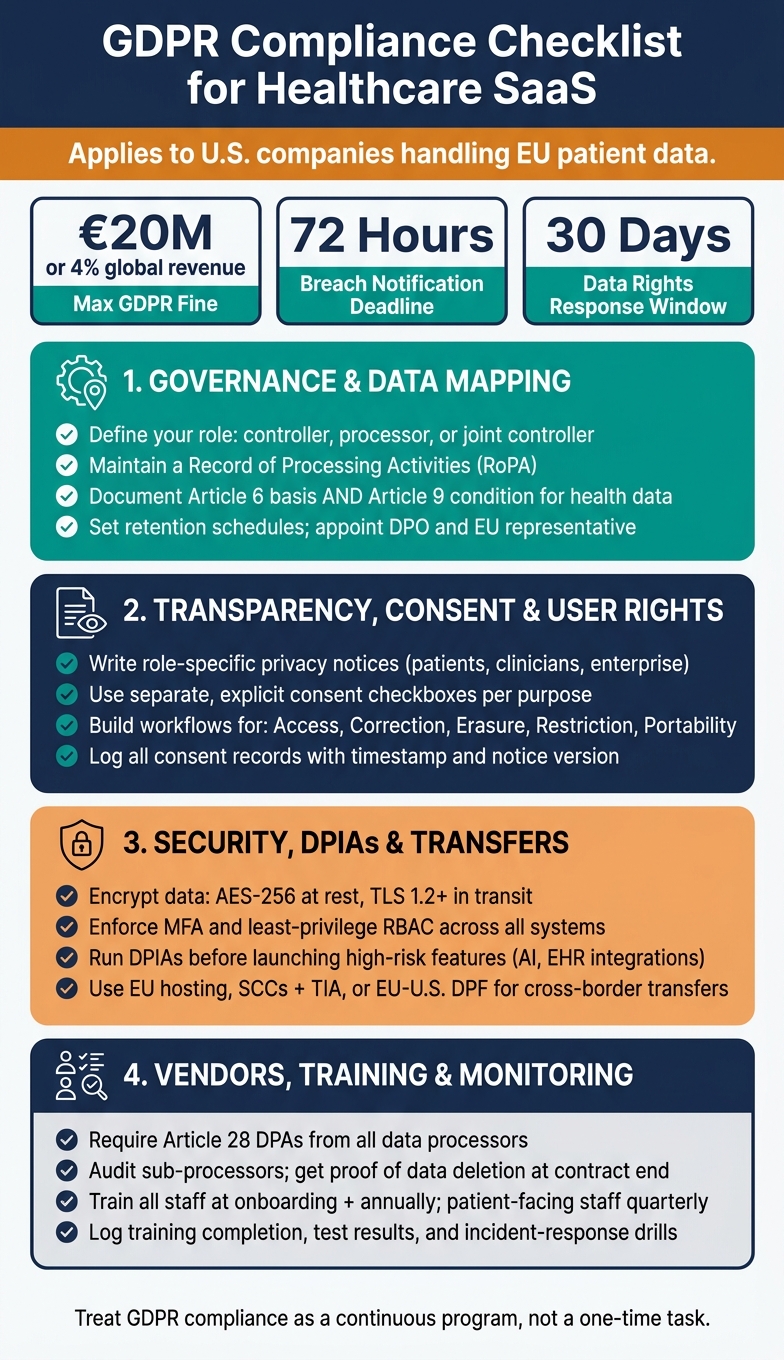
GDPR Compliance Checklist for Healthcare SaaS
Data Privacy & Compliance: GDPR, HIPAA & Best Practices Explained
sbb-itb-8f61039
Checklist 1: Governance, Data Mapping, and Lawful Basis
Get governance in place before you scale. That work sets up everything else in this checklist. If your data flows, lawful bases, and owners aren’t documented, your compliance program can fall apart the moment an audit starts. Start with governance and records, because every later control depends on them.
Map Every Data Flow and Keep Records of Processing Up to Date
Once your role is defined, map every data flow tied to that role.
Under GDPR Article 30, maintain a Record of Processing Activities (RoPA) - a current record of the personal data your platform processes, why you process it, where it is stored, who can access it, and how long it is kept.
Map patient data such as clinical, billing, portal, app, and device data. Also include mentor and clinician data, enterprise user data, and secondary flows such as analytics, marketing, support, research, and AI/ML data.
Your RoPA should also note storage locations, third-party cloud systems, retention periods, access permissions, encryption status at rest and in transit, logging points, API connections, and any international transfer triggers. Visual data flow diagrams can help you spot risk points before they turn into audit findings.
| Data Category | Key Elements to Map | Typical Source |
|---|---|---|
| Patient Data | Clinical, billing, portal, app, and device data | EHR, patient portals, mobile apps |
| Mentor/Clinician | Professional contact info, staff records, user account details, access logs | Internal HR systems, admin dashboards |
| Enterprise User | Business contact info, user preferences, activity logs, billing data | CRM, billing platforms, support tools |
| Secondary/Technical | Analytics, marketing, support, research, and AI/ML data | Analytics platforms, marketing APIs, research databases |
Document Lawful Basis and Article 9 Conditions for Health Data
A lot of healthcare SaaS teams stop after picking a general lawful basis under Article 6. That’s not enough for health data.
Because health data is a special category under Article 9, each processing purpose needs two things: an Article 6 lawful basis and a specific Article 9 condition. For example, treatment-related processing may rely on Article 6(1)(b) and Article 9(2)(h), while marketing uses need separate consent.
Record both bases in the RoPA before launch.
Set Retention Schedules and Assign Accountability Roles
Set retention by purpose, not by habit. Delete or anonymize personal data when it is no longer needed, even if other rules call for longer storage in some cases.
Where HIPAA limits deletion, anonymize or delete personal identifiers to meet a GDPR erasure request while keeping the de-identified record under GDPR Article 17(4)(c).
On the accountability side, appoint a DPO for large-scale health-data processing. An EU representative is also usually required when you offer services to EU residents without an EU presence.
Once ownership is assigned, build the workflows that let people exercise their rights. With lawful basis and retention set, the next step is notices, consent, and user rights.
Checklist 2: Transparency, Consent, and Data Subject Rights
Use your data map to drive notices, consent flows, and rights workflows.
Write Clear Privacy Notices for Patients, Mentors, and Enterprise Users
Treat your data map as the source of truth for every notice. Patients, mentors, and enterprise users care about different things, so each group needs its own notice. Under GDPR, one generic privacy policy does not cut it.
Each notice must explain the organization's identity and contact details, the types of health data collected, the purpose of each processing activity, the lawful basis and Article 9 condition for health data, retention periods, recipient categories, international transfer details, how users can exercise their rights, and any automated decision-making, if used.
A layered format works best. Put a plain-language summary at the top for patients and mentors, then link out to more detailed technical information for enterprise users. Write in plain U.S. English and skip legal jargon. Publish notices at sign-up, in the app, and in the portal. Also include rights-exercise instructions in support channels.
Build Consent and Preference Tracking Where Required
Use explicit consent for analytics, marketing, and secondary research when consent is the basis you rely on. Do not tuck these uses into a general privacy-policy checkbox.
Keep consent separate by purpose. Use distinct, non-pre-ticked checkboxes for analytics, research, marketing communications, and any third-party sharing that relies on consent. Log each consent record with the user ID, timestamp, notice version, and capture method.
Withdrawal must be as easy as opt-in.
A preference center helps here. It lets users opt out of non-essential processing, such as analytics, without cutting off care-related communications, which may sit on a separate legal basis.
Set Up Workflows for Access, Correction, Erasure, Restriction, and Portability
Once users can see what you collect, they need direct ways to act on it. Build in-product flows for access, correction, erasure, restriction, and portability.
Every request workflow needs four stages:
- intake
- identity verification
- internal review
- fulfillment
Verify identity in a proportionate way before releasing or deleting any health data. Log each step, including the intake date, the verification method used, review decisions, and the final response timestamp.
When erasure requests run into record-retention rules, anonymize personal identifiers while keeping the de-identified clinical record.
For portability, export data in structured formats such as JSON, CSV, or FHIR.
| GDPR Right | Responsible Team | Response Window | System Dependency |
|---|---|---|---|
| Access (Art. 15) | Support / Privacy | 30 days | Data Export Tool (JSON/FHIR) |
| Rectification (Art. 16) | Clinical / Support | 30 days | Database Update API |
| Erasure (Art. 17) | Engineering / DPO | 30 days | Anonymization Pipeline / Backup Purge |
| Portability (Art. 20) | Engineering | 30 days | Machine-Readable Export (JSON/CSV) |
| Restriction (Art. 18) | Privacy / Legal | 30 days | Processing Restriction Flag in User Profile |
Once these workflows are live, move to security controls, DPIAs, and transfer safeguards.
Checklist 3: Security Controls, DPIAs, and International Transfers
Now secure the systems that store, analyze, and move data under Article 32.
Apply Privacy by Design and Core Security Controls
Start with the systems that hold and move these records: patient messages, mentor notes, app activity, exports, and analytics.
Use AES-256 for data at rest and TLS 1.2+ for data in transit.
Set up least-privilege RBAC so people only get access to what they need. Add multi-factor authentication (MFA) across every system that touches health data. If clinical teams need emergency access, spell out your break-glass process and review it on a regular basis.
You should also log every view, edit, and export. Then watch for odd activity and failed login attempts. Add pseudonymization by separating direct identifiers from health data. And make sure backups are immutable, with recovery drills run at set intervals.
Run DPIAs for High-Risk Features and Patient Analytics
A Data Protection Impact Assessment (DPIA) is required under GDPR Article 35 when processing is likely to create a high risk for individuals.
In healthcare SaaS, that often means:
- Large-scale processing of health data
- New tools such as AI diagnostics or wearables
- Systematic monitoring
- Profiling
- Integrations with EHR or CRM systems
Do the DPIA during design, not after launch, and bring in the DPO from the start. The assessment should cover the processing activities and their purpose, why the processing is needed and proportionate, the risks to patients' rights and freedoms, and the steps used to cut those risks down.
Go back and update each DPIA when you make major tech changes, add new data uses, or change sub-processor workflows.
Use what comes out of the DPIA to pick the right transfer safeguard.
Confirm US-EU Data Transfer Mechanisms and Breach Response Readiness
Then decide how EU data moves across borders.
Your first choice should be EU data residency. Keep EU patient data in EU cloud regions, such as AWS Frankfurt or Azure Netherlands, to avoid the mess of cross-border transfer rules. If data has to leave the EU, use SCCs with a TIA to assess whether U.S. surveillance laws give enough protection for the health data being transferred. For eligible transfers, use the EU-U.S. Data Privacy Framework (DPF).
Breach timing matters here. GDPR gives you a 72-hour supervisory authority notification window, which is much tighter than HIPAA's 60-day allowance. That means automated log monitoring and anomaly detection aren't just nice to have. They help you move fast when something goes wrong. Put breach-response steps into both your contracts and your internal playbook so your team can hit that 72-hour deadline.
| Transfer Mechanism | When to Use | Notes |
|---|---|---|
| EU-U.S. Data Privacy Framework (DPF) | US company self-certified under the DPF | Self-certification mechanism |
| Standard Contractual Clauses (SCCs) | DPF not in place or as a fallback | Transfer Impact Assessment (TIA) required |
| Multi-Region Data Residency | EU data stays in EU cloud regions | Simplest path; avoids transfer complexity |
Checklist 4: Vendor Management, Training, and Ongoing Monitoring
Vendor controls and staff training make the earlier security rules stick in day-to-day work. It’s one thing to write policies. It’s another to make sure vendors follow them and staff know what to do under pressure.
Put Article 28 DPAs and Sub-Processor Controls in Place
Any vendor that processes health data needs an Article 28 DPA. That includes cloud, analytics, support, and communications services.
The DPA should spell out the scope, duration, and purpose of processing. It also needs to cover data types, data subjects, confidentiality, support for rights requests, breach notices, DPIAs, and prior written approval for sub-processors.
Before you sign with any vendor, review their certifications, technical controls, breach history, and data locations. Don’t treat this like a box-checking task. If a vendor has weak controls or stores data in the wrong place, that risk becomes your problem too.
When the contract ends, get proof that the data was returned or destroyed.
Train Staff and Patient-Facing Teams on Sensitive Data Handling
Train all staff and contractors at onboarding and every year after that. Clinicians, mentors, and other patient-facing roles need training every quarter.
For patient-facing staff and mentors, training should also cover secure communications, confidentiality, and safe use of patient stories and patient interactions. Anyone who handles this kind of information should know how to spot a breach and escalate it at once so the issue gets to the right team without delay.
| Training Type | Target Audience | Key Topics | Frequency |
|---|---|---|---|
| Foundational | All staff and contractors | GDPR basics, minimization, phishing | Onboarding & Annual |
| Clinical/Frontline | Clinicians, mentors | Patient stories, DSARs, confidentiality | Quarterly |
| Technical | Developers, IT admins | Privacy by design, encryption, logging | Annual/Per Release |
| Incident Response | Management, IT, Legal | Breach detection, reporting, forensics | Annual Tabletop |
Keep a central log with completion dates, comprehension test results, and participation in breach-response tabletop exercises.
Conclusion: Treat This Checklist as a Continuous Compliance Program
Keep sub-processor records current. Audit vendors, review sub-processor reports, and refresh DPIAs and incident-response drills on a fixed schedule. Review these controls on a set cadence, not only after incidents or audits.
That steady oversight can cut audit risk and limit exposure to GDPR fines of up to €20 million or 4% of global annual revenue, whichever is higher.
FAQs
Does GDPR apply if my healthcare SaaS company is based in the U.S.?
Yes. GDPR can apply to a U.S.-based healthcare SaaS company if you process personal data from people in the European Union.
It kicks in when you target EU residents or monitor their behavior while they’re in the EU. In plain English: the rule follows the person, not your company’s location. That means processing sensitive health data for even one EU resident can trigger compliance duties.
How do I know if I’m a controller or a processor under GDPR?
Under GDPR, the answer comes down to one thing: who decides why the data is used and how it’s handled.
You’re a controller if you make those decisions yourself.
You’re a processor if you handle the data only for a controller and follow their documented instructions.
A lot of SaaS companies wear both hats. They act as controllers for their own business data, and as processors for patient data that customers upload.
What should I do first to prepare for a GDPR audit?
First, figure out whether GDPR applies to your operations and write down that decision.
Then build a healthcare data inventory by mapping the personal data you process: what health data you collect, why you collect it, where it’s stored, who can access it, and how long you keep it. That gives you the record you need to show compliance during an audit.