


Ultimate Guide to Personalized Patient Outcome Tracking
Key Takeaways
Author


If you want patient outcome tracking to work, I’d keep it simple: measure the right things, ask at the right time, use the right channel, and act fast when scores change.
This article shows that patient tracking is not just about lab results. It combines clinical outcomes, patient-reported outcomes (PROs), and patient experience measures (PREMs) so teams can spot symptom changes, adherence issues, and care gaps earlier. It also shows how to build a program around risk-based follow-up, FHIR-based data sharing, clear consent rules, and KPIs like completion rate, therapy persistence, and hospitalization signals.
A few numbers stand out:
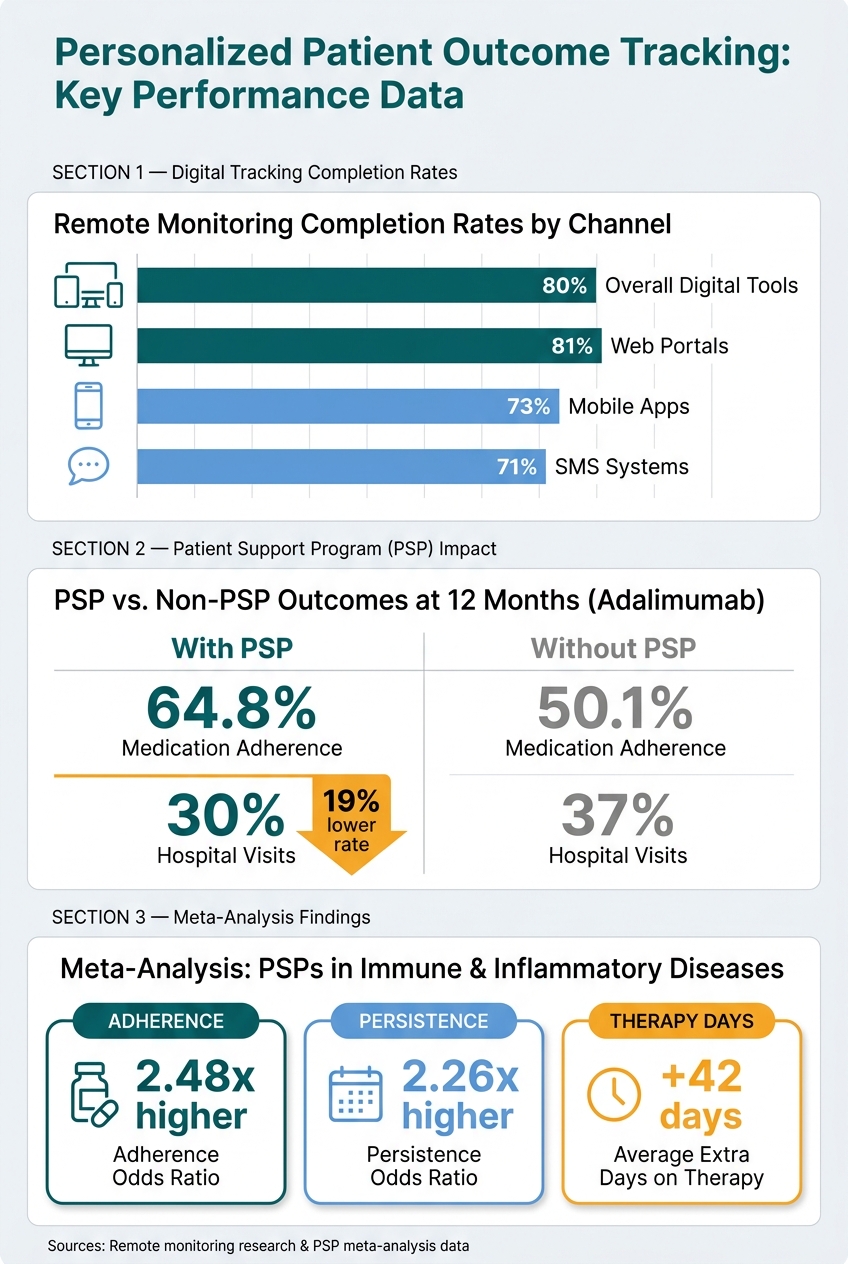
- Digital remote tracking reached 80% pooled completion in one research set
- Web tools hit 81%, apps 73%, and SMS 71%
- A PSP for adalimumab showed 64.8% adherence vs. 50.1% for non-participants
- The same program showed 30% vs. 37% hospital visits at 12 months
- A meta-analysis found 2.48x higher adherence odds and 2.26x higher persistence odds, with patients staying on therapy 42 days longer
Here’s the core idea in plain English:
- Clinical data tells you what happened medically
- PROs tell you how the patient feels and functions
- PREMs tell you how the patient experienced care
- Personalized schedules tell you when to ask
- Alerts and support tell you what to do next
I’d read this as a playbook for building a tracking program that people will complete and teams will use.
Patient Support Programs: Key Outcome Metrics & Digital Tracking Performance
Patient Outcomes Activated | Smarter Medicine Starts Here | PatientIQ

sbb-itb-8f61039
Quick comparison
| Area | What it does | Main point |
|---|---|---|
| Clinical outcomes | Tracks objective medical results | Good for disease status, but misses day-to-day patient burden |
| PROs / PROMs | Tracks symptoms, function, and quality of life | Shows what the patient feels directly |
| PREMs | Tracks care experience | Shows if communication, coordination, and support are working |
| Personalized scheduling | Sets timing by risk, therapy stage, and events | Helps avoid over-surveying or missing warning signs |
| Data integration | Connects EHR, labs, claims, and devices | Lets teams respond based on a fuller view |
| Mentorship support | Helps patients stay engaged | Useful when confusion, stress, or tech issues slow response |
That’s the full story upfront: better tracking comes from better timing, lower burden, connected data, and human follow-up when it counts.
How to Build a Patient Outcome Tracking Framework
Define Outcomes That Matter to Patients and Stakeholders
Move from definitions to decisions. Pick the outcomes this program will actually use.
Start with patient interviews, focus groups, and advisory boards to bring out lived experience, day-to-day limits, emotional strain, and the barriers people run into outside the clinic. Then map the real-time patient journey from first symptoms through follow-up and flag the moments that matter most: time to diagnosis, return to work, and fewer ER visits.
Then bring in clinical experts to connect patient goals to measurable endpoints. A goal like walking my dog without stopping can map to a 6-minute walk test. Wanting more energy can map to a validated fatigue scale. That translation step turns patient language into data you can track.
You also need alignment across medical, HEOR, market access, commercial, and patient support teams. The point is simple: agree on which outcomes matter for access, contracts, and post-marketing obligations, then map those priorities to HEDIS and CMS Star Ratings.
Choose Measures That Are Valid, Feasible, and Easy to Complete
Once you know what to measure, the next step is picking the right instrument. Use PROMs with a documented conceptual model, reliability, validity, responsiveness, and interpretability. Without those pieces, the measure is not fit for patient-centered outcomes research.
Good measures should match the outcome closely, perform well psychometrically, keep burden low, use plain English, have clear licensing terms, and fit the program's delivery mode. In practice, many programs use both:
- A generic PROM, such as EQ-5D or PROMIS Global Health, for cross-disease comparison and payer communication
- A disease-specific tool, such as the Asthma Control Test or Kansas City Cardiomyopathy Questionnaire, for clinical detail
Access matters too. Offer professionally translated versions in Spanish and other commonly used languages using standard forward-backward translation processes. Then test those versions with varied patient panels, including Medicaid beneficiaries, rural patients, and older adults, so you can catch comprehension problems before scale-up.
Set Personalized Tracking Schedules by Risk, Therapy Stage, and Channel
Build the schedule in three layers. First come care-phase checkpoints: baseline within ±14 days of first dose or procedure, on-treatment check-ins tied to visit frequency and risk windows, and follow-up at 3, 6, and 12 months. Next, adjust frequency by risk. High-risk patients may need weekly tracking in month 1, then every 2 weeks, while low-risk patients can follow monthly to quarterly intervals. The third layer is event-triggered assessment. These fire when something changes, like a hospitalization, dose adjustment, therapy interruption, or patient-reported decline.
The channel matters just as much as the schedule. Web portals work well for longer forms. Mobile apps fit push alerts and diaries. SMS and phone calls offer a lower-friction option. The schedule only works if patients can respond in a channel they already use.
When completion starts to slip, PatientPartner's real-time mentorship can step in to explain why tracking matters, sort out tech issues, and help patients stay engaged during high-stress periods. Capture channel preference at enrollment, then set a fallback path - app, SMS, phone, mentor support - for cases where response rates start to drop.
Those requirements define the tool layer that follows.
Core Components of Personalized Outcome Tracking Tools
With the tracking schedule set, the platform needs to do three things well: collect data, connect that data across systems, and act on it at the right moment.
Data Capture, Integration, and Personalization Logic
Patients should be able to respond in the channel they already use. That means supporting mobile apps, patient portals, SMS, phone outreach, and in-clinic kiosks.
That choice matters more than it might seem. In remote monitoring research on chronic arthritis, pooled completion rates across digital tools reached 80%. By channel, web platforms reached 81%, smartphone apps 73%, and SMS systems 71%.
Collecting responses is only part of the job. The data also needs to flow into the systems care teams use every day. API integration based on standards - especially HL7 FHIR APIs and SMART-on-FHIR app architecture - allows an outcome tracking tool to pull clinical data from EHRs, receive lab results, ingest pharmacy claims, and accept device data streams. If the EHR shows a new prescription, or a device reports a missed dose, the system can trigger follow-up right away.
Personalization logic is what keeps the process useful instead of noisy. Rule-based triggers can change survey timing and content based on score shifts, milestones, or risk tier. Adaptive branching helps keep surveys in the 5–10 minute range by asking follow-up questions only when a threshold is crossed. To cut down on fatigue, the system should enforce pause periods after high-intensity events like surgery. Teams should also A/B test trigger rules against completion and dropout rates so they can find the right balance between signal and burden.
Once the data is flowing and the trigger rules are set, the next need is role-based reporting.
Dashboards, Reporting, and Decision Support
Dashboards are where the tracking plan turns into day-to-day action.
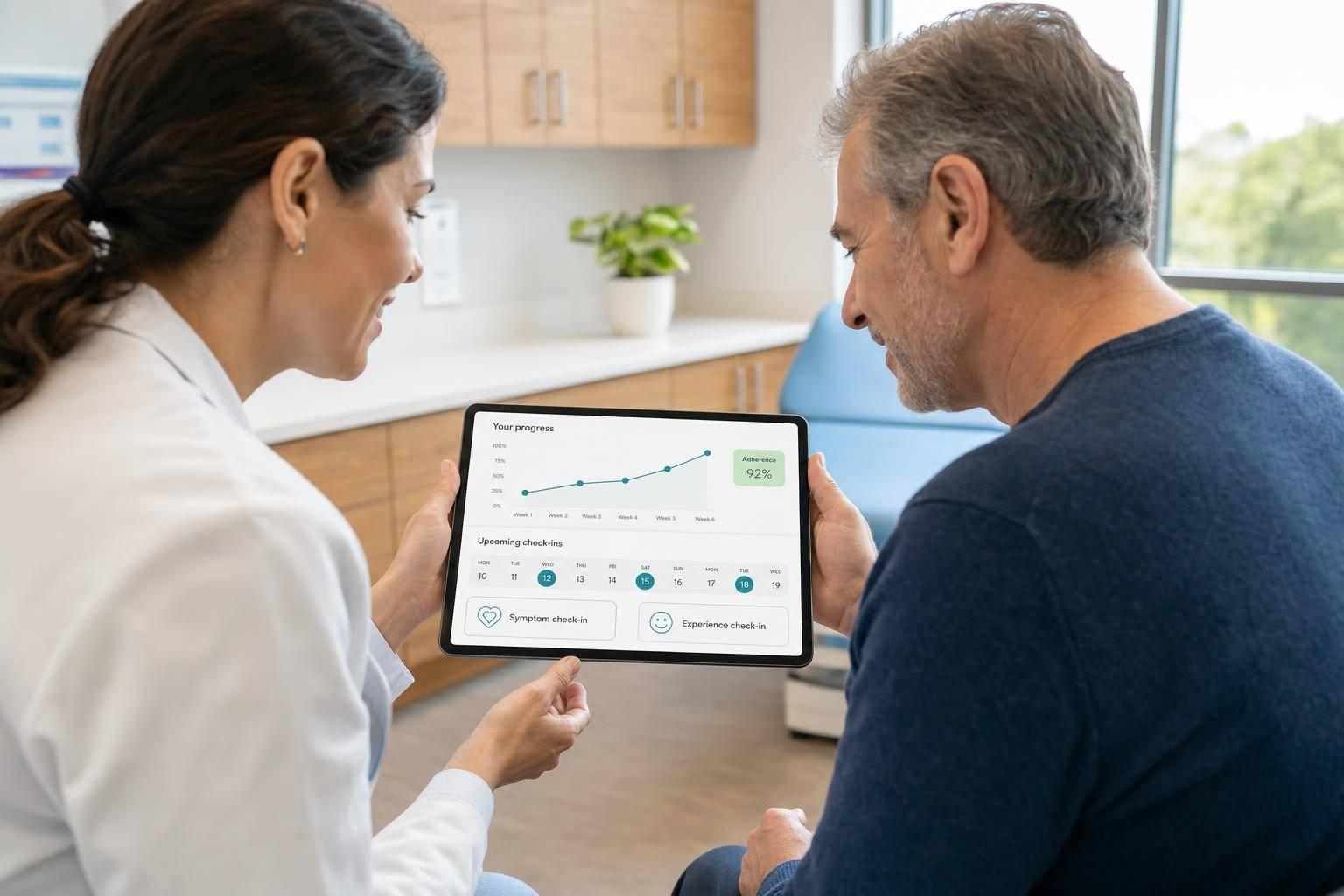
Clinicians need to see individual trajectories. In plain terms, that means time-series graphs showing PRO scores, lab values, and adherence, with threshold lines that mark concerning ranges. Program managers need a cohort view: response rates, clinically meaningful improvement, and alert volume by risk tier. Executives need the big picture: outcome performance against targets, site-level variation, and the relationship between better outcomes and business metrics such as therapy persistence.
A useful reporting setup tracks four metric groups:
- clinical outcomes
- PROs
- PREMs
- utilization/adherence
| Metric Category | Definition | Primary Data Source | Key Strengths | Key Limitations |
|---|---|---|---|---|
| Utilization & Adherence Metrics | Medication possession ratio, days covered, appointment attendance, device usage | Pharmacy claims, scheduling systems, device logs | Operationally relevant; ties outcomes to behavior | Claims-based data may not reflect actual consumption |
Metrics matter most when they lead to a clear next step. For example, a PRO score increase of two or more points on a validated scale might trigger a symptom-worsening alert with an embedded recommendation, such as scheduling a nurse call within 48 hours or sending the nausea management education module. To avoid alert fatigue, start with a small set of high-value rules, watch resolution rates, and tighten thresholds before adding more.
Those alerts only help if they fit the way clinical and program teams already work.
Real-Time Mentorship as a Patient Support Layer
Mentorship helps close the engagement gap that software alone can't fix.
Technology collects data. Real-time mentorship helps patients stay involved when confusion, fatigue, or plain old friction starts to get in the way.
PatientPartner can connect patients with matched mentors at key milestones and return de-identified engagement data to the tracking system.
From here, the next step is aligning the tool with workflow, consent, and governance.
Implementation, Compliance, and Program Measurement
Once data capture and personalization are live, the next job is governance: ownership, compliance, and measurement. The rules from the prior section only hold up when teams know who owns what, what consent covers, and which KPIs matter.
Stakeholder Alignment and Workflow Design
A personalized outcome tracking program needs clear ownership across medical affairs, HEOR, patient engagement, commercial, compliance/legal, privacy/security, and any provider-facing care team or care-management team.
The biggest gap is usually escalation ownership. Before launch, define who reviews worsening symptom alerts after hours, who documents possible adverse events, and who routes them to pharmacovigilance. These are legal and day-to-day operating requirements. If escalation rules live only in someone's head, the program is asking for trouble. Write them down, assign them, and test them before launch.
Use the table below to line up the operating model with program complexity.
| Model | Scalability | Patient Burden | Site Burden | Data Completeness |
|---|---|---|---|---|
| Clinic-centric | Low - tied to visit volume | Low - embedded in visit flow | High - staff manage data capture | Moderate - misses between-visit changes |
| Remote-first | High - no site dependency | Moderate - requires app/SMS engagement | Low - automated collection | High - longitudinal, real-world data |
| Hybrid | Moderate - scales with support infrastructure | Low to moderate - brief remote check-ins, clinic reviews exceptions | Moderate - staff review alerts, not routine data | High - combines visit and remote signals |
Match the model to therapy complexity. Hybrid works well for complex treatments with milestone-based follow-up. Remote-first makes more sense for lower-touch evidence programs. The model also shapes who handles PHI and which platform controls are required.
HIPAA, Consent, Oversight, and Patient Trust
Under HIPAA, PHI collected through portals, remote monitoring, or patient-support platforms needs encryption in transit and at rest, role-based access, audit logs, secure authentication, and session timeouts. Any vendor that processes protected health information should have business associate agreements in place.
Consent should match the use case. Support use and research use need different consent, and post-launch evidence needs its own disclosure and governance. Use plain-language forms, version control, and clear opt-in and opt-out choices. U.S. patient surveys show that almost 80% of patients want the ability to opt out of sharing their health data with companies, and more than 75% want to opt in before a company repurposes it. That's not a small detail. Transparency is what keeps patients engaged long enough to produce data that teams can use.
Predefined triage tiers and scripted decision trees matter for severe side effects, device malfunctions, or hospitalization signals. Patient support staff should follow scripts, not make up clinical guidance on the fly. Each tier should spell out who reviews the alert, how fast they need to respond, how the case is documented, and when it moves to medical information or pharmacovigilance. Keep timestamps for submission, alerting, response, and closure.
After governance is in place, the program needs to show value through a focused set of operational and outcome KPIs.
KPIs That Link Patient Outcomes to Business Value
Track KPIs that show engagement, safety, and value.
| KPI | Clinical Impact | Patient Experience Impact | Commercial Value |
|---|---|---|---|
| Completion rate | How representative the data is | How easy the program is to use | Whether engagement is strong enough to sustain the program |
| Time to first response | Earlier follow-up can support symptom management | Builds trust early in the journey | Operational responsiveness that can support retention |
| Worsening symptom frequency | Helps identify patients who need follow-up | Patients feel monitored and supported | Can reduce costly care escalations |
| Therapy persistence at 12 months | Indicates sustained treatment use | Reflects confidence in the therapy | Tied to revenue and market share |
| New patient start conversion | Shows how many patients move from interest to treatment | Reflects how well onboarding removes friction | Core commercial metric for patient support programs |
| Hospitalization signals | Early warning for clinical deterioration | Can reduce anxiety through proactive outreach | Supports the value story |
| Patient satisfaction score | Correlates with adherence and self-reported outcomes | Direct measure of program quality | Supports renewals and program expansion |
The data behind these metrics is strong. One patient support program (PSP) for adalimumab showed 64.8% adherence versus 50.1% in non-participants at 12 months. It also showed 30% vs. 37% hospital visits at 12 months, which equals a 19% lower rate. A meta-analysis of PSPs in immune and inflammatory diseases found higher adherence (odds ratio 2.48) and higher persistence (odds ratio 2.26), with an average persistence gain of 42 days.
Review leading indicators weekly and lagging indicators monthly. Using both gives teams a clean view of launch performance and what happens downstream.
Conclusion: How to Scale Personalized Outcome Tracking
Once tracking, workflow, and governance are set up, scaling comes down to steady refinement. Personalized patient outcome tracking is no longer stuck in the pilot phase. It’s becoming a core operating function for pharma and med-tech companies that need to show real-world value. The teams that build programs that last tend to follow the same pattern: they pair structured outcome data - clinical metrics, PROs, and PREMs - with timely human support, so they can step in before patients drop off.
The data behind that model is hard to ignore. A meta-analysis of patient support programs in immune and inflammatory diseases found an adherence odds ratio of 2.48 and a persistence odds ratio of 2.26 compared with standard care. Patients also stayed on therapy an average of 42 days longer. But those gains don’t happen just because a company measures more. They happen when personalized tracking changes what teams do next and how follow-up happens.
That kind of progress only scales if the platform can handle it. Programs that grow well usually rely on modular tech that can take on new brands and indications without a full rebuild. They also use risk stratification to match the right level of support to the right patients. And they feed patient insights back into clinical strategy and product design, creating a closed loop instead of a one-way flow of data.
Human support is what keeps that system working in the messiness of day-to-day care. Real-time mentorship can close the engagement gap that software alone can’t fix. PatientPartner puts this into practice by connecting prospective or newly diagnosed patients with experienced mentors when anxiety and uncertainty tend to peak. That support can improve adoption of complex treatments and surgeries through real-time peer support.
Scaling also depends on regular review, A/B testing, and patient feedback. Personalized tracking works best when data, workflow, and mentorship function as one system. Data shows where friction lives; mentors help clear the path.
FAQs
How do we choose the right outcomes to track?
Track both clinical success and the key steps in the patient journey, especially the points where people tend to get stuck. That includes treatment start, follow-up completion, refill rates, adherence, and day-to-day engagement.
Review these on a set schedule - 30 days, 90 days, 6 months, and 1 year. Then look at the numbers alongside patient feedback so you can catch barriers like cost or side effects early, before they turn into drop-off.
What’s the best follow-up schedule for different patients?
The right follow-up schedule depends on the patient’s risk level and where they are in treatment. The best approach is tiered, not one-size-fits-all.
That means using a mix of automated, data-led check-ins and human support. Some patients need close contact. Others do fine with less frequent outreach.
High-risk patients, or people in acute recovery, need follow-up more often. A good example is the 90-day period after surgery, when issues can show up fast and support needs tend to be higher.
Lower-risk patients can usually stay on periodic check-ins instead. Even then, the schedule shouldn’t stay fixed forever. It should be reviewed on a regular basis as the patient’s needs shift.
How do we protect patient data and consent?
Protecting patient data and consent takes more than one lock on the door. It calls for a layered setup built on compliance rules and technical controls.
PatientPartner supports HIPAA, SOC 2, ISO 27001, and GDPR compliance. It also uses AES-256 encryption, role-based access controls, and audit trails to help keep data protected and track who did what.
We also follow the HIPAA Minimum Necessary Rule, use data de-identification, require signed BAAs from third-party vendors, and apply automated oversight to help maintain privacy during mentor-patient interactions.