


How to Define Patient Engagement Standards

Key Takeaways
Author


If your team can’t define patient engagement the same way every time, your metrics won’t mean much. In pharma and med-tech, that leads to weak comparisons, unclear targets, and poor follow-through - while nonadherence still costs the U.S. about $290 billion a year and contributes to 125,000 preventable deaths.
I’d keep it simple: set one plain definition of engagement, tie it to patient actions you can track, use a small metric set, and put rules around privacy, ownership, and review. That gives you a shared way to judge onboarding, education, reminders, adherence support, care navigation, and peer mentorship.
Here’s the short version:
- Define the scope first: What patient behaviors should change?
- Map it to the journey: start, onboarding, adherence, and retention
- Keep categories separate: engagement, activation, experience, and outcomes are not the same
- Use a small metric set: usually 8–15 metrics
- Set one metric dictionary: formula, population, exclusions, data source, cadence, owner, and version
- Build privacy rules in early: HIPAA, consent, de-identification, BAAs, and audit logs
- Use internal baselines first: pull 6–12 months of data before setting targets
- Add clear thresholds: minimum standard, target, and alert range
- Treat peer mentorship like any other channel: define triggers, session rules, and downstream measures
- Assign owners: each metric needs one team and one accountable lead
A simple standard is easier to use, review, and fix. That’s the core idea behind the article.
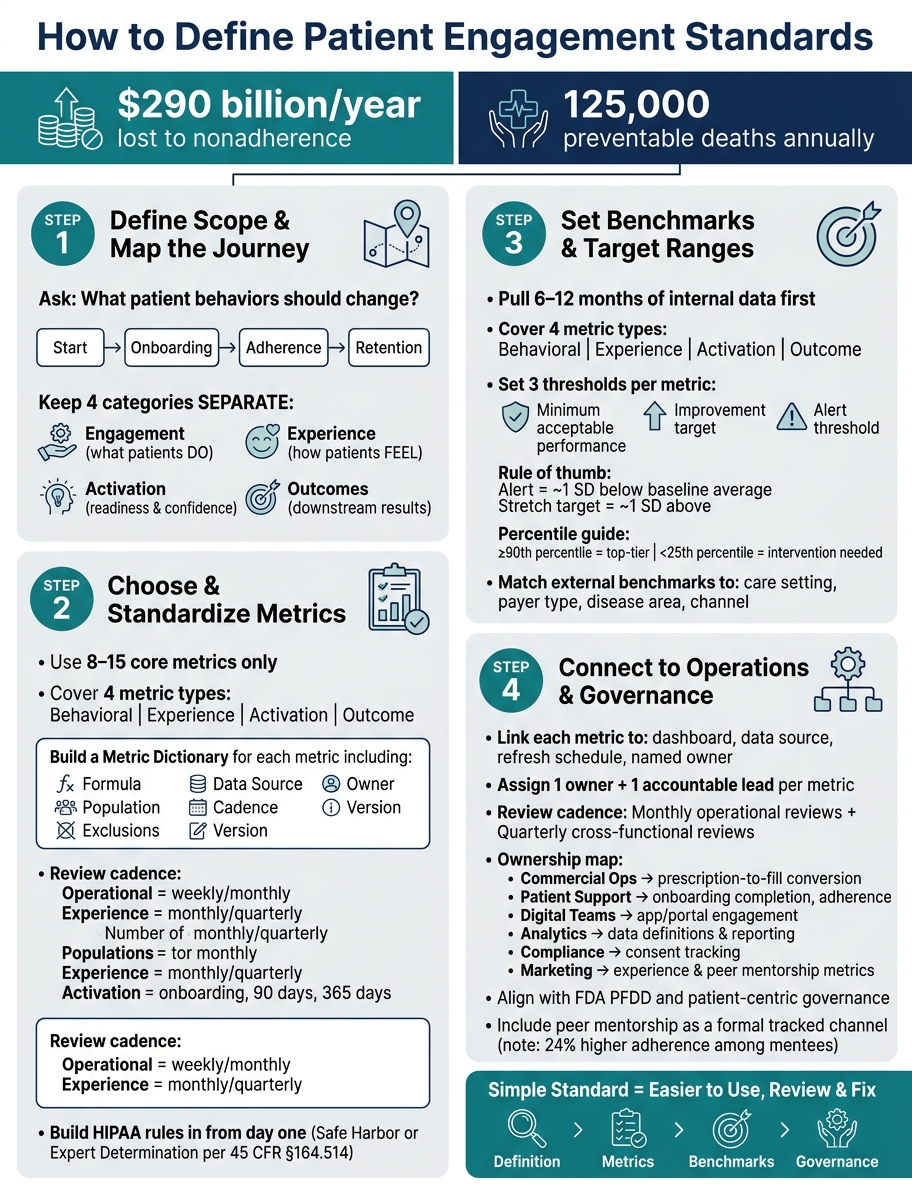
How to Define Patient Engagement Standards: 4-Step Framework
1. Define what patient engagement includes for your program
Start by defining patient engagement in plain terms: what patient actions is this program supposed to change? Not vague intent. Not general interest. Specific actions you can track.
That usually means behaviors like completing onboarding education within 7 days of enrollment, filling a first prescription within 14 or 30 days, attending a scheduled follow-up, or staying on therapy past the 90-day mark. If a behavior can't be measured and tied to an outcome, it shouldn't be your standard.
The patient journey helps narrow this down to the points that matter most.
Map engagement to the patient journey
Engagement doesn't look the same from one stage to the next. What counts as strong engagement at the start is not the same as what counts later during adherence or retention. A useful way to map this is across four stages: start, onboarding, adherence, and retention.
| Journey Stage | Specialty Medication | Implanted Device | Elective Procedure |
|---|---|---|---|
| Start | Benefit verification, prior authorization completion, first fill | Pre-op education, procedure attendance | Consultation scheduling, decision support |
| Onboarding | Education completion, hub enrollment | Device training, peri-operative support | Pre-op education, procedure preparation |
| Adherence | Refill rate, PDC at 90 days | Post-op follow-up, long-term monitoring | Recovery milestone check-ins, rehabilitation adherence |
| Retention | 365-day persistence | Ongoing monitoring and troubleshooting | Rehabilitation adherence and follow-up |
Once you've mapped the journey, the next step is simple but easy to miss: don't lump engagement together with activation, experience, and outcomes.
Separate engagement, activation, experience, and outcomes
This is where a lot of teams get tripped up. They mix four different things into one bucket, then wonder why the data tells a muddy story. An email open rate is not proof of adherence. A satisfaction score is not the same as clinical progress. Each of these categories needs its own KPIs and benchmarks.
- Engagement is what the patient does: completing a module, attending a call, refilling a prescription, responding to an outreach message.
- Activation is the patient's readiness and confidence to act, often measured through self-efficacy questions or Patient Activation Measure (PAM) scores.
- Experience is how the patient feels about the interaction: satisfaction, trust, and perceived clarity, usually captured through Patient-Reported Experience Measures (PREMs).
- Outcomes are the downstream results: treatment start, 90-day or 365-day persistence, reduced discontinuation, or symptom improvement.
Keeping these layers separate makes troubleshooting a lot easier. Low adherence paired with high satisfaction points to one kind of problem. Low satisfaction paired with high activation points to another.
Include peer mentorship as an engagement channel
Peer mentorship should be treated as a measurable engagement channel, not just a nice extra. When it's set up the right way, it works as a formal engagement channel with clear goals, touchpoints, and tracked results.
That means defining when mentor support gets triggered, what mentors are trained to cover, how sessions are documented, and how escalations are handled. You can then track metrics like referral-to-match time, number of completed mentor sessions, patient confidence before and after sessions, and downstream effects on new starts or adherence. A peer-to-peer mentoring program for a complex drug-device combination therapy reported 24% higher adherence among mentees compared with non-mentees.
Once peer mentorship has defined inputs and tracked outputs, a team can improve it, measure it, and manage it like any other channel.
sbb-itb-8f61039
2. Choose the metrics and instruments you will standardize
Once the scope is set, the next move is simple: pick the small set of metrics that will guide decisions. In most cases, that means 8–15 core metrics tied to outreach, onboarding, adherence, and retention.
The key is consistency. If a metric can't be measured the same way across sites, time periods, and data sources, it won't help much. Standard metrics are what make benchmarking possible.
Select behavioral, experience, activation, and outcome metrics
Don't rely on one type of metric to tell the whole story. Use one for behavior, one for perception, one for readiness, and one for results. Each one shows a different part of the picture, and each one calls for different tools.
| Metric Category | What it measures | Typical tools/instruments | Common benchmark sources |
|---|---|---|---|
| Behavioral | Observable patient actions: outreach response, attendance, onboarding completion, refills, retention | CRM logs, EHR scheduling modules, pharmacy claims (PDC/MPR), patient support program databases | Internal baselines, payer quality dashboards, and published no-show and adherence studies |
| Experience | Patient perception of communication, access, and shared decision-making | NPS surveys, CAHPS-aligned questionnaires (e.g., CG-CAHPS, HCAHPS domains) | AHRQ CAHPS benchmarks, CMS HCAHPS public reporting, and health system top-box score summaries |
| Activation | Knowledge, confidence, and readiness to self-manage | Patient Activation Measure (PAM-13), Patient Health Engagement (PHE) Scale | Published PAM and PHE validation studies and vendor-reported score distributions |
| Outcome | Downstream results: initiation, persistence, and adherence | EHR and claims data (PDC, MPR), pharmacy refill records, longitudinal program data | Internal historical data, payer or health system performance reports, published studies, and quality measurement organizations |
Use PAM-13 as the default activation measure. It's the most widely used validated tool for patient knowledge, skills, and confidence.
After you lock the metric set, lock the definitions too. Otherwise, two teams can report the "same" metric and mean two different things.
Build a standard metric dictionary
Create a standard dictionary for every metric. Include:
- Formula
- Population
- Exclusions
- Baseline period
- Data source
- Reporting cadence
- Owner
- Version
- Last update
The same metric needs to mean the same thing at every site and in every reporting period. That's the whole point.
For review timing, keep it practical. Operational metrics usually work best on a weekly or monthly cycle. Experience metrics often fit a monthly or quarterly schedule. Activation metrics should be checked at fixed milestones, such as onboarding, 90 days, and 365 days.
Standardization falls apart fast if the data rules aren't set at the same time.
Build HIPAA-aware measurement rules from the start
Build HIPAA rules into the metric design from day one. Use role-based access, encryption, and audit logs across every system that handles protected health information (PHI).
When possible, report with de-identified or limited datasets. HIPAA's de-identification standard under 45 CFR §164.514 recognizes two methods: Safe Harbor and expert determination. Safe Harbor means removing 18 specific identifiers. Expert determination means documenting a very low re-identification risk.
Poor data governance can throw off your benchmarks. So in the metric dictionary, flag:
- PHI use
- De-identification method
- Any required Business Associate Agreements (BAAs)
With the metric set fixed, the next step is setting baselines and target ranges.
3. Set benchmarks and target ranges for each metric
Once your metric dictionary is set, the next move is simple: turn each metric into a rule for action. Start with your own data, then use outside benchmarks to pressure-test it. For each metric, you want three things: a baseline, a target, and an alert rule.
Start with internal baselines before setting targets
Stick with the same engagement definition, metric dictionary, and measurement rules you set earlier. Then pull 6–12 months of stable data and calculate the mean, median, standard deviation, and percentiles. That gives you your baseline.
From there, set three thresholds for every metric:
- Minimum acceptable performance: at least 85% of enrolled patients complete their first mentor conversation within 7 days
- Improvement target: improve 6-month persistence by 10 percentage points within 12 months
- Alert threshold: if weekly onboarding completion drops below 75%, escalate to program leadership
A practical rule of thumb: place alert thresholds around one standard deviation below the baseline average, and set stretch targets around one standard deviation above it. Then adjust those ranges based on clinical risk, patient safety, and business priority.
Some metrics aren't open for debate. Use minimum standards for those nonnegotiables. And when therapy pathways differ, set therapy-specific targets. A high-touch, high-risk therapy shouldn't be judged the same way as a simpler pathway. Benchmark ranges should reflect therapy complexity, risk, and support intensity.
Once your internal baselines are in place, outside benchmarks can help fine-tune them.
Use external and percentile benchmarks carefully
Not all benchmarks travel well. Match them to the same setting, population, and channel. If the benchmark comes from a different engagement channel or care setting, it can steer you in the wrong direction.
In the 2024 national benchmark, HCAHPS top-box scores were 87% for Discharge Information and 61% for Communication about Medicines, but those numbers reflect inpatient hospital settings, not specialty pharmacy or peer mentorship programs. So if you use outside references, line them up by care setting, payer type, disease area, and channel.
Percentile benchmarking is a clean way to frame performance. Programs at or above the 90th percentile can be treated as top-tier. Programs below the 25th percentile likely need intervention. MassHealth's 2025 Managed Care Plan Quality Performance report, for example, compares HEDIS measures such as Transitions of Care – Patient Engagement After Inpatient Discharge against 75th and 90th percentile thresholds.
That said, percentiles can be misleading if the whole peer group is underperforming. A program might hit the 75th percentile and still miss a reasonable absolute standard. That's why percentile targets work best when paired with minimum thresholds.
Use the source that best fits the decision in front of you.
| Data source | Advantages | Limitations | Best use case |
|---|---|---|---|
| National patient experience surveys (e.g., HCAHPS) | Widely recognized; transparent methods; national percentile comparisons available | Primarily inpatient; limited disease-specific detail; may not map to outpatient or digital programs | Setting broad communication and experience minimum standards |
| Disease- or setting-specific registries and studies | Reflect specific patient populations and therapies; realistic adherence and satisfaction ranges | Often small samples; methods vary; may lag current practice | Therapy-specific targets for adherence, activation, and outcomes |
| Industry program benchmarks (e.g., hub services, specialty pharmacy data) | Directly aligned with support program operations; includes engagement, conversion, and retention metrics | Proprietary; definitions may differ; may not adjust for case mix | Setting operational targets for onboarding, call completion, and retention |
| Internal percentile benchmarking | Reflects your own reality; easy to compute; drives continuous improvement | Doesn't indicate external competitiveness; can penalize programs serving complex populations | Prioritizing internal improvement and identifying top-performing programs |
Patient experience tends to move gradually, not all at once. So set step-by-step targets instead of expecting big jumps overnight.
Once the targets are defined, plug them into dashboards, alerts, and named review ownership.
4. Connect standards to operations, analytics, and governance
Standards only matter if they lead to action. That means building them into dashboards, alerts, day-to-day workflows, and governance.
Link standards to dashboards and intervention workflows
Once thresholds are in place, turn them into live rules. Analytics teams should connect each standard to a data source, refresh schedule, and owner, then show it in role-based dashboards.
The big question is simple: what happens when a metric slips? An alert should trigger a set response right away, not another meeting to figure out next steps. For peer mentorship programs, platforms like PatientPartner can send API data on match rate, time to first mentor contact, and number of mentor touches per patient straight into these dashboards. That way, mentorship performance appears next to clinical and behavioral metrics in one place.
| Metric | Standard threshold | Alert range | Responsible team | Intervention type |
|---|---|---|---|---|
| Prescription-to-fill conversion rate | ≥70% within 14 days | 50–69% (warning); <50% (critical) | Commercial operations & patient support | Benefit verification audit, prescriber education, financial counseling |
| Onboarding completion rate | ≥80% within 30 days of first fill | 60–79% | Patient support program team | Reminder campaigns, nurse educator outreach, digital onboarding optimization |
| 90-day adherence (MPR) | ≥0.85 | 0.70–0.84; <0.70 | Medical affairs & patient support | Side-effect management, regimen simplification, peer mentor referral |
| Mentor engagement (first 30 days) | ≥3 interactions | 1–2; 0 | Patient mentorship team (e.g., PatientPartner program lead) | Re-matching, mentor outreach, patient activation messages |
| Patient-reported experience score (e.g., onboarding NPS) | ≥+30 | +10 to +29; <+10 | Patient experience & innovation | Journey redesign workshops, script changes, content updates |
Assign ownership and set a review cadence
Next comes accountability. Every metric needs one owner and one accountable leader. Put both in a governance playbook and review them at least once a year. When ownership gets blurry, gaps show up fast.
A simple ownership map might look like this:
- Commercial operations: prescription-to-fill conversion, prior authorization cycle time
- Patient support teams: onboarding completion, adherence metrics
- Digital teams: app, portal, and content engagement
- Analytics: data definitions, quality checks, integrated reporting
- Compliance: consent tracking, opt-in rates, regulatory documentation
- Marketing and patient engagement: patient experience metrics and peer mentorship performance
Review cadence also needs structure. A two-tier setup works well.
Monthly operational reviews should focus on the prior month’s dashboard. That includes trends, root-cause hypotheses, and action items with named owners and due dates. Quarterly reviews should bring in medical affairs, compliance, and innovation leaders to check whether thresholds and playbooks still match current evidence and market conditions. If a metric or threshold changes, route it through written rationale, impact review, cross-functional approval, and a documented effective date.
Align standards with FDA, PFDD, and patient-centric governance
Standards should track more than throughput. Throughput by itself does not meet PFDD expectations. Programs also need to measure whether patients felt informed, whether treatment options were clearly explained, and whether they had access to decision aids before consent.
In practice, that means adding metrics such as percentage of patients reporting that treatment options were clearly explained or percentage of patients who received decision aids before consent. These can be measured through structured surveys built into onboarding or follow-up workflows. FDA guidance also supports using fit-for-purpose clinical outcome assessments (COAs) and structured patient input, which means teams need governance around metric selection, version control, and documentation when those measures change.
Governance is what keeps standards consistent, auditable, and centered on the patient. Every patient-facing workflow should include documented consent language, opt-out options, and recorded patient preferences, such as preferred communication channel and contact frequency. Dashboards should default to de-identified or aggregated views for most users, with role-based access and audit logs for patient-level detail. Compliance teams should also set oversight metrics, such as percentage of interventions using approved scripts or time to respond to potential adverse event reports, with alert ranges that trigger internal investigations and clear escalation paths when thresholds are crossed.
Conclusion: A simple framework for defining patient engagement standards
Put together, these steps create a usable standard, not just a measurement plan. Patient engagement should be defined through four parts: a clear operational definition, a small validated metric set, benchmark ranges tied to program goals, and a governance layer that keeps the standard active.
When standards are built into workflows and dashboards, it becomes easier to repeat improvements instead of starting from scratch each time.
That same setup should include peer mentorship rather than treating it as a separate program. PatientPartner can keep mentorship within the same measurement system by tracking matches, sessions, and follow-up alongside adherence and patient experience.
Key points to carry into implementation
For implementation, keep the system simple:
- Use one shared definition of engagement
- Keep metrics limited and reproducible
- Start with internal baselines before looking at external benchmarks
- Review standards on a set cadence under HIPAA-, FDA PFDD-, and patient-centered governance
FAQs
How do we choose the right engagement metrics?
Choose metrics that are valid, reliable, feasible, and tied to points in the patient journey where people often drop off.
Track a mix of clinical outcomes and PROMs, adherence measures like MPR and PDC, engagement signals such as PAM scores, portal use, and mentor interactions, plus patient sentiment.
The goal isn't to track everything. It's to focus on the measures most likely to predict patient success, then review them on a regular basis alongside patient feedback.
What should a patient engagement metric dictionary include?
A patient engagement metric dictionary should spell out what each metric means, how to calculate it, and where the data comes from so teams track performance the same way across the organization.
That matters more than it may seem. If one team defines adherence one way and another team uses a different formula, the numbers stop being useful. You’re no longer comparing apples to apples.
Your dictionary should cover metrics across three areas:
- Engagement and mindset
- Adherence and behavior
- Outcomes and experience
For each metric, include the data source - such as pharmacy claims, mentor notes, or EHR data - plus the patient journey stage it supports. That way, the metric isn’t just a number on a dashboard. It’s tied to a point in the patient experience, from onboarding to persistence to long-term follow-up.
How often should patient engagement standards be reviewed?
How often you review your program should match two things: how mature the program is and which data points you track.
For new initiatives, review participation monthly. That gives you a chance to spot early trends before they turn into bigger issues.
For established programs, quarterly reviews are usually enough to see what’s changed and decide what to adjust.
It also helps to split your review cadence by metric type:
- Check leading indicators weekly
- Assess lagging indicators at longer, set intervals
One more thing: keep the schedule flexible. Patient needs can shift over time, and your review rhythm should shift with them.