


GDPR Data Retention Rules for Patient Mentorship
Key Takeaways
Author


GDPR sets no single retention deadline for patient mentorship data. I recommend setting a purpose, owner, deletion trigger, and justified retention period for each record type - not using one deadline for everything. A 12-month period, for example, is a policy choice to validate, not a GDPR rule.
Here’s the checklist I use:
- Check scope and roles: Determine whether GDPR applies, who controls the data, and where providers store it. HIPAA does not replace GDPR.
- Separate record types: Give profiles, matches, messages, consent evidence, safety records, analytics, and audit logs their own schedules.
- Document legal grounds: Identify an Article 6 basis and, for health data, an Article 9 condition. Removing names alone does not make data anonymous.
- Limit exceptions: Preserve only the records covered by a valid safety duty or legal hold - not the whole account.
- Make deletion work: Cover live systems, exports, processors, and backups, and stop deleted data from returning during recovery.
- Test and review: Check rights requests, access limits, privacy notices, contracts, and deletion results before launch and when the service changes.
My rule of thumb: <u>keep identifiable data only while a documented purpose or duty requires it</u>. Then delete it or make it anonymous.
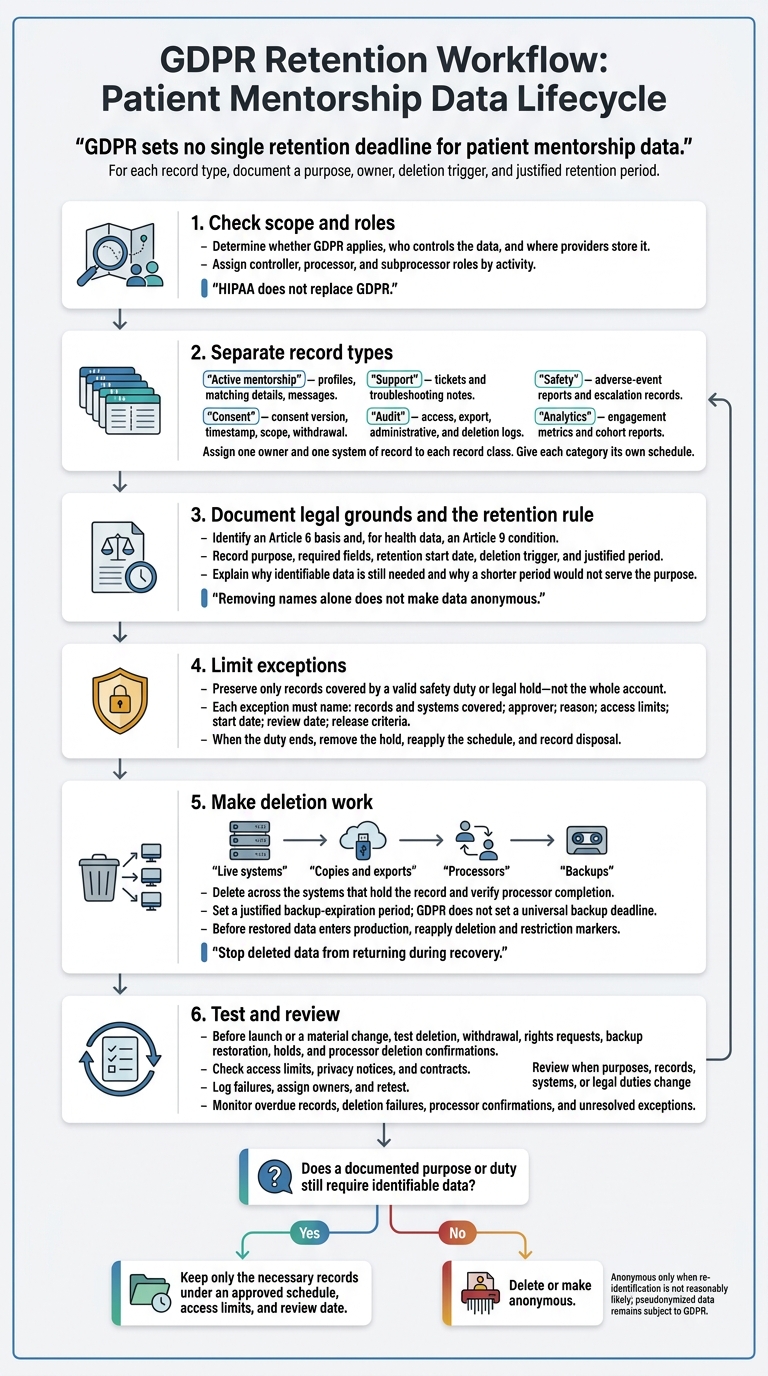
GDPR Patient Mentorship Data Retention Workflow
How Does GDPR's Storage Limitation Principle Affect Data Retention? - AI and Technology Law
sbb-itb-8f61039
GDPR Retention Rules for Patient Mentorship Data
Separate legally required retention from company policy. GDPR allows identifiable data to be kept only as long as necessary. Any fixed retention period must cite its legal source. For patient mentorship SaaS, each workflow - matching, messaging, support, safety, consent, and analytics - needs its own rule. Quality reviews and service improvements justify only limited retention tied to a stated purpose. Classify each record type using this distinction before setting its retention period.
Purpose, Data Minimization, and Storage Limits
Turn Article 5 into a rule for each record: its purpose, required fields, retention start date, and deletion trigger. Matching participants does not, on its own, justify collecting their complete medical histories.
Record classification
| Record class | Typical contents | Retention decision |
|---|---|---|
| Active mentorship | Profiles, matching details, messages | Set the active-service period and a documented closure period. |
| Support | Tickets and troubleshooting notes | Tie retention to case resolution and documented dispute or legal needs. |
| Safety | Adverse-event reports and escalation records | Verify safety obligations and document the required period. |
| Consent | Consent version, timestamp, scope, withdrawal | Keep enough evidence to show consent and how it was managed. |
| Audit | Access, export, administrative, and deletion logs | Set a separate security and accountability schedule. |
| Analytics | Engagement metrics and cohort reports | Use aggregated or anonymized outputs and limit retention of identifiable source data. |
Assign one owner and one system of record to each record class. Keep records needed for a safety investigation separate from routine mentorship content. That way, an investigation does not extend retention for the entire account.
Define retention triggers precisely, including what counts as closure when using:
“after mentorship closure”
Use these record classifications to set the retention schedule for each data category.
Health Data, Anonymization, and Pseudonymization
Profiles, matching fields, and messages can reveal health information even when they contain no formal medical record. Health data requires both a lawful basis and an Article 9 condition. Consent to join a mentorship program does not justify keeping that data indefinitely. Flag treatment references and indirect health indicators in the data inventory before approving retention rules.
Removing names does not necessarily make data anonymous. Under Recital 26, data is anonymous only when re-identification is not reasonably likely. Article 4(5) defines pseudonymization: data remains subject to GDPR when additional information can reconnect it to a person.
Before keeping platform analytics or exports long term, check whether rare conditions, locations, or recognizable messages in mentorship records and reports could identify participants. If re-identification remains possible, restrict access and set a fixed retention limit. Use that classification to decide which analytics can be kept long term and which must be deleted on schedule.
Legal Grounds and Retention Schedules
Choose a Lawful Basis and Health Data Condition
Map the record categories above to each purpose before assigning a legal basis and retention period. Each purpose needs both an Article 6 basis and an Article 9 condition. If someone withdraws consent, stop the affected processing. Any later retention for safety or legal defense needs its own documented basis, access limits, and time limit.
Neither contract nor legitimate interests alone permits health-data processing. Identify the applicable Article 9 condition and check any national-law requirements. A patient mentorship SaaS must not assume that contract or legitimate interests covers health data.
Do not switch bases after the fact to avoid deletion. Continued processing for a safety investigation or legal defense needs a separate, documented purpose and an applicable health-data condition. Withdrawal does not invalidate earlier lawful processing. And Article 89 does not turn routine product analytics into research or statistical processing.
Create a Retention Schedule by Data Category
For each period, explain why identifiable data is still needed and why a shorter period would not serve the purpose. That explanation must not become a reason for indefinite storage. The periods below are examples only, not fixed GDPR deadlines. They need legal review and checks against how your service works. Record controller, processor, storage, and backup details alongside the schedule.
Use a separate schedule for each data class. Matching, messaging, consent, safety, and audit records should not all inherit the same deadline.
Data category Purpose Article 6 basis / Article 9 condition, if applicable System location Owner Trigger Proposed period Legal justification to validate Disposal method Patient and mentor profiles Account administration and matching Contractual necessity or consent / explicit consent or another documented Article 9 condition Identity service; CRM; patient database Program operations Last interaction or program closure 12 months after closure Keep only while support, reconciliation, or a documented claim period requires identifiable data Delete profile fields; retain only approved aggregate metrics Matching records Show how matching decisions were made and manage support Contractual necessity or legitimate interests, if justified / applicable Article 9 condition when matching includes health data Matching service; case-management system Operations and privacy Last match or program closure 12 months Needed to resolve disputes, handle support requests, and verify program operation Delete direct identifiers; anonymize approved statistics Mentor-patient messages Deliver mentorship and manage safety escalation Contractual necessity, consent, or another documented basis / explicit consent or applicable health-data condition Messaging database; secure archive Operations; safety team Last interaction or case closure 12 months, unless a documented safety or legal hold applies Retain only as needed for service delivery, complaints, and safety review Secure deletion from active systems and the defined backup cycle Consent evidence Show consent, scope, version, and withdrawal Accountability / evidence of consent scope and withdrawal; document the applicable Article 6 basis and Article 9 condition separately Consent-management platform; compliance archive Privacy or compliance Withdrawal, program closure, or expiration of the relevant claim period 3 years after the last relevant activity Accountability and defense of claims; retain evidence, not unnecessary clinical content Delete or irreversibly anonymize after the approved period Safety escalations Investigate and route potential adverse events or other safety concerns Legal obligation where applicable, or another documented basis / applicable pharmacovigilance or medical-device legal condition under relevant law Safety system; case-management platform Pharmacovigilance or device safety Safety-case resolution Period defined by applicable product and jurisdictional rules Regulatory duties may require longer retention, but only for records within the organization’s role and scope Transfer required records to the authorized safety repository; delete duplicate mentorship content Audit logs Show access, changes, exports, and deletion actions Legal obligation or legitimate interests, as applicable / assess the log contents by record type SIEM; immutable audit store; application logs Security and compliance Log creation or system retirement 12–24 months as a hypothetical range Security monitoring, incident investigation, and compliance evidence Purge or make inaccessible under the log policy
The schedule should also name the data controller, processor, and subprocessor. Include the storage region, backup behavior, and whether each record is under a legal hold.
Set Retention Triggers and Exceptions
After setting each category’s period, define what starts or pauses its retention clock. For last interaction, set an inactivity threshold. For program closure, record an end date. Consent withdrawal ends the affected activity immediately, while safety-case resolution follows the applicable regulatory schedule.
Contract termination starts return or deletion under the service agreement, subject to justified preservation duties. Specify which event takes priority when triggers overlap. Record timestamps consistently, such as in UTC.
Pharma and med-tech teams should check pharmacovigilance, medical-device, and legal-hold duties by jurisdiction, product, record type, and organizational role. EU guidance requires relevant medicinal-product pharmacovigilance records to remain available while authorization continues and for at least 10 years after authorization expires. This rule does not apply to all mentorship messages.
Each exception must name the records and systems covered, an approver, the reason, access limits, a start date, a review date, and release criteria. When the duty ends, remove the hold, reapply the schedule, and record disposal.
Storage, Deletion, and Audit Controls
Once the retention schedule is set, define how to restrict, delete, and verify data across live systems, backups, and audit trails.
Compare Retention, Deletion, and Other Data Actions
Restriction limits processing. Deletion removes data. Anonymization removes identifiability. Legal hold preserves evidence. Archiving or hiding a record does not restrict its processing. Keep Article 17 exceptions narrow, documented, and open to review - not a blanket hold on every patient record.
| Action | Purpose | Identifiability after action | Trigger | Documentation |
|---|---|---|---|---|
| Retention | Keep data needed for a stated healthcare, contractual, legal, safety, or accountability purpose | Identifiable or pseudonymous data | Active purpose and approved schedule | Category, purpose, lawful basis, owner, start event, end date |
| Deletion | Remove data when no longer needed or when a valid erasure request applies | None intended in the deleted scope | Schedule expiry, withdrawal of consent where no alternative basis exists, or Article 17 request | Request or rule, systems checked, completion status, exceptions |
| Anonymization | Keep statistical or service insights without identifying individuals | No reasonably usable identifier | Analytics or reporting need after the direct-use period | Anonymization method, re-identification assessment, reviewer |
| Restriction | Stop most processing while keeping data for a limited reason | Usually remains personal data | Article 18 request, accuracy dispute, unlawful-processing dispute, or pending legal assessment | Scope, reason, permitted uses, review date |
| Legal hold | Preserve specified evidence despite normal deletion | Remains for the held scope | Litigation, investigation, or defined legal obligation | Legal basis, scope, custodian, approving counsel, expiry or review date |
After choosing the action, make sure the deletion process reaches every system that holds the record.
Delete Data Across Systems and Backups
Use controlled patient, tenant, conversation, and export identifiers to find records in databases, messages, support tools, CRM, identity systems, analytics, caches, exports, processors, and paper files.
Delete records across these systems using least-privilege service accounts, automated checks, retries, and failure alerts. Require processors to confirm which systems they searched, which actions they completed, and which copies remain. Check those confirmations against the data map, and notify downstream recipients where required.
Backups are not exempt from erasure. Set a justified backup-expiration period; GDPR does not set a universal backup deadline. Cover snapshots, recovery replicas, and vendor-managed backups. If immediate deletion is not possible, restrict access and prevent routine restoration until scheduled disposal.
Before restored data enters production, reapply deletion and restriction markers. This prevents erased records from returning to matching, messaging, or analytics. Test these controls across recovery paths.
Set Separate Retention Limits for Audit Records
Keep only the evidence needed to prove approvals, deletions, failures, exceptions, rights decisions, processor confirmations, access reviews, and corrective actions. That evidence should show that staff and systems followed retention and deletion rules.
Use a case ID, minimal subject reference, timestamp, system result, and approving role - not copies of conversations or diagnoses. Assign each evidence category its own owner, access controls, and justified retention limit.
Keep processing records, technical logs, and patient records separate. Compliance evidence must not become an indefinite health-data archive. Link these records to named owners and review dates before testing the policy in practice.
Put Retention Policy Into Practice
Assign Roles and Map Patient Data
Turn the retention schedule into working controls before launch. Assign roles by activity, not contract labels. Use an Article 26 arrangement when two parties jointly decide the processing, and make its core terms available to patients and mentors. If the provider acts as a processor, use an Article 28 contract. It must cover documented instructions, confidentiality, security, subprocessor oversight, rights assistance, and return or deletion at termination unless applicable law requires storage.
For a patient mentorship program, assign owners for each area: a business owner for the patient-support program, a privacy owner for notices and rights, a security owner for access and technical deletion controls, a safety owner for adverse-event and product-quality escalation, a records-management owner for schedules and legal holds, and a patient-support owner for daily workflows. Map intake, matching, messaging, consent, support, safety, analytics, exports, logs, backups, and regions. Document retention instructions for each category, then check current contracts and technical documentation to verify that systems and providers can carry them out.
Review Retention Periods and Test Controls
Once roles and systems are mapped, test the controls that enforce the schedule. Question every field and retention period: what purpose still requires this data? Define active, inactive, and archived states, each with review dates. Archived records still need a documented purpose, restricted access, and a review or deletion date.
Assess whether Article 35 requires a DPIA, especially for vulnerable participants, and check Chapter V transfer safeguards. Before launch or a material change, test deletion, withdrawal, rights requests, backup restoration, holds, and processor deletion confirmations. Log failures, assign owners to fix them, and retest.
Approve, Monitor, and Update the Policy
After testing, finalize the policy through an approval checklist and monitor it in production. The sign-off checklist should cover categories, purposes, lawful bases, Article 9 conditions, periods, owners, exceptions, and disposal methods. Confirm recipients, regions, and transfer mechanisms, too. Privacy notices under Articles 13 and 14 must state the retention period or the criteria used to determine it - not an unsupported promise.
After approval, track overdue records, deletion failures, processor confirmations, and unresolved exceptions. Require written approval for extensions. Reopen the policy when purposes, fields, processors, storage regions, laws, or safety duties change, and after incidents or audit findings. Give each change a responsible owner who will carry the revisions through to contracts, notices, and operational controls.
Conclusion: Document, Enforce, and Review Retention
After defining categories, triggers, and exceptions, finish the policy with a written retention schedule for patient profiles, messages, consent records, safety logs, and audit trails. GDPR sets no universal retention period for patient mentorship data. Keep each record category only for its stated purpose. Document the Article 6 lawful basis and, for health data, the Article 9 condition.
Apply the same controls to deletion. When a record’s purpose ends, delete or anonymize it unless a documented obligation requires keeping it. Deletion must cover live systems, copies, exports, processors, and backups so the data cannot be restored. Audit records need their own retention schedule; they aren’t exempt from deletion.
Approve the written schedule, assign owners, and test enforcement before launch. Check that expired records are removed, exceptions remain narrow, and the policy is updated when records, systems, or legal duties change.
FAQs
Does GDPR apply to my U.S.-based mentorship program?
Yes, GDPR can apply to your U.S.-based mentorship program if you offer services to individuals in the EU or monitor their behavior there. Where your company is based doesn’t determine whether GDPR applies. If it does, you must meet its requirements for data processing, security, and international data transfers.
Health data falls under special-category personal data under GDPR. To process it, you need both a lawful basis and an Article 9 condition.
How do I justify a retention period without a legal deadline?
Tie your retention period to the documented purpose for collecting the data. Under GDPR, keep data only as long as needed - not out of habit - and delete or anonymize it once that purpose is fulfilled.
Explain why the timeframe is needed to meet the program’s goals in your Record of Processing Activities (ROPA) or data-flow matrix. Document and justify any exceptions for safety or operational reasons to show accountability.
How should I handle deletion during a safety investigation?
During a safety investigation, prioritize data preservation over standard deletion requests. GDPR’s right to erasure is not absolute: legal proceedings or active investigations may limit it. Document the patient-safety reasons for keeping the data.
Maintain immutable, timestamped evidence audit logs, and record the chain of custody for any exported logs. If deletion must proceed, consider anonymizing personal identifiers while keeping the de-identified clinical record.