


The ROI of Patient Mentorship Programs: How Peer Support Drives Adherence, Retention, and Revenue

Key Takeaways
Author


Patient mentorship programs offer a straightforward way to improve healthcare outcomes and financial performance. By pairing experienced patients with those navigating similar challenges, these programs address critical issues like treatment adherence, patient retention, and unnecessary healthcare costs. Here’s the key takeaway:
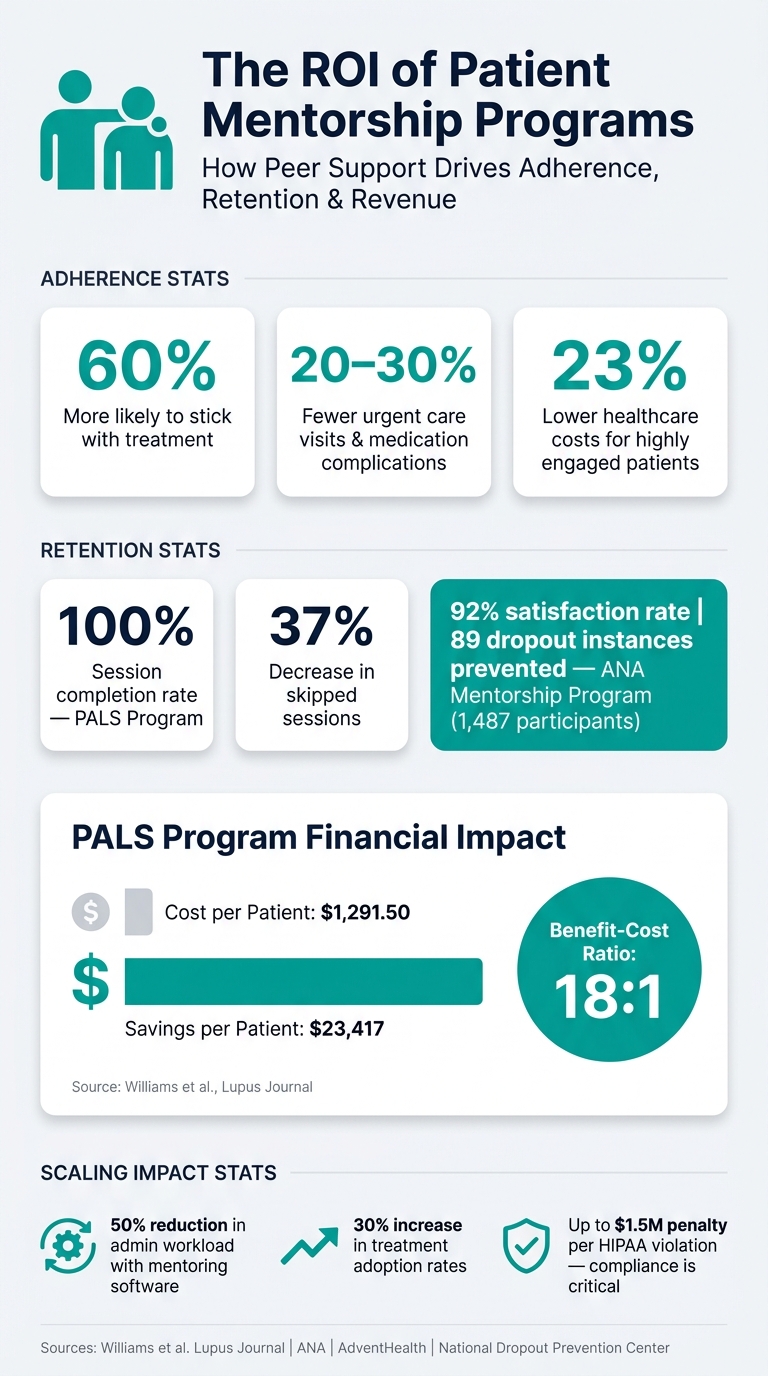
- Adherence: Patients in mentorship programs are 60% more likely to stick with their treatment, reducing urgent care visits by 20–30%.
- Retention: Programs like the PALS initiative achieved a 100% session completion rate, keeping patients engaged long-term.
- Financial Impact: For every $1,291.50 spent per patient, mentorship programs can save over $23,000 in reduced healthcare utilization, with a benefit-cost ratio of 18:1.
These programs not only improve patient outcomes but also strengthen revenue by reducing dropouts and increasing engagement. With the right structure, training, and compliance measures, mentorship programs can scale effectively while maintaining high impact.
Patient Mentorship Programs: ROI, Adherence & Retention Stats
How Peer Support Improves Treatment Adherence
Treatment adherence isn’t just about following medical instructions - it’s deeply tied to emotions and personal challenges. Many patients skip medications or appointments because they feel isolated, overwhelmed, or uncertain about their treatment’s effectiveness. Peer mentorship tackles these hurdles by connecting patients with someone who’s been through a similar journey. Hearing a mentor’s story can transform a patient’s mindset from "why me?" to "others have faced this too - and it gets better." This shift can be a powerful motivator for staying on track with treatment. And beyond the emotional impact, the numbers back it up.
Peer mentorship also helps patients move along a spectrum of engagement. On one end, disengaged patients miss appointments and avoid care. On the other, highly engaged patients work closely with their healthcare teams and take an active role in managing their health. Research highlights the benefits of this engagement: patients at higher levels of involvement see 23% lower healthcare costs and contribute 15% more revenue to practices through consistent care and referrals. Peer mentorship accelerates this engagement, creating a win-win for both patients and providers.
Data Supporting Adherence Gains Through Mentorship
The impact of peer support programs is reflected in the numbers. Practices that combine mentorship with digital adherence tools report 20–30% fewer urgent care visits and medication-related complications. Moreover, patients engaged in such programs are 60% more likely to remain with a practice long-term. This kind of loyalty benefits both patient outcomes and the financial health of healthcare organizations.
A concrete example comes from AdventHealth, where personalized outreach efforts yielded impressive results. Over a 90-day period ending in 2025, AdventHealth used the Upfront platform to segment patients based on their behaviors, barriers, and motivations. Tailored messages were sent via SMS and email, resulting in significant care gap closures: 30% of 45,000+ diabetes patients addressed care gaps, 41% of 54,000+ patients completed annual physicals, and 23% of 51,000+ patients followed through with recommended mammograms. While this initiative focused on activation rather than mentorship, it underscores the power of personalized strategies that address individual motivations instead of relying on generic reminders.
How Personalized Mentor Matching Affects Adherence
Tailored mentor-mentee matching takes adherence a step further. When a mentor shares a similar diagnosis, treatment journey, or life stage, it creates a deeper, more meaningful connection than a generic support system could provide. This trust fosters open communication, making it easier for patients to navigate challenging treatment steps.
What sets effective mentor matching apart is its focus on more than just clinical data. By considering a patient’s motivations, values, and emotional hurdles, these programs build authentic relationships. PatientPartner exemplifies this approach by using detailed data to pair patients with mentors whose experiences closely align with their own. This reduces barriers in the care journey, encouraging patients to engage more consistently.
"Our mentoring program fosters a culture of support and belonging... Mentorship helps guide them through those transitions so we don't lose them altogether." - Janelle Wozniak, Mayo Clinic
When patients feel genuinely understood by their mentor, they’re far more likely to stick with their treatment plans. This leads to improved health outcomes, stronger patient-provider relationships, and measurable financial benefits for healthcare organizations.
sbb-itb-8f61039
How Mentorship Programs Improve Patient Retention
Peer support doesn't just help patients stick to their treatment plans - it also keeps them engaged for the long haul by addressing ongoing challenges.
While adherence and retention are connected, they’re not interchangeable. A patient might initially follow their treatment plan but still drop out later when faced with obstacles. Retention focuses on keeping patients actively involved over time, even through setbacks and routine difficulties. Peer mentorship plays a critical role here, offering patients a steady, trusted relationship to rely on.
How Peer Mentorship Reduces Patient Dropout Rates
A standout example of mentorship's impact on retention comes from the Peer Approaches to Lupus Self-management (PALS) program. This 12-week initiative, published in July 2019, paired African American women with systemic lupus erythematosus (SLE) with mentors who shared similar life stages and maternal experiences. These pairs connected through weekly 54-minute phone sessions. The results were striking: a 100% session completion rate across all 20 mentees and 7 mentors. Every single session was attended.
Beyond perfect attendance, participants saw measurable improvements in disease activity, depression, and anxiety - factors that often contribute to treatment dropout. This shows how consistent engagement and accountability can directly influence retention.
Effective mentors play a central role in this success. As highlighted by the National Dropout Prevention Center, mentors who show up regularly and align with a patient’s personal goals create relationships that patients value deeply.
"Mentoring is a one-to-one caring, supportive relationship between a mentor and a protégé that is based on trust." - National Dropout Prevention Center
Structured mentorship programs further demonstrate their value with a 37% decrease in skipped sessions and a 46% reduction in high-risk behaviors - both key contributors to program dropout.
Using Data and Analytics to Strengthen Retention
Mentorship programs that incorporate data-driven strategies can identify and address disengagement risks early on.
High-performing programs use multi-stage tracking, surveying participants at key points - such as 30 days in, halfway through, and at the program’s end. A low satisfaction score at the 30-day mark, for instance, signals that a mentor-patient match might not be working, giving coordinators time to step in before the patient disengages entirely.
PatientPartner uses this approach by tracking metrics like engagement levels, match quality, and participant sentiment throughout the mentorship journey. This helps healthcare and pharmaceutical organizations pinpoint which relationships need attention and take action before issues escalate. Instead of guessing, coordinators rely on a clear, structured process for improving retention.
The results speak for themselves. The American Nurses Association (ANA) implemented a dual-track mentoring system in March 2025, involving 1,487 participants. By leveraging structured data tools to monitor engagement, they achieved a 92% satisfaction rate and prevented 89 instances of dropout.
"We track satisfaction surveys at different points... Our 92% satisfaction rate tells us that mentoring is making a real impact." - Lola Tumaini, American Nurses Association
Automated matching is another game-changer. Moving from manual pairings to intelligent, self-matching platforms ensures that patients are paired with mentors who truly align with their needs. This compatibility is often the deciding factor in whether a patient stays committed or disengages.
Improved retention doesn’t just lead to better health outcomes - it also strengthens the financial benefits of well-structured mentorship programs.
Calculating the Financial ROI of Patient Mentorship Programs
Quantifying the financial benefits of patient mentorship programs is the next step after recognizing their impact on clinical outcomes. Improved retention and adherence play a direct role in enhancing an organization's revenue. However, translating these improvements into monetary terms can be a challenge.
The ROI Formula for Patient Mentorship Programs
A simple formula helps outline the financial return:
ROI = (Gains from Adherence + Gains from Retention − Program Costs) ÷ Program Costs
Improved adherence and retention lead to measurable cost savings. For adherence, this includes increased prescription refills, fewer missed appointments, and better performance-based incentives. Retention gains come from reducing patient dropouts and maintaining long-term patient-provider relationships.
To accurately calculate ROI, organizations should track healthcare utilization data - such as hospital charges and emergency visits - for the 12 months before and after patients participate in mentorship programs. Tools like the Patient Activation Measure (PAM) can also help assess improvements in patient self-management.
Let’s break this down further with a case study example.
Case Studies: Financial Returns from Peer Mentorship
Real-world examples highlight the financial benefits of well-executed mentorship programs. One standout case is the Peer Approaches to Lupus Self-management (PALS) program, spearheaded by Dr. Edith M. Williams at the Medical University of South Carolina. The program demonstrated a cost of $1,291.50 per patient, while reduced healthcare utilization resulted in savings of $23,417 per individual, yielding an impressive 18.13:1 benefit-cost ratio.
"There was a savings of $23,417 per individual receiving the intervention with a benefit-cost ratio of 18.13 per patient." - Williams et al., Lupus Journal
Here’s a breakdown of the key financial metrics:
| Metric | Baseline (Pre‑Mentorship) | Post‑Mentorship Outcome |
|---|---|---|
| Program Cost per Patient | - | $1,291.50 |
| Average Savings per Patient | $0 | $23,417 |
| Benefit‑Cost Ratio | - | 18.13:1 |
| Patient Engagement/Activation | Lower baseline | Statistically significant improvement |
| Disease Activity & Depression | Higher baseline | Statistically significant decrease |
These figures, sourced from Williams et al., Lupus Journal, demonstrate the financial viability of mentorship programs.
Similarly, PatientPartner uses data-driven analytics to track patient engagement and tailor mentor-patient matches. This approach allows organizations to directly link mentorship efforts to financial outcomes, moving beyond rough estimates to precise, measurable results.
How to Build and Scale a Patient Mentorship Program
Creating a successful mentorship program requires a well-defined structure, reliable technology, and strict adherence to compliance standards. These elements work together to ensure the program achieves its intended goals, as outlined earlier. Getting these aspects right from the start is critical for long-term success.
Steps to Launch a Patient Mentorship Program
"Know what the purpose is and then build the program to that purpose... when you've determined where that need is and how you plan to support it, make sure you have support from the organization." - Dr. Wendy Axelrod, Author of 10 Steps to Successful Mentoring
The foundation of any mentorship program starts with identifying its purpose. Whether the focus is on improving treatment adherence or increasing retention, the program's objectives will shape every decision moving forward. After defining the goal, the next step is finding the right mentors. Experienced mentors bring a level of trust and credibility that goes beyond traditional clinical support.
Structured training plays a huge role in ensuring success. Research shows that mentorship success rates can jump from 33% to 90% with proper training. Pairing mentors and patients effectively is equally important. Matching participants based on health conditions, demographics, psychological traits, and other factors ensures both efficiency and quality. While manually matching 50 participants could take up to 15 hours, AI-powered tools can accomplish the same task in just 30 seconds. This makes technology-driven matching a game-changer, especially as programs grow.
Don’t forget to ensure that mentor recruitment and training processes comply with the necessary regulations, particularly when dealing with sensitive patient data.
Meeting Compliance and Data Security Requirements
Once the program’s purpose is clear and mentors are recruited, protecting patient data becomes a top priority. Programs must comply with regulations like the HITECH Act and HIPAA, which extend to any third-party platforms used in mentorship programs. Every tool in your tech stack must meet the same rigorous standards as your internal systems. Skipping this step could lead to penalties as high as $1.5 million per violation.
The best platforms meet certifications such as HIPAA, GDPR, SOC 2, and ISO 27001. They also incorporate essential features like end-to-end encryption, role-based access controls, and audit trails. PatientPartner’s platform is specifically designed with these safeguards in place.
"Compliance is at the core of everything we do. PatientPartner's platform is fully HIPAA and GDPR compliant, employing end-to-end encryption, role-based access controls, and audit trails to protect patient data." - George Kramb, CEO & Co-Founder, PatientPartner
Training your workforce is another critical step. According to the HIPAA Privacy Rule (45 CFR 164.530(B)), all workforce members must complete training on policies related to protected health information (PHI) within 30 days of starting and renew that training annually.
Scaling Mentorship Programs with Digital Tools and Analytics
Once compliance is in place, digital tools can help take your mentorship program to the next level. Mentoring software can cut administrative workload by 50%, freeing up staff to focus on patient care rather than time-consuming management tasks. PatientPartner’s SaaS platform, for example, automates key processes like matching mentors and patients, tracking engagement, and integrating with existing systems. This eliminates data silos and speeds up decision-making.
Analytics offer even more potential for scaling. Advanced platforms can use sentiment analysis to identify early signs of disengagement, flagging risks before patients drop out. Programs using mentor-driven platforms have reported a 30% increase in treatment adoption rates, with patient adherence improving by 20% within the first year.
The most effective mentorship programs also create a feedback loop where successful patients transition into mentor roles. This self-sustaining cycle strengthens the program over time. With the help of automation and data-driven insights, your mentorship program can grow to meet the increasing needs of patients while maintaining high-quality outcomes.
Conclusion: What Patient Mentorship Programs Deliver
Patient mentorship programs provide measurable benefits on both clinical and financial fronts. Clinically, they help reduce disease activity, depression, and anxiety while boosting patient activation. Financially, the data highlights their strong return on investment, showcasing results that are often hard to achieve through traditional clinical support alone.
But the impact goes beyond numbers. Peer support changes the way patients engage with their healthcare journey. When patients connect with someone who has lived through the same diagnosis or treatment, trust develops quickly. Honest answers replace uncertainty, and motivation becomes personal rather than strictly clinical. This shift in mindset helps peer-driven programs significantly improve adherence rates. These clinical improvements naturally align with the financial benefits.
Retention rates also see a positive boost. Patients who feel supported are far less likely to drop out. Organizations using structured, data-driven mentorship programs report a 12% increase in retention and a 92% satisfaction rate among patients. These results directly address revenue losses tied to patient dropout.
"PatientPartner delivers real-time, personalized engagement that drives measurable results in patient recruitment, adherence, and satisfaction." - George Kramb, CEO & Co-Founder, PatientPartner
PatientPartner's platform exemplifies how scalable, compliant mentorship systems deliver these outcomes. With features like AI-powered mentor matching, sentiment analytics, automated workflows, and full HIPAA and GDPR compliance, the infrastructure is already in place for healthcare and pharmaceutical organizations aiming to achieve long-term growth. These results highlight how PatientPartner integrates patient support with operational success seamlessly.
FAQs
What should I track to prove ROI from a mentorship program?
To show the return on investment (ROI) of a mentorship program, focus on tracking essential metrics like treatment adherence, appointment attendance, therapy duration, patient engagement, and health outcomes. These data points provide insight into both the success of patients and the financial benefits the program brings to your organization.
How do you match patients with the right peer mentor?
Matching patients with the right peer mentor means taking a close look at what the patient needs, their background, and their preferences, while also considering the mentor’s skills and experience. It’s about understanding the patient’s goals, health challenges, and personal situation to create a strong match. This personalized method helps build meaningful connections, encourages active participation, and supports better follow-through with treatment plans.
How do mentorship programs stay HIPAA-compliant?
Mentorship programs play a key role in ensuring HIPAA compliance by focusing on patient confidentiality, following strict privacy guidelines, and upholding professional conduct. These programs align with the FSHRMPS Code of Professional Responsibility, which stresses the importance of secure communication and ethical practices to safeguard sensitive information.