


Predicting Patient Drop-Off with Analytics
Key Takeaways
Author


Patient drop-off often starts before a missed refill or no-show shows up in the record. In U.S. healthcare, 20% to 30% of new prescriptions are never filled, and about 50% of patients who start therapy stop within 12 months. I’d sum up the fix like this: use data to spot risk early, rank who needs help first, and match each person to the right next step.
Here’s the short version:
- Watch early signals: refill gaps, missed follow-ups, claim denials, cost changes, and low response to patient engagement strategies
- Score risk: sort patients into high-, medium-, and low-risk groups
- Act on the cause: route cost issues to coverage help, logistics issues to scheduling or ride support, and regimen issues to pharmacist or staff outreach
- Put scores inside daily tools: CRM and EHR placement matters more than a separate dashboard
- Check privacy and bias: use HIPAA-aligned controls, consent tracking, audit logs, and regular model review
- Measure results: track treatment starts, refills, visit return rates, retention, and model accuracy while evaluating how mentorship impacts patient decisions
The main idea is simple: don’t wait for drop-off to happen. I’d use linked claims, pharmacy, scheduling, engagement, and provider data to spot risk in time to step in.
A quick side-by-side view:
| Area | Reactive approach | Predictive approach |
|---|---|---|
| Timing | After the patient misses something | Before disengagement becomes clear |
| Outreach | Same reminder for most people | Outreach based on the likely barrier |
| Staff focus | Review many cases manually | Contact higher-risk patients first |
| Data used | Missed events only | Claims, fills, scheduling, engagement, and cost signals |
| Goal | Recover lost patients | Keep more patients from dropping off |
If I were building this program, I’d focus on one loop: find risk, act fast, track retention.

Reactive vs. Predictive Patient Engagement: Key Differences
Using Advanced Analytics to Predict Member Terminations and Inform Retention Strategies
sbb-itb-8f61039
Where Analytics Can Spot Drop-Off Risk Early
Predictive analytics can flag rising drop-off risk before a missed refill or appointment turns into full disengagement. The strongest clues usually come from pharmacy, scheduling, financial, and engagement data.
Data Signals That Point to Rising Drop-Off Risk
The signals that matter most tend to fall into a few buckets. A delayed refill, a gap in pharmacy claims, or an unusual dosing change can each hint at rising risk on its own. Put them together, and the picture gets much clearer.
Scheduling data adds another layer. Patients who miss appointments and don't reschedule, or stop booking follow-up visits altogether, are often starting to pull away. Low response rates to outreach and limited communication activity point in the same direction. On the financial side, a shift in insurance coverage or a jump in out-of-pocket costs often comes before drop-off. High claim denial rates can also signal trouble.
Provider-level patterns matter too. A prescriber's past patient retention rate and outreach effectiveness can shape how likely their patients are to stay on therapy. From day one, all of these signals need HIPAA-aligned governance.
| Data Category | Key Early Warning Signals |
|---|---|
| Pharmacy & Claims | Delayed refills, unusual dosing changes, claim denials, pharmacy claim gaps |
| Scheduling | Missed appointments, failure to book follow-ups, long wait times |
| Engagement | Unreturned outreach, few outreach responses, negative survey responses |
| Financial | Insurance coverage changes, increased out-of-pocket costs, high claim denial rates |
| Provider Patterns | Historical retention rates, outreach effectiveness |
How Risk Scores Help Teams Decide Who to Contact First
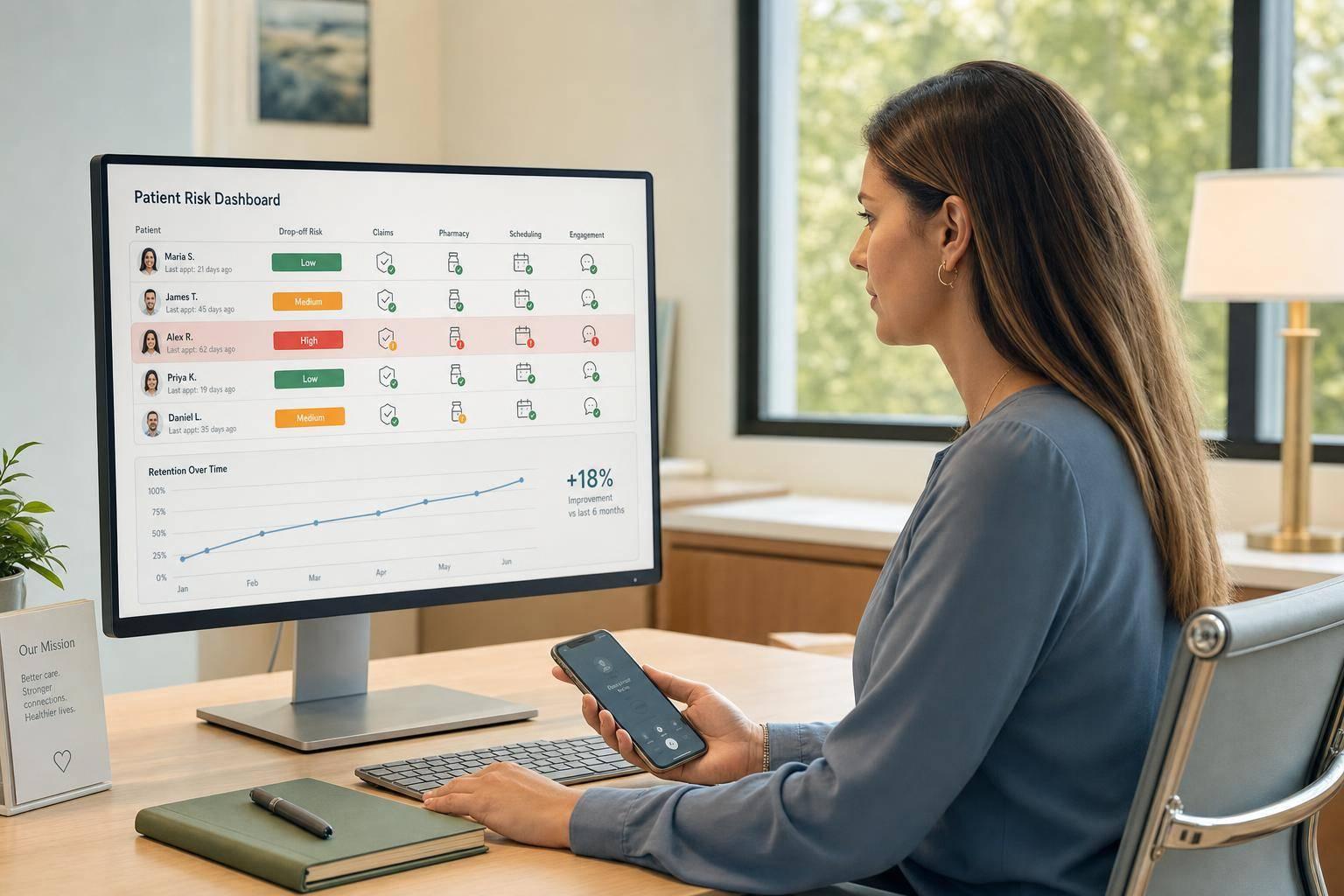
Risk scores turn scattered signals into one priority list. High-risk patients can get immediate outreach. Medium-risk patients can move into scheduled follow-up. Low-risk patients can stay in lighter monitoring.
A biotech company used real-time risk scoring in Salesforce, refreshed every 15 minutes, to help 110 support specialists prioritize outreach and improve adherence by 5%.
That kind of gain happens when the risk score becomes part of day-to-day work, not just another report sitting in a separate dashboard. Once that list is in place, teams can match each patient with the right retention move.
Why Teams Need to Understand What Drives a Risk Score
A score only helps if teams know what set it off. Was it a delayed pickup, a claim denial, or fewer outreach responses? That answer changes the conversation and patient decision making completely.
This kind of visibility matters beyond the care team. Clinical, commercial, and compliance groups all need to trust that the model is doing what it should. That means regular model monitoring and checks for demographic bias, including tools like Aequitas to look for disparities in false omission rates.
"The companies that treat adherence as a data problem - not just a patient education problem - will achieve meaningfully better outcomes for their patients and their business." - Preeti Kulkarni, Infocepts
All of these signals require HIPAA-aligned governance from the start. That context helps teams turn risk into the right retention action.
Turning Drop-Off Predictions Into Retention Actions
A risk score sitting in a dashboard doesn't retain a single patient. What matters is what happens next: who gets called, what they're told, and how fast the team moves. The right response depends on the barrier behind the score - cost, logistics, regimen complexity, or trust.
Matching Interventions to Drop-Off Points Across the Care Journey
Different drop-off points call for different responses. A patient who missed an appointment because they couldn't get a ride isn't dealing with the same problem as someone who stopped refilling after a jump in out-of-pocket costs. Treat them the same way, and you waste time while missing the issue.
When predictive signals point to financial barriers - like higher out-of-pocket costs or claim denials - the best next step is routing the patient to insurance support, not sending a generic reminder call. When signals suggest logistical friction, teams can step in with transportation help or automated reminders. And when risk is tied to regimen complexity - such as confusion about the regimen or side effects - a pharmacist consult or a direct call from a support specialist is much more useful than an automated message.
This only works at scale if the triggers live inside the team's day-to-day workflow. If staff have to bounce to a separate tool just to check risk signals, follow-up slows down. Put each trigger directly into the CRM, and teams can act from the same place they already work. That keeps the response fast and specific.
Using Patient Mentorship to Support High-Risk Patients
When the barrier is uncertainty, mentorship makes sense. For high-risk patients starting a new therapy or heading into surgery, patient mentorship adds the human support a model can't provide.
PatientPartner connects high-risk patients with experienced mentors who have been through similar healthcare journeys. When a predictive model flags a patient who needs added support, a mentor can answer questions, ease uncertainty, and reinforce the care plan. That kind of direct reassurance can help sustain adherence over the long term, not just during the first few weeks.
Reactive vs. Predictive Patient Engagement: A Side-by-Side Comparison
The gap between reactive and predictive engagement isn't just theoretical. You can see it in staffing efficiency, patient experience, and measurable adherence outcomes.
| Feature | Reactive | Predictive |
|---|---|---|
| Timing | After a missed dose or appointment | Before disengagement, based on early warning signals |
| Data Inputs | Manual tracking of missed events | AI analysis of fill data, engagement history, and regimen complexity |
| Outreach Strategy | Generic reminders | Targeted interventions matched to specific risk drivers |
| Staffing Efficiency | Specialists sift through every case individually | Time focused on the highest-risk patients |
| Patient Experience | Generic reminders that may not address the root cause | Personalized support addressing barriers like transportation or insurance |
The move from reactive to predictive support isn't just about technology. It's about changing how support teams spend their time - and what they say when they reach out.
Building a Predictive Drop-Off Program for U.S. Enterprise Teams
Once a team can spot likely drop-off, the next move is simple: put those scores into the systems that help patients take the next step.
Connecting Scheduling, Claims, CRM, and Engagement Data
To see the full patient journey, teams need to connect EHR, claims, CRM, scheduling, pharmacy, and engagement data. Start by ingesting EHR data through secure, HL7 FHIR-compliant APIs into a HIPAA-compliant data lake. Then layer in scheduling, claims, pharmacy, and engagement sources so one model can track no-shows, prior authorization delays, coverage gaps, refill gaps, outreach response, and portal activity.
That kind of connected view can change how fast teams act. A 500-bed health system with 75,000 attributed patients deployed an AI churn prediction engine tied to its EHR, spotted prior authorization bottlenecks 60 to 90 days earlier, and cut patient attrition by 25% to 40% within six months. The takeaway is hard to miss: if teams catch authorization friction early, fewer patients disappear in the middle of care.
Embedding Analytics Into Patient Support Workflows
Once the data is connected, the score needs to show up where staff already work. Put risk scores inside tools specialists use every day, such as Salesforce or the EHR. Refresh those scores every 15 minutes so care coordinators get a prioritized outreach list instead of a pile of names with no clear order.
The next piece is action. Teams should set playbooks for each risk driver - for example, financial counseling when out-of-pocket costs are high or faster scheduling when prior authorization delays show up - then log which intervention helped so the model can improve over time.
In one biotech deployment, giving 110 specialists a real-time prioritization model improved patient adherence by about 5%.
Handling Privacy, Compliance, and Patient Trust
Access to these scores has to come with tight controls. Otherwise, trust disappears fast. Use role-based access, audit logs, and encryption both in transit and at rest. Only staff who need to act on a risk score should be able to view it, and every access event should be logged to meet CMS Conditions of Participation and Joint Commission requirements.
Consent also needs one clear system across partners. Specialty pharmacies and patient support programs often collect patient authorization in different ways and on different forms, which can create legal and process gaps. A unified consent management solution helps keep the basis for data processing consistent across the network.
CMS rules add another layer. The 2024 Medicare Advantage and Part D Final Rule (CMS-4201-F) says algorithmic tools must not make bias worse. That means teams should audit models on a regular basis and check whether variables such as cost or high utilization are acting as stand-ins for need.
"CMS has issued rules and guidance that require MA plans to ensure that their algorithmic tools are not perpetuating or exacerbating existing or new biases." - Pankhuri Sharma, MBA, LLB, Humana
PHI should stay inside the organization’s HIPAA-compliant environment and out of external model training.
Conclusion: What to Measure and Improve Next
Predictive analytics helps teams spot drop-off sooner and cut it down. But the program works only if teams measure the right numbers on both sides: model performance and business results.
To improve the program, track model accuracy alongside patient outcomes. On the model side, pay attention to how fast the system flags early warning signs. On the business side, focus on the numbers that matter most: treatment starts, refills, visits, and retention over time. Those time gaps show where patients are most likely to disengage and whether interventions are hitting at the right moment. The core loop is simple: detect risk, act fast, measure retention.
It also helps to track operational efficiency. When teams place scores directly into the workflow, they move faster and follow through more often.
When risk comes from uncertainty or low motivation, mentorship can help close that gap. PatientPartner adds real-time mentorship that supports adherence and patient outcomes. Adherence improves when teams treat it as a data and workflow issue, not just an education issue.
The aim is a system that gets better with each intervention. That feedback loop is what turns prediction into sustained retention.
FAQs
What data is most useful for predicting patient drop-off?
The most useful data pulls from a few different sources so you can see both the emotional side and the day-to-day friction that gets in the way.
That usually includes:
- Behavioral data: refill records, claims, appointment attendance, and engagement patterns
- Sentiment data: surveys, feedback, calls, emails, reviews, and tone shifts
- Demographics and social factors: age, income, insurance status, and location
- Clinical data: diagnosis, treatment plans, and regimen complexity
How can teams act on a risk score without slowing down workflows?
Teams can put risk scores to work by feeding predictive insights into tools they already use, like CRM systems or electronic health records. That means support specialists can automatically sort outreach by priority and spend more time on high-risk patients, instead of sifting through cases by hand.
With platforms like PatientPartner, teams can also use real-time sentiment tracking and mentorship triggers to prompt fast, automated interventions while still working efficiently and giving each patient more personal support.
How do organizations reduce bias and protect patient privacy in these models?
Organizations cut bias and protect patient privacy through transparency, accountability, and ethical data governance. On the privacy side, that means using de-identified and tokenized data, following HIPAA rules, and setting up governance that keeps anonymized analytics separate from authorized outreach after documented patient consent.
To reduce bias, teams should routinely audit models, use stratified sampling to deal with data imbalances, and clearly explain to patients how their information is used.