


Patient Data Anonymization in Healthcare: 2026 Guide

Key Takeaways
Author


Removing a patient’s name does not make their data anonymous. I start with the analysis you need, remove details you don’t need, and test whether what remains could identify someone.
HIPAA offers 2 de-identification methods: Safe Harbor and Expert Determination. Neither automatically meets GDPR’s anonymity standard, and pseudonymized data still counts as personal data under GDPR.
My approach covers four steps:
- Set the rules: Identify applicable laws, permitted uses, recipients, and team duties.
- Reduce the detail: Generalize dates and locations, protect keys, and check rare conditions and narratives.
- Test the outputs: Review linkage risks, small groups, repeated queries, dashboards, APIs, and exports - not just source files.
- Control each release: Record the approved version, privacy risk, analytics limits, access rules, retention, and review date.
<u>If I cannot justify anonymity, I treat the data as personal or pseudonymized</u> and keep the required protections in place.
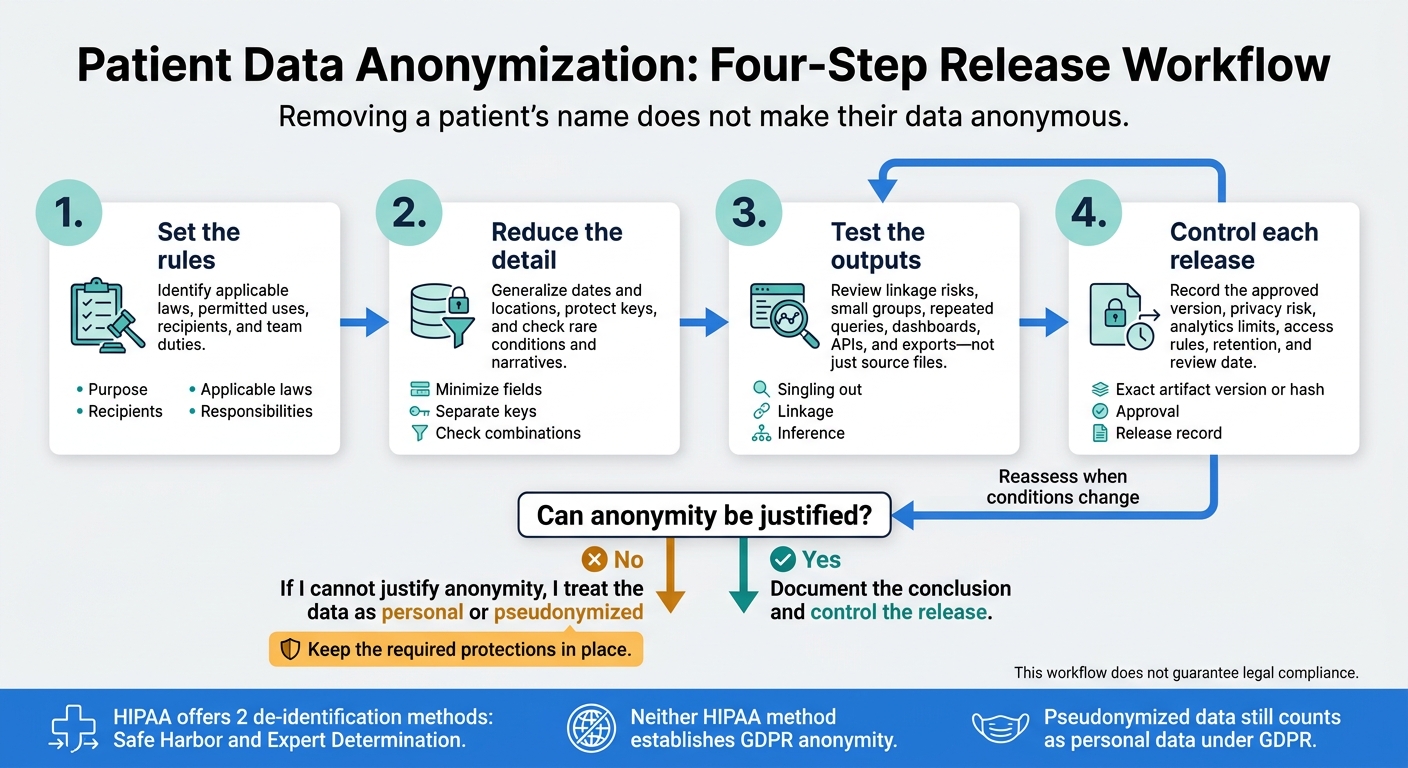
Patient Data Anonymization: Four-Step Release Workflow
Learn Data Anonymization Techniques for GDPR & HIPAA Compliance
sbb-itb-8f61039
Privacy Rules and Patient Identifiers
Before changing any data, identify which privacy rule applies. Start with the processing activity, not the server location. GDPR covers processing tied to an EEA establishment and, in some cases, non-EU organizations serving or monitoring people in the EU. HIPAA covers entities and business associates handling PHI. Inventory the service, patient base, locations, data flows, and contract role before choosing a standard.
GDPR Anonymization vs. HIPAA De-identification
| Standard | Identifiability | Reversibility | Regulatory status |
|---|---|---|---|
| GDPR anonymization | The person cannot be identified using means reasonably likely to be used. | Intended to be irreversible in the relevant setting | No longer personal data once anonymity is effective |
| GDPR pseudonymization | A person may still be identified through a separate key or by combining records with other information. | Reversible or linkable by an authorized party | Remains personal data under GDPR |
| HIPAA Safe Harbor | Identifiers listed in the regulation are removed, and the organization has no actual knowledge that the remaining data could identify a person. | Not necessarily technically irreversible, but the disclosed dataset must meet HIPAA’s de-identification standard | De-identified information is generally outside HIPAA’s PHI restrictions |
| HIPAA Expert Determination | A qualified expert finds that identification risk is very small for the anticipated recipient, alone or with reasonably available information. | May retain carefully controlled analytical structure | Meets HIPAA’s de-identification standard when documented requirements are satisfied |
GDPR’s reasonably likely means test considers available external data, lookup keys, cost, time, technology, and foreseeable recipients. Check whether records allow someone to single out a person, link records, or infer sensitive information - not just whether names remain. If a key remains or a realistic linkage route exists, pseudonymized records still need personal-data controls. Neither HIPAA method establishes GDPR anonymity. Processing the source data must also be lawful, even if the resulting data becomes anonymous.
Safe Harbor requires removing 18 classes of identifiers, including relevant identifiers of relatives, household members, and employers. It also requires meeting the actual-knowledge requirement. Most geography smaller than a state and dates more precise than permitted year information must go, subject to the regulation’s specific exceptions.
Expert Determination takes a different route. A qualified expert must document the methods and results supporting a finding that identification risk is very small for anticipated recipients, considering reasonably available information. Use this route when needed detail cannot meet Safe Harbor. An informal internal approval does not replace it.
Direct Identifiers and Linkable Attributes
| Inventory category | Fields to check | Identification risk | Illustrative treatment - not a substitute for HIPAA requirements |
|---|---|---|---|
| Names and contact details | Names, email, phone, mailing address | Direct lookup and account matching | Remove from analytics; keep for service delivery only when needed |
| Record and portal IDs | Medical-record numbers, portal usernames, account IDs | Persistent cross-system linkage | Use scoped tokens; separate lookup keys |
| Government and payer IDs | Social Security and health-plan numbers | Matching against external records | Exclude from analytics releases |
| Biometrics and images | Fingerprints, voiceprints, facial templates, full-face images | Recognition | Exclude or segregate |
| Dates and geography | Birth dates, procedure dates, timestamps, ZIP codes | Matching to schedules, locations, and public records | Generalize or suppress according to the selected standard |
| Providers and organizations | Named clinician, specialty, site, pharmacy, employer | Provider schedules and public records can enable linkage | Use broader categories or suppress rare combinations |
| Rare diagnoses and treatment sequences | Uncommon disease, unusual surgery, medication order, one-off sequence | A rare combination can identify a patient even without a name | Aggregate, redact, suppress, or use expert risk analysis |
| Clinical data and narratives | Symptoms, lab values, free text, dates, family history | Combinations can single out people or reveal sensitive facts | De-identify structured fields and inspect narratives for names, locations, and events |
| Metadata and technical traces | IP address, device ID, URLs, file names, logs, geolocation | Connects sessions, devices, and external accounts | Strip or transform before export; HIPAA Safe Harbor expressly includes several technical identifiers |
These categories overlap. A treatment sequence can act as a date pattern, a clinical attribute, and a quasi-identifier. A provider name combined with a visit date can identify a patient. A portal ID may be both a direct identifier and a persistent linkage key. Test combinations and external linkage rather than scanning only for obvious columns.
Date shifting, tokenization, diagnosis grouping, and small-cell suppression do not, by themselves, prove GDPR anonymity or HIPAA de-identification.
Legal Bases and Team Responsibilities
Map each purpose separately to Article 6 and one applicable Article 9 condition. Contract necessity may support delivering a patient-support service, but a contract alone does not authorize health-data processing. Legal obligations need an identified law. Research conditions need applicable legal support and safeguards.
Security may rely on legitimate interests or a legal obligation. Voluntary communications may use consent or legitimate interests where appropriate. None of these choices bypasses Article 9. When using consent, it must be specific, informed, freely given, and withdrawable. Record the fields needed, permitted uses, retention, and recipients for each purpose.
Controllers set the purpose and means; processors follow instructions; subprocessors inherit the same safeguards. Assign data minimization, deletion, rights support, security, and breach duties in the DPA. Use a BAA when HIPAA requires one. Neither contract makes identifiable data anonymous.
Separately assess international-transfer mechanisms and supplementary safeguards. Complete a DPIA when processing is likely to create high risk. Check applicable state privacy laws dataset by dataset rather than assuming all data is exempt.
Use these roles to decide which transformations and risk tests the dataset can support. With scope and responsibility set, select the transformations and tests that reduce the remaining identification risk.
Data Methods, Risk Testing, and Analytics Limits
Choose Data Transformations
Once the legal scope is set, build the least detailed dataset that supports the use case. Start with the analysis, the recipient, and the outside data they can access. Then choose the lightest method that answers the question. Determine whether the recipient needs cohort statistics or individual journeys, and whether results stay in a restricted workspace or leave through exports. Weigh usefulness and identification risk together.
| Method | Analytical usefulness | Reversibility | Primary linkage risk | Patient-journey use |
|---|---|---|---|---|
| Generalization | Keeps broad trends but loses detail | Exact values usually cannot be recovered from the output alone | Remaining combinations may identify one person | Broader age, region, and time bands |
| Suppression | Removes risky detail but can bias results | Omitted values may still be deduced | Totals or other releases can reveal hidden values | Excluding rare events or small cells |
| Aggregation | Supports counts, rates, and averages | Individual rows are not released | Small groups and overlapping queries can expose individual contributions | Enrollment and adherence reporting |
| Masking/tokenization | Masking controls display, not anonymity; tokens preserve joins | Masked values may be guessed; tokens may be reversed through a vault | Remaining characters, reusable tokens, or vault access preserve linkability | Restricted displays and approved joins |
| Separately keyed pseudonymization | Preserves individual journeys | Reversible using separately held information | Key access or external matching | Longitudinal analysis and duplicate detection |
| Perturbation | Keeps approximate patterns | Depends on the method | Weak noise may be defeated through averaging | Approximate statistical reporting |
| Differential privacy | Supports statistics under a formal privacy model | Limits individual influence by design; does not make data reversible | Poor parameters or unmanaged cumulative releases weaken protection | Controlled population metrics |
For differential privacy, specify the mechanism, sensitivity, contribution limits, ε, δ, and total privacy budget. Informal noise is not enough. Track composition across dashboards and exports. Use k-anonymity, l-diversity, and t-closeness to test shared combinations and the spread of sensitive values, but none guarantees anonymity.
Score and Test Identification Risk
Use a documented low/moderate/high rubric. A low score requires broad dates and regions, common attributes, large relevant populations, and no linkage path. Moderate covers smaller cohorts, finer detail, or recipients with useful auxiliary data. High includes records that identify one person, rare conditions, unusual sequences, narratives, or recipients with relevant outside data or a clear linkage path.
Score record rarity, population size, geography, timing, clinical rarity, external information, recipient capability and access to outside data, and the release channel. The score guides approval; it does not replace legal review.
Test whether the intended recipient can use accessible outside data to single out a person, link records to available sources, infer sensitive facts, or identify a rare patient. Inspect narratives and event sequences - not just columns. Check whether repeated queries can reconstruct hidden values.
Record the threat model, external sources considered, assumptions, methods, successful and failed attacks, utility losses, remaining risk, and approval. Reassess when fields, recipients, integrations, populations, or available external information change.
Apply these tests to the outputs people will see, not just the source dataset.
Set Limits on Patient-Journey Analytics
Apply reporting limits across patient-journey dashboards, exports, and CRM joins.
| Purpose | Appropriate data layer | Reporting limits |
|---|---|---|
| Enrollment and conversion | Aggregated or anonymous counts and rates | Suppress risky combinations; broaden dates and regions |
| Treatment starts | Cohort totals, ranges, or rates | Apply complementary suppression so totals cannot reveal hidden cells |
| Engagement and adherence | Aggregated or anonymous summaries | Use broad time windows; keep individual trajectories out of broad-access dashboards |
| Sentiment | Aggregated categories or reviewed anonymous themes | Remove narratives and quotations that could single someone out |
| Longitudinal analysis and duplicate detection | Controlled pseudonymized datasets | Separate keys, restrict joins, log access, and limit retention |
| Patient matching, outreach, and safety escalation | Restricted personal data | Limit fields and access to the approved operational purpose |
Set cell rules for each release: no universal minimum count guarantees anonymity. For small cohorts or rare conditions, combine clinically meaningful categories, broaden dates and regions, report ranges, or delay publication.
Review free text and exports. Control overlapping queries, differencing, and joins with CRM or provider data. Measure losses in precision, attribution, and personalization before approval. Once limits are set, document the methods, risk score, and approved uses.
Enterprise Workflow and Documentation
After risk testing, put the approved dataset into a controlled release workflow. Release controls must follow transformed patient data into every system.
Map Mentorship Data and Separate Access
Start by mapping the full data flow: collection, matching, mentorship, analytics, storage, integrations, exports, and deletion. For each field, record its source, purpose, recipient, retention period, sensitivity, and any copies sent to downstream systems. Classify direct identifiers, linkable or quasi-identifiers, clinical and treatment data, narrative or content data, and technical keys.
Keep identity records outside the analytics environment. Store token maps in a separately managed vault with tighter access controls. Give each role only the fields needed for its work. Limit conversation access to trained staff, and prohibit copying conversations into spreadsheets, email, or external AI tools. Context, treatment details, and specific events can still make mentor conversations identifiable.
Use this inventory to guide release reviews and access separation.
Review Datasets, Dashboards, and Integrations
Tie each release checklist to the exact artifact version or hash. Require the purpose, recipients, field classifications, legal status, transformation versions, risk and utility evidence, and permitted uses. Review dashboard drill-downs, API responses, exports, integrations, and model inputs separately.
The security review should cover role-based access, least privilege, multifactor authentication, encryption, environment separation, monitoring, audit logging, retention, deletion, backup handling, and controls on downstream copies. Product defines the need, engineering builds it, and an independent reviewer tests it. Privacy, security, legal, and compliance must approve the release before the accountable owner signs off.
Document the exact approved artifact so teams can compare later changes against it.
Keep Records and Schedule Reviews
Maintain a release record that includes the source inventory, roles, legal basis, transformation versions, risk assumptions, test results, utility findings, final classification, and residual-risk decision. Include approved recipients, jurisdictions, uses, retention, deletion rules, owner, approvals, and the next review date. Record whether the dataset contains health data or PHI.
Attach a data-flow diagram showing collection, processing, storage, integrations, exports, and destruction. Keep key-custody records separate. Token maps and secrets do not belong in the general approval file.
Define incident handling before release. Plan how to contain disclosures, exports made without permission, or suspected re-identification; preserve logs under restricted access; identify affected records, recipients, systems, and the time period; and rotate compromised credentials or keys. Privacy and legal teams must assess contractual, HIPAA, GDPR, and state-law notification duties rather than rely on an “anonymized” label.
Use the release record to reassess residual risk whenever fields, external data, recipients, integrations, models, jurisdictions, purposes, retention, or release conditions change. Schedule periodic reviews based on risk, too: linkage risk can grow even when the dataset stays unchanged.
Conclusion: Test and Document Before Release
Release only what you can defend through testing and documented workflow controls. Pseudonymized data remains personal data under GDPR. HIPAA de-identification does not establish GDPR anonymity, so assess identifiability separately under each applicable framework.
Before release, minimize fields to the approved purpose. Test transformations against singling out, linkage, and inference, including field combinations matched against information reasonably available to the intended recipient. Document the dataset’s classification and remaining risk, restrict access and outputs, and reassess over time.
If you cannot justify anonymity, classify the dataset as personal or pseudonymized. Keep purpose limits, access controls, retention rules, and incident procedures in place.
FAQs
How do I choose between HIPAA’s two de-identification methods?
For the most certainty and simpler governance, use HIPAA Safe Harbor, which requires removing 18 specified identifiers. If you need to retain more usable data, use Expert Determination: a qualified expert must document that the risk of re-identification is very low.
Both methods require meeting the “not reasonably likely” re-identification standard. Limit access using least-privilege permissions, and make de-identified or aggregated outputs the default for sponsor reporting. Document your workflow and how you evaluated re-identification risk.
How can I anonymize data without distorting patient outcomes?
Start with clear research objectives to balance privacy with data utility. Identify direct and indirect identifiers, then apply techniques such as k-anonymity, differential privacy, or synthetic data generation.
Compare the de-identified dataset with the original using metrics such as mean absolute error or AUROC. This helps you check whether outcome patterns remain intact. Your approach must also meet technical requirements and GDPR mandates.
What should I do if previously anonymous data becomes identifiable?
If previously anonymous data becomes identifiable, treat it as personal data under GDPR. Immediately restrict access to the dataset to prevent further processing without permission.
Reassess the risk using k-anonymity, l-diversity, or t-closeness. Then apply further de-identification or data transformation techniques to restore anonymity. Fully document the incident and corrective actions in your Record of Processing Activities (ROPA) to maintain accountability and show continued compliance.