


RPM Predictive Analytics for Pharma Leaders

Key Takeaways
Author


I’d start with the response plan - not the risk score. Before testing predictive remote patient monitoring (RPM), define the event you want to predict, such as hospitalization within 30 days, and assign someone to review each alert. A prediction can guide outreach; it cannot replace clinical judgment.
In this guide, I cover how to:
- Check the data: Confirm quality, timing, patient matching, and model performance across patient groups.
- Plan the response: Set alert tiers, review deadlines, and clinical escalation steps.
- Keep mentorship nonclinical: Use support such as PatientPartner for shared experience and treatment barriers - not medical advice.
- Measure results separately: Track prediction accuracy, outreach, treatment starts, persistence, and health outcomes.
- Set launch limits: Review FDA status, privacy, security, consent, and vendor responsibilities before a pilot.
My starting rule: <u>test a limited pilot before expanding</u>, with clear success measures and reasons to pause. More alerts alone do not mean better care.
Real-time RPM Data is the Missing Piece for Truly Meaningful Healthcare Data Science
sbb-itb-8f61039
What Data Do Predictive RPM Models Need?
Predictive models combine historical and incoming data to estimate the risk of a future event, such as deterioration, nonadherence, or hospitalization. Teams use these predictions for triage, outreach, and escalation. Start with a defined outcome and prediction window, such as an unplanned admission within 30 days. A risk score is not a diagnosis.
Recent cohort data illustrate why combining sources matters.
In a 2025 cohort of 913 patients, home vital signs plus EHR data improved prediction of 30-day ED visits and unplanned admissions, but the result applies only to that cohort.
Which Patient Data Help Predict Risk?
Choose inputs that match the prediction - not every field you can collect. Wearable measurements and patient-reported information should have a clear link to the target outcome. EHR records add clinical context, but their use must meet the program’s legal, contractual, privacy, and security requirements.
| Data source | How it informs action | Limits in use | Governance requirement |
|---|---|---|---|
| Blood pressure, weight, blood glucose, heart rate, oxygen saturation | Trends, variability, and shifts from baseline guide review | Device errors, poor technique, and uneven measurement schedules can distort patterns | Track device identity, calibration or quality status, units, timestamps, and provenance |
| Symptoms and patient-reported outcomes | Worsening symptoms, side effects, and treatment barriers guide outreach | Recall, language, and reporting bias can affect results; relevance depends on the prediction | Document question wording, response options, collection time, consent, and permitted use |
| Refills, smart-cap opens, reminders, and reported doses | Possible adherence gaps guide follow-up | Refills and container opens do not prove ingestion | Preserve source and timing; reconcile treatment changes before interpreting gaps |
| Device use and transmission logs | Monitoring gaps linked to technical or connectivity issues guide troubleshooting | Missing uploads may reflect transmission failures | Track device assignment, technical failures, and audit logs |
| EHR diagnoses, labs, and treatment history | Disease severity, comorbidities, and recent therapy changes inform review | Codes may be outdated, results delayed, and medication orders do not confirm use | Define clinical fields, effective dates, update rules, and authorized access |
| Prior encounters, emergency visits, and admissions | Baseline utilization and recent instability inform triage | Utilization also reflects insurance, geography, and access to care | Verify event definitions, outcome windows, and access-related bias |
How Can Teams Check Data Readiness?
Once teams choose the inputs, data quality determines whether the model is usable. Build a data dictionary before modeling and check it again before launch. Record each input’s source, units, collection method, collection time, expected range, and missing-data rules. Then check patient identity matching, device calibration, provenance, outcome completeness, and data leakage.
Measure how many records are missing, delayed, duplicated, contradictory, or out of range. Define how to handle each issue: remove the record, impute a value, carry a value forward, or flag it. Prevent data leakage: every input must have been available when the prediction would have been made - not added later in a discharge summary or post-event note.
Define outcome labels and have clinicians review them. Check representation across diagnoses, age, sex, race and ethnicity, language, geography, device type, and care settings. Keep training, tuning, and evaluation data separate. Test on later data and, when available, external data.
Validate claims in the intended population and workflow, and state subgroup limits. TRIPOD+AI emphasizes representative evaluation data and transparent quality checks. Strong model performance does not prove patient benefit; only prospective evaluation of the support program does.
How Should Alerts and Mentorship Guide Patient Support?
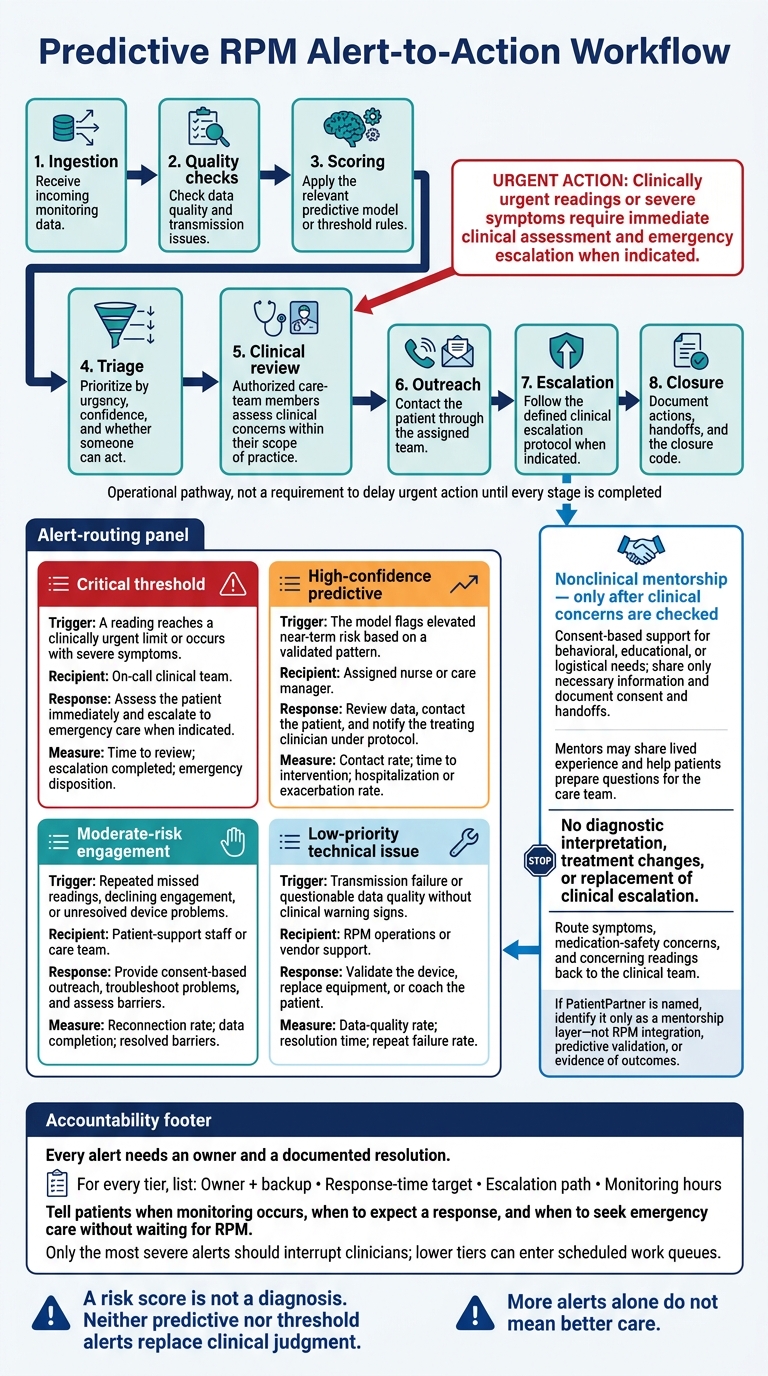
Predictive RPM Alert-to-Action Workflow
Once the model goes live, decide who acts on each risk tier. Every alert needs an owner and a documented resolution. The treating clinician defines the clinical purpose, escalation criteria, and treatment approval. Each alert should move through ingestion, quality checks, scoring, triage, clinical review, outreach, escalation, and closure. Predictive analytics should prompt the right support - not simply generate more alerts.
Vendors maintain data transmission, model operations, audit logs, uptime, and technical support. Nurses, pharmacists, or other authorized care-team members can handle first-line review, patient assessment, and protocol-based follow-up within their scope of practice. Support staff address nonclinical barriers and route clinical issues to the care team. Document each action, handoff, and closure code.
How Do Predictive and Threshold Alerts Differ?
Threshold alerts flag readings that cross preset limits. Predictive alerts flag patterns linked to future risk. Neither is a diagnosis. Predictive alerts may allow earlier outreach, but their usefulness depends on the disease, population, model, and response workflow. Apply the same tiering logic to risk alerts and technical alerts.
| Alert type | Trigger | Intended recipient | Response | Measurable result |
|---|---|---|---|---|
| Critical threshold | A reading reaches a clinically urgent limit or occurs with severe symptoms | On-call clinical team | Assess the patient immediately and escalate to emergency care when indicated | Time to review; escalation completed; emergency disposition |
| High-confidence predictive | The model flags elevated near-term risk based on a validated pattern | Assigned nurse or care manager | Review data, contact the patient, and notify the treating clinician under protocol | Contact rate; time to intervention; hospitalization or exacerbation rate |
| Moderate-risk engagement | Repeated missed readings, declining engagement, or unresolved device problems | Patient-support staff or care team | Provide consent-based outreach, troubleshoot problems, and assess barriers | Reconnection rate; data completion; resolved barriers |
| Low-priority technical issue | Transmission failure or questionable data quality without clinical warning signs | RPM operations or vendor support | Validate the device, replace equipment, or coach the patient | Data-quality rate; resolution time; repeat failure rate |
Alert fatigue happens when too many low-value notifications make people less responsive. Tier alerts by urgency, confidence, and whether someone can act on them. Combine repetitive, low-value notices without hiding urgent signals. Only the most severe alerts should interrupt clinicians; lower tiers can go into work queues for scheduled review.
For every tier, name an owner and backup, set a response-time target, and define the escalation path and monitoring hours. Tell patients when monitoring takes place, how soon they can expect a response, and when to seek emergency care without waiting for the RPM program. Track alert volume, action rate, median response time, override or dismissal rates, and adverse events linked to delayed responses.
Where Does Patient Mentorship Fit?
In pharma patient programs, mentorship can help address nonclinical barriers that threaten treatment starts, adoption, and adherence when predictive signals suggest disengagement. PatientPartner connects patients considering treatment with experienced mentors. Use PatientPartner only as a mentorship layer - not as RPM integration, predictive validation, or evidence of outcomes.
Mentorship fits behavioral, educational, or logistical needs - not clinical ones. When engagement drops, the care team should check for clinical concerns first, then offer consent-based mentorship for nonclinical needs. Share only the information needed and document consent and handoffs.
Mentors can share lived experience and help patients prepare questions for the care team. They must not interpret diagnostic results, change treatment, or replace clinical escalation. Send symptoms, medication-safety concerns, and concerning readings to the clinical team.
Which Outcomes Should Pharma Leaders Measure?
Measure engagement and trial adherence, adoption, clinical outcomes, and model performance separately. For each metric, define its numerator, denominator, data source, owner, baseline, follow-up period, and success threshold.
Use these measures to assess whether predictive alerts and mentorship change patient behavior and treatment starts. Prediction accuracy alone does not show better health or more treatment starts. Check whether completed interventions produce meaningful results, and separate signal quality from business and clinical impact.
Which Metrics Track Program Progress?
| Category | Measures and definitions | Measurement limits |
|---|---|---|
| Leading indicators | Enrollment: enrolled ÷ eligible patients offered participation. Device activation: successful transmission within an onboarding window. Data submissions: received ÷ expected readings. Mentorship: mentor contact rate. Care-team follow-up time: median and 90th-percentile time from alert to documented action. | Activity and timely action do not establish treatment benefit. Missing readings may reflect connectivity or device problems. |
| Program outcomes | Retention: patients still participating at a specified follow-up point. New patient starts: verified first dispense or administration; use documented initiation only when dispense data are unavailable. Time to start: median and distribution from eligibility or enrollment to treatment start. Persistence: time on therapy before discontinuation. Escalation completion: share of required escalations resolved within protocol. | Coverage, prescribing, supply, and clinical decisions affect results. Retention is not persistence, and escalation completion does not establish better health. |
| Clinical outcomes | Symptom control, validated patient-reported outcomes, ED visits, and hospitalizations over a prespecified period. | Severity, treatment changes, and follow-up affect interpretation. Distinguish all-cause from disease-related utilization. |
| Model performance metrics | Sensitivity, specificity, positive predictive value, false-positive rate, calibration, subgroup performance, and drift. | Strong prediction does not prove that outreach or treatment decisions improved outcomes. |
Define persistence and adherence separately. Use therapy-specific rules for refill gaps, holds, and discontinuation. Choose clinical measures that match the therapy, and report denominators and confidence intervals - not just raw counts. Then test performance across patient groups.
How Should Teams Test Performance Across Patient Groups?
Sensitivity is the share of true events detected. Specificity is the share of non-events correctly left unflagged. Positive predictive value (PPV) is the share of positive predictions followed by the target event within the prediction window.
A false positive flags an event that does not occur. Calibration checks whether predicted risks match observed event rates. Lower thresholds detect more events, but they also generate more false alerts.
Compare model performance, alert burden, engagement, treatment adoption, and clinical outcomes across relevant groups. Include age, sex, race and ethnicity, language, disability, geography, insurance, digital access, device type, and disease severity. Report sample sizes and confidence intervals, and label small-group findings as uncertain.
Monitor changes in inputs, missingness, event frequency, and model performance. Retest after material changes to devices, data pipelines, populations, workflows, models, or thresholds.
Require a suitable comparison before attributing gains to analytics. Depending on the program, use randomization, a stepped-wedge rollout, a matched contemporaneous group, or an interrupted time series. Prespecify the primary endpoint, analysis population, follow-up duration, missing-data rules, and clinically meaningful difference.
Before-and-after gains alone may reflect prescribing changes, payer policies, seasonality, or patient selection - not predictive RPM. Even strong results do not justify launch without privacy, security, and regulatory clearance.
What Must Compliance Teams Confirm Before Launch?
Once model design and alert logic are set, compliance teams must check whether the program is ready to launch.
Require a written intended-use statement and a function-by-function FDA review. Document the users, patient population, data inputs, outputs, clinical purpose, and actions each alert triggers. Specify whether the system supports operational outreach, adherence, care coordination, or diagnosis and treatment decisions. FDA status depends on software function and intended use - not the “RPM” label or human review alone.
For patient-specific recommendations, document inputs, logic, validation, limits, and clinician review. Confirm the current regulatory assessment at launch. Reassess whenever the product, claims, data sources, or intended users change.
Which Privacy, Security, and Regulatory Controls Apply?
Apply controls to the same data flows used for scoring, alerts, and mentorship. Map sensor data, alerts, and mentor interactions. Determine whether each organization is a HIPAA covered entity, business associate, or independent consumer-facing service.
Execute business associate agreements when a vendor handles PHI on behalf of a covered entity. Specify permitted uses, disclosures, training, de-identification, subcontractors, retention, and breach reporting. Assess applicable U.S. state privacy laws and FTC requirements, including the Health Breach Notification Rule. Provide required notices and obtain consent or authorization when needed. Apply GDPR only when the program falls within its jurisdictional scope.
Permission to run predictions does not automatically permit model training. Document each use and require de-identification or other HIPAA-compliant processing. Restrict vendor reuse, model training, cross-customer learning, and further disclosure. Maintain required processes for access, correction, and deletion.
Before deployment, test encryption in transit and at rest, strong authentication, and role-based access. Also test audit logs, backups, vulnerability management, and incident response. Preserve validation records, model versions, threshold changes, and release approvals.
Give every alert an accountable reviewer, a response deadline, an escalation route, and coverage outside business hours. Define fallback steps for missing readings, device malfunctions, delayed transmissions, contradictory data, and unreachable patients.
For nonclinical follow-up triggered by predictive signals, keep mentors within education, encouragement, navigation, and appointment preparation. Their role must not extend to diagnosis, treatment selection, emergency response, or individualized medical advice.
If the program uses PatientPartner for structured patient mentorship, review communication boundaries, data access, training use, and escalation responsibilities within the same privacy, security, and vendor-governance review. Establish adverse-event and product-complaint procedures before launch. Escalate every potentially reportable case to the safety or complaints team.
Conclusion: Is the Program Ready for a Pilot?
Approve a limited pilot only when readiness is documented. That documentation must cover:
- Intended use and regulatory status; validated performance in the target population; and subgroup and accessibility testing.
- Named alert owners with response-time targets, plus mentor boundaries and escalation scripts.
- Predefined clinical, adherence, engagement, safety, and equity outcomes, along with complete privacy, security, vendor, and change-management controls.
Set success and harm thresholds before enrollment. Review false alerts and missed events weekly, and define pause and rollback triggers. Proceed only if the RPM program passes all three launch gates - regulatory classification, privacy/security controls, and mentor governance. Require it to meet predefined success and safety thresholds before expansion.
FAQs
How much data do we need to validate an RPM model?
Use separate training, validation, and test sets to train the model, tune its settings, and measure final performance. In clinical settings, training on earlier records and testing on later ones often works better than splitting records at random.
Keep data clean, consistent, and representative across age, race, ethnicity, language, insurance, and treatment. This helps prevent bias and supports accuracy in clinical practice.
How can we isolate mentorship’s impact on treatment starts?
Treat peer mentorship as a measurable engagement channel, with clear inputs and tracked outputs. Set baselines before launch. When possible, use a control group to compare results against your current process.
Track referral-to-match time, completed sessions, and changes in patient confidence. Bring PatientPartner’s API data into your CRM or dashboards alongside clinical and behavioral metrics. This lets you check how mentorship interactions correlate with new patient starts and adherence.
How should we set RPM pilot pause thresholds?
First, define what makes a signal unreliable: expired authorizations, missing or conflicting signatures or statuses, inconsistent refill or prescription dates, discontinuation, or sync failures. Pause alerts or lower their priority when these issues occur so bad data doesn’t trigger escalation.
Use audited grace periods tailored to each workflow, whether that means immediate action or a short delay. Compare signals against internal baselines covering 6–12 months, and set escalation alerts at about 1 standard deviation below baseline. Assign a clear owner and response path for each alert.