


Accreditation Renewal Q&A for Patient Support Teams

Key Takeaways
Author


I start renewal planning with four checks: assigned owners, current records, role-based training, and tested patient-facing workflows. Your accreditor’s current standards and deadlines - not last cycle’s checklist - should guide each check.
I work backward from the renewal date, allowing 3–6 months for a pre-renewal audit, adjusted to the actual deadline. My checklist covers:
- Ownership: Name a renewal lead and an owner for every requirement.
- Records: Link dated, approved records to the required review period.
- Training: Check that staff, contractors, and mentors can perform their assigned tasks.
- Patient safeguards: Test privacy, communication, safety reporting, and escalation procedures.
- Gap closure: Verify that corrections work before approving readiness.
The goal is <u>proof that daily practice meets the requirements</u> - not just a finished submission. And renewal does not replace legal, payer, or contract duties. I keep those checks separate and maintain controls between reviews, too.
Renewal ownership and review schedules
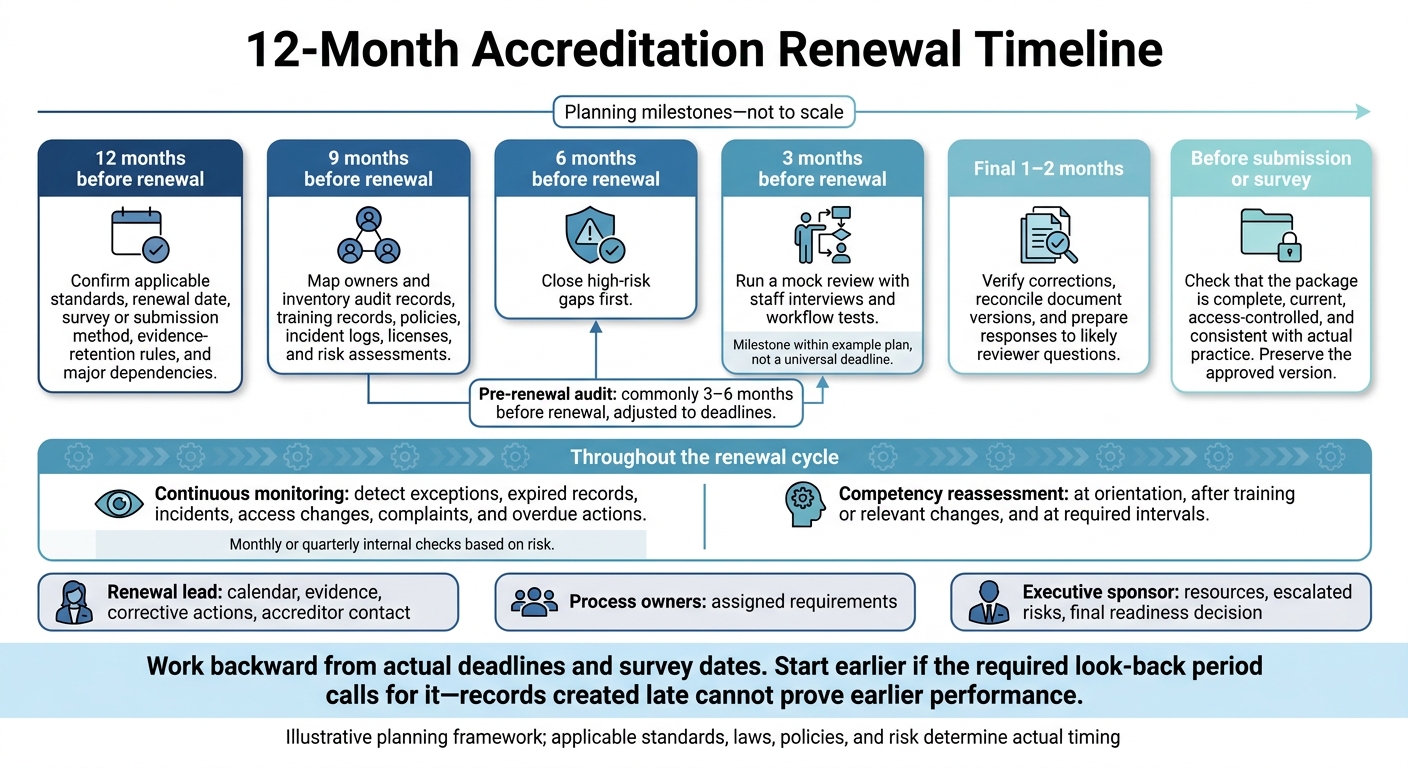
12-Month Accreditation Renewal Timeline
With the control framework in place, assign owners and set review dates. Name one renewal lead to manage the calendar, collect evidence, track corrective actions, and contact the accreditor. An executive sponsor should approve resources, resolve escalated risks, and make the final readiness decision. Give each requirement a named process owner.
Assigning responsibility for each requirement
Assign ownership by function - not just department name. Compliance interprets standards; legal reviews laws and contracts; clinical leadership approves clinical controls; and learning and development manages training and competency records. Patient support checks that workflows are followed, privacy oversees consent and disclosures, and security handles access, logging, and incident response. Include quality and, where relevant, product, IT, and vendor management.
Keep a responsibility matrix that records each requirement’s ID and wording, applicable program and role, accountable executive, responsible process owner, consulted stakeholders, and final approver. Also include the evidence location, review frequency, due date, current status, open gap, remediation owner, and escalation path. Make clear who performs the control, who verifies it, and who can accept any remaining risk.
Scheduling readiness reviews
Base review timing on the applicable standard, law, policy, and risk - not a blanket annual schedule. Include orientation, initial competency checks after role-specific training, required reassessments, and targeted reviews when patient workflows, standards, laws, policies, technology, or duties change. Incidents, complaints, and repeated errors may also call for reassessment. Checks between submissions help catch problems before the next review.
| Review type | Owner | Purpose | Timing | Output |
|---|---|---|---|---|
| Continuous monitoring | Control or process owner, with compliance oversight | Detect exceptions, expired records, incidents, access changes, complaints, and overdue actions | Throughout the renewal cycle; monthly or quarterly internal checks based on risk | Exception log, metrics, alerts, and assigned corrective actions |
| Competency reassessment | Supervisor, qualified evaluator, or learning and development | Verify role-specific performance | At orientation, after training or relevant changes, and at required intervals | Observation record, test result, sign-off, or remediation plan |
| Pre-renewal audit | Renewal coordinator with cross-functional reviewers | Test whether requirements are met and evidence is complete before submission or survey | Commonly 3–6 months before renewal, adjusted to deadlines | Mock findings, evidence index, corrective-action tracker, and readiness decision |
Building a 12-month renewal plan
Work backward from the actual deadline and survey dates. At 12 months, confirm the applicable standards, renewal date, survey or submission method, evidence-retention rules, and major dependencies. At 9 months, map owners and inventory audit records, training records, policies, incident logs, licenses, and risk assessments.
At 6 months, close high-risk gaps first. At 3 months, run a mock review with staff interviews and workflow tests. Use the final 1–2 months to verify corrections, reconcile document versions, and prepare responses to likely reviewer questions.
Before submission or survey, check that the package is complete, current, access-controlled, and consistent with actual practice. Preserve the approved version. Start earlier if the required look-back period calls for it - records created late cannot prove earlier performance. Once the calendar is set, link each due date to the records needed for submission.
sbb-itb-8f61039
Proof of compliance
Once owners and review dates are set, define what evidence each control must produce. Each record must be current, dated, attributable, retrievable, and linked to one requirement or role. It should show what happened, who performed or approved it, which version applied, and where to verify the source. A certificate can prove completion - not competency.
Records to include in the evidence package
Group records by requirement. Include accreditation certificates, scope statements, prior findings, renewal correspondence, corrective actions, policies, logs, complaints, incidents, and minutes documenting decisions. Keep validated corrective-action results, approved policies and escalation protocols, version histories, system audit logs, and quality reviews. For contractors, retain qualification checks, training requirements, oversight reviews, and any resulting actions.
Training records should link each person to the curriculum version, completion date, assessment result, passing criteria, and evaluator approval. Include retraining and current credentials when required. Add HIPAA, OSHA, emergency preparedness, safety, and CPR records only when they apply to the standard, role, location, or program. Use certificates only when their scope, expiration, and role match the assigned duty.
Checking for incomplete evidence
Missing dates, unclear ownership, expired qualifications, absent assessment results, and broken source links can leave compliance unproven. Missing evidence does not prove failure, but it prevents verification.
Use this check to find gaps before submission.
| Dimension | Strong evidence | Incomplete evidence | Remediation evidence |
|---|---|---|---|
| Date range | Current record covering the required period | Expired qualification or missing effective date | Verified renewal or updated record; any earlier gap remains documented |
| Attribution | Named employee, evaluator, and approver | Unsigned form or unidentified participant | Verified attribution and documented approval |
| Requirement match | Requirement, role, course version, and assessment result | “Training completed” without competency results | Linked assessment, pass criteria, and evaluator sign-off |
| Traceability | Working source link and approval history | Broken link or unexplained attachment | Restored source link and documented verification |
| Corrective action | Finding, implemented change, and validated result | Action closed because a policy was published | Follow-up audit or reassessment showing effectiveness |
Storing and controlling evidence
Use a controlled repository or an evidence index linked to source systems. Make sure each item traces back to its requirement, owner, and due date. Apply consistent naming, version control, approval status, retention schedules, role-based access, and audit trails. Then ask someone who did not assemble the package to test retrieval.
Limit duplicate sensitive records. Use redacted extracts when they provide enough information, and include patient information only when needed and legally permitted under applicable HIPAA requirements. HIPAA generally requires keeping required documentation of policies, procedures, actions, activities, and assessments for six years from creation or the last effective date, whichever is later. Do not apply this rule to all patient records. Follow longer retention requirements where they apply.
Use the same record map to connect training evidence to each role’s workflow.
Training for patient-facing programs
Link training records to the same renewal controls used for workflow records and proof of compliance.
Training requirements by role
Assign training by actual duties, not job title. Use a role-based training matrix to define what each person must know and demonstrate.
- Clinicians: Current clinical competencies, scope-of-practice limits, treatment education, documentation, handoffs, and safety escalation.
- Support specialists: Privacy and confidentiality, applicable consent and authorization rules, approved materials, health literacy, respectful communication, workflow documentation, referrals, follow-up, and adverse-event or product-quality intake.
- Mentors: Confidentiality, participant consent and disclosure rules, nonclinical boundaries, approved messaging, avoiding individualized medical advice, referral pathways, and urgent-symptom escalation.
- Managers: Supervision, quality review, incident handling, corrective actions, and record retention.
Set refresher schedules based on applicable standards, policy, and program risk. Use plain language, interpreter support, and authorized caregiver involvement. Apply teach-back to check understanding without pressuring patients about treatment decisions.
Linking training to workflow records
Once role-based training is assigned, map each task to the procedure it supports.
The training-to-task map should link each task to its governing policy or standard operating procedure, approved materials, role owner, required training, assessment method, escalation pathway, documentation field, and system of record. Also record the retention period, procedure version and effective date, quality reviewer, and remediation process.
Use observed role-play to assess referrals and nonclinical boundaries. When performance falls short, document coaching and reassessment. Require retraining after policy or product changes, incidents, repeated errors, a new role, changes to approved scripts or content, or an extended absence. For renewal sampling, match training records to the procedure version in effect when the interaction occurred.
Check that mentors can handle medication questions without recommending that a patient start, stop, change, or continue treatment. Mentors should direct medication decisions to qualified clinical staff or a pharmacist and follow emergency procedures for potentially urgent symptoms. Those procedures should name the receiving team, response timeframe, required documentation, and method for confirming handoff closure.
Train personnel to recognize suspected adverse events, medication errors, therapeutic failures, and product-quality complaints. Record the patient’s account verbatim when possible, and promptly route authorized information to the designated safety or quality team. Sponsors should validate product-specific reporting duties and deadlines.
Applying controls to PatientPartner mentorship
Apply the same controls to any mentorship platform involved in patient-facing workflows. PatientPartner illustrates how these controls apply to digital mentorship.
PatientPartner connects prospective patients with mentors to support treatment education and adherence. Before launch, sponsors should document privacy and security responsibilities, consent and disclosure rules, data flows and access controls, mentor eligibility and training, approved content, escalation contacts, adverse-event and product-quality intake, retention requirements, and vendor oversight. Separate sponsor and vendor responsibilities in contracts and procedures, including incident-notification terms and evidence access. Verify controls rather than assume them: platform use alone does not establish accreditation, reporting compliance, or clinical safeguards. Mentorship is nonclinical and does not replace clinical judgment, licensed care, or accreditation duties.
Closing gaps and confirming renewal readiness
Verifying corrective actions
Once the evidence package is assembled, use the final review to address any open gaps.
Keep a gap register for each finding. Record the applicable requirement, affected role or workflow, risk level, accountable owner, due date, interim control, root cause, corrective action, and closure evidence. Prioritize patient safety, privacy and security, licensure, treatment information accuracy, safety reporting, and overdue assessments. Keep the original finding and its full remediation history rather than replacing it with a closed status.
Verify both implementation and effectiveness. Policy revisions, retraining, system fixes, and access changes need evidence that they work in practice. An independent reviewer should document the test method, sample or period, results, exceptions, and approval. Align testing with each standard’s required review period.
For incomplete work, document what remains, why it’s delayed, the interim control, the monitoring owner, and the final completion date. Also record the responsible leader’s formal risk acceptance or escalation. An interim control is not permanent closure and does not waive an accreditation requirement.
Use the checklist below to confirm that these controls work in practice.
Final renewal readiness checklist
Before approval, confirm:
- Requirements and timing: Current standards, deadlines, survey dates, and overdue items.
- Accountability: An owner and backup for every requirement.
- Training and workflow oversight: Current role-specific training and competency records, tested patient-facing controls, and contractor and mentor oversight.
- Gap closure: Tested corrective actions, qualified review, approvals, and clearly identified unresolved risks.
- Evidence: Coverage of required review periods; recorded sources, versions, dates, and retention rules; and an approved, searchable, access-controlled package that staff can retrieve within the survey window.
Hold a documented readiness review with compliance, quality, operations, program leadership, privacy/security, training, and vendor owners, as applicable. Require owners to attest that the evidence reflects actual practice. Approve renewal only after verified gap closure. After renewal, continue routine accreditation maintenance.
FAQs
What should we do if renewal owners disagree about readiness?
Set up a cross-functional governance team and use a RACI model to make roles and accountability clear. Bring business leaders, compliance officers, and privacy teams together around shared goals for day-to-day work. Use data-driven audits and risk assessments to measure readiness and identify gaps objectively.
If needed, update program documentation so all stakeholders agree on ownership, review duties, and escalation procedures before moving ahead with renewal.
How can we prove compliance when historical records are missing?
When historical records are missing, verify the current infrastructure and improve future documentation. Start with a formal gap analysis, then work with internal compliance and security teams to decide how to address the gaps.
To prevent future gaps, use automated, time-stamped audit trails for all patient interactions, built-in compliance checkpoints, and real-time monitoring. Maintain strict data governance and run quarterly audits to keep documentation complete and compliant.
How should we test mentors’ training during real patient interactions?
Pair automated monitoring with regular review. PatientPartner’s automated systems check conversations for compliance and professionalism. They flag potential adverse events or product complaints for your team to review internally and escalate.
Keep chat logs and call transcripts as records of peer support sessions. Review them to check that mentors follow communication guidelines, maintain professional boundaries, and don’t give medical advice.